 英语
 俄语

Content
- 1 What 1/4 Inch Tubing Actually Means
- 2 Material Choices and Where Each One Fits
- 3 Pressure, Temperature, and Flow Limits You Need to Check
- 4 Connection Methods for 1/4 Inch Tubing
- 5 How to Size and Match Fittings Without Leaks
- 6 Common Applications for 1/4 Inch Tubing
- 7 Installation and Maintenance Practices That Extend Service Life
- 8 Frequently Asked Questions
- 8.1 What is the difference between 1/4 inch tubing and 1/4 inch hose?
- 8.2 Can I use a 1/4 inch push-to-connect fitting on PE irrigation tubing?
- 8.3 What pressure can 1/4 inch tubing handle?
- 8.4 How do I stop a 1/4 inch tube from leaking at a barbed fitting?
- 8.5 What is the minimum bend radius for 1/4 inch tubing?
- 8.6 Can 1/4 inch tubing be used for compressed air?
- 8.7 How do I connect 1/4 inch tubing to a 1/2 inch irrigation line?
- 8.8 What causes 1/4 inch tubing to crack?
- 8.9 Are 1/4 inch fittings interchangeable between brands?
- 8.10 How often should I inspect 1/4 inch tubing systems?
A 1/4 inch tubing failure usually starts with a mismatch, not a bad material. The tube may be marked 1/4 inch, but that number can mean outside diameter (OD), inside diameter (ID), or a nominal trade size. A 1/4 inch OD pneumatic tube and a 1/4 inch ID irrigation tube are different products, and they need different fittings. Before you order, measure the actual OD with a caliper and confirm the wall thickness. That single step prevents most leaks, pulled connections, and callbacks.
This guide explains how 1/4 inch tubing behaves in real systems, which materials survive which fluids, how to connect it without guessing, and what to check before you buy. It also covers pressure derating, flow limits, installation practices, and answers to the questions that come up most often on the shop floor and in the field.
What 1/4 Inch Tubing Actually Means
Nominal size is a label. Actual size is what seals. In North America, 1/4 inch tubing is commonly specified as 1/4 inch OD (6.35 mm) for pneumatic and instrumentation lines. In irrigation, 1/4 inch usually refers to the outside diameter of the distribution tube, while the inside diameter may be 0.170 inch (4.32 mm) or 0.250 inch (6.35 mm) depending on wall. A 1/4 inch NPT thread is a separate story: it has a major diameter of about 0.540 inch and 18 threads per inch, and it does not mean the tube or fitting is 1/4 inch across.
| Nominal Reference | Typical OD | Typical ID | Common Wall | Typical Application |
|---|---|---|---|---|
| 1/4 inch OD pneumatic tube | 0.250 inch (6.35 mm) | 0.170 inch (4.32 mm) | 0.040 inch (1.02 mm) | Air lines, instrumentation |
| 1/4 inch ID irrigation tube | 0.375 inch (9.53 mm) | 0.250 inch (6.35 mm) | 0.060 inch (1.52 mm) | Drip irrigation, low-pressure water |
| 1/4 inch OD nylon | 0.250 inch (6.35 mm) | 0.188 inch (4.78 mm) | 0.031 inch (0.79 mm) | Fuel, pneumatic, air brake |
| 1/4 inch OD PTFE | 0.250 inch (6.35 mm) | 0.188 inch (4.78 mm) | 0.031 inch (0.79 mm) | Chemical, high-temperature |
The table shows why a single 1/4 inch label is not enough. If you order a 1/4 inch push-to-connect fitting for a tube with 0.250 inch OD, it will grip and seal. If you try the same fitting on a 1/4 inch ID tube with 0.375 inch OD, it will not enter the fitting. The reverse mistake is just as common: using a 3/8 inch push fitting on a 1/4 inch OD tube, which will leak from the first pressure cycle.
Material Choices and Where Each One Fits
Material determines pressure, temperature, chemical compatibility, and cost. For 1/4 inch tubing, six materials cover most industrial and irrigation work. Choose the material first, then the fitting. A brass fitting on a stainless tube can cause galvanic corrosion in wet environments. A nylon tube in a UV-exposed outdoor irrigation line will degrade faster than black PE.
- Polyurethane (PU): flexible and abrasion resistant. Temperature range -40 F to 176 F. Working pressure 150 to 250 psi. Best for pneumatic tools, robotics, and tight routing.
- Nylon: strong and low moisture absorption. Temperature range -60 F to 200 F. Working pressure 250 to 400 psi. Best for fuel, air brakes, and instrumentation. SAE J844 covers nylon air brake tubing.
- Polyethylene (PE): low cost and good chemical resistance. Temperature range -40 F to 140 F. Working pressure 50 to 100 psi. Best for water, irrigation, and lab lines. ASTM D2737 covers PE tubing for irrigation.
- PTFE: highest chemical and temperature resistance. Temperature range -100 F to 500 F. Working pressure 200 to 500 psi. Best for chemicals, steam, and high-purity systems.
- Copper: metallic and no permeation. Temperature range -400 F to 400 F. Working pressure over 500 psi. Best for refrigeration and instrumentation.
- 316 stainless steel: highest strength and corrosion resistance. Temperature range -300 F to 800 F. Working pressure over 1,000 psi. Best for high-pressure, offshore, and chemical injection.
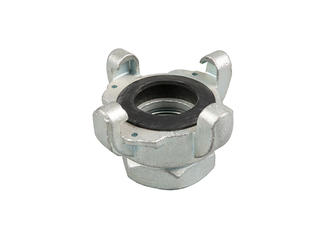
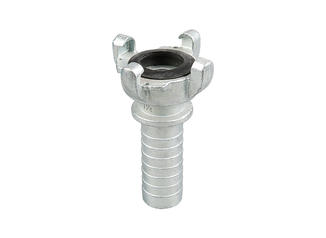
 Universal air couplingAdditional InformationView Product →
For air service, the coupling matters as much as the tube. A universal air hose coupling gives you a standard interface for 1/4 inch ID air lines, so you can change tools or drop legs without replacing the whole run. Match the coupling material to the environment: brass for indoor shop air, stainless for washdown or coastal areas.
Pressure, Temperature, and Flow Limits You Need to Check
Pressure ratings are not constant. Every thermoplastic tube has a working pressure at 73 F (23 C), and that rating drops as temperature rises. A common rule in tubing catalogs is that working pressure falls by about 50 percent at the maximum rated temperature. For example, a 1/4 inch OD polyurethane tube rated 200 psi at 73 F may be rated only 100 psi at 176 F. Nylon holds up better: a 1/4 inch OD nylon tube with 0.040 inch wall is often rated 350 to 400 psi at room temperature.
Flow is a function of ID, not OD. A 1/4 inch ID tube has a cross-sectional area of about 0.049 square inches. A 3/16 inch ID tube has about 0.028 square inches. The 1/4 inch ID tube passes roughly 75 percent more flow at the same pressure drop. If your application needs high flow in a small package, use the largest ID that fits the space and the fitting.
Temperature limits by material:
- PU: -40 F to 176 F
- Nylon: -60 F to 200 F
- PE: -40 F to 140 F
- PTFE: -100 F to 500 F
- Copper: -400 F to 400 F
- 316 stainless steel: -300 F to 800 F
These are general ranges. Always check the specific tube data sheet for the exact compound, because plasticizers, UV stabilizers, and wall thickness change the numbers. A tube that is rated for 200 psi at room temperature may be limited to 50 psi in a hot engine compartment or near a steam line.
Connection Methods for 1/4 Inch Tubing
Five connection methods cover almost every 1/4 inch tubing job. The right one depends on pressure, fluid, disassembly frequency, and whether you need a permanent or reusable joint.
Push-to-Connect Fittings
Push-to-connect fittings seal with an O-ring and grip with a stainless steel collet. They work best with 1/4 inch OD tube that has a hard, smooth surface, such as nylon or PU. Insert the tube until it bottoms out, then pull back gently to set the grip. To release, push the collet ring in and pull the tube out. Typical working pressure is 150 to 250 psi, depending on tube material and temperature.
Barbed Fittings and Hose Clamps
Barbed fittings are the standard for 1/4 inch ID flexible tubing, especially in irrigation and low-pressure fluid transfer. The barb goes inside the tube, and a hose clamp compresses the tube against the barb. For 1/4 inch ID tube, a 9 mm band clamp with a range of 8 to 16 mm works well. Do not overtighten: excessive clamp force can cut the tube or create a stress crack. A proper clamp leaves a slight imprint without deforming the bore.
 KC NippleAdditional InformationView Product →
A KC nipple is a common barbed adapter for connecting 1/4 inch ID hose to a threaded port or another hose. It provides a smooth flow path and a defined barb profile that holds under vibration when paired with the correct clamp.
Compression Fittings
Compression fittings use a ferrule that crimps onto the tube as the nut tightens. They are common on copper and rigid plastic tubing for instrumentation and water lines. A 1/4 inch compression fitting typically accepts 1/4 inch OD tube. The ferrule must match the tube material: brass ferrules for copper, plastic ferrules for plastic. Over-tightening crushes the tube and causes leaks.
Flare and Ferrule Joints
Flare fittings are used on copper and soft metal tubing. A 45 degree flare is common in refrigeration; a 37 degree flare is common in hydraulic and instrumentation. The tube must be cut square and deburred, and the flare must be smooth and the correct angle. A mismatched flare angle will leak no matter how tight you make the nut.
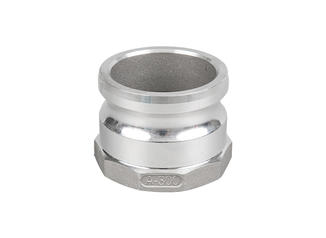
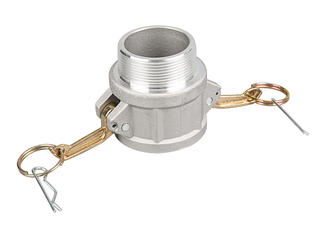
Camlock and Quick-Disconnect Couplings
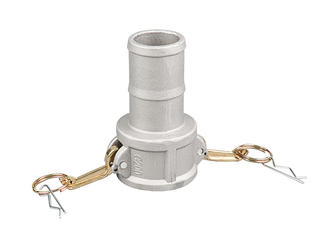
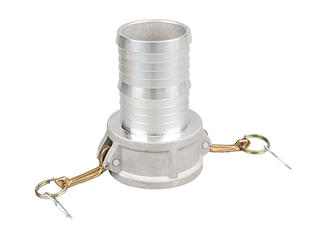
Camlock couplings are usually found on larger hose, but small camlock and quick-disconnect couplings are available for 1/4 inch lines in low-pressure chemical and water service. They allow fast changes without tools. For 1/4 inch tubing, verify that the coupling hose barb or thread matches the tube ID or fitting thread. A 1/4 inch NPT camlock adapter is a common way to connect a 1/4 inch tube to a pump or manifold.
Choosing the right coupling is not just about size. Review the article on how to choose a hose coupling for a structured selection method that covers pressure, media, and connection type.
How to Size and Match Fittings Without Leaks
Measure the tube OD with a caliper, not a ruler. A 1/4 inch nominal tube can measure 0.245 to 0.255 inch OD in commercial tolerances, and some thin-wall tubing measures 0.240 inch. Fitting manufacturers publish a tolerance window for their products. A push-to-connect fitting for 1/4 inch OD typically accepts 0.247 to 0.253 inch OD; outside that window, the collet may not grip or the O-ring may not seal.
Check the wall thickness. A 1/4 inch OD tube with 0.062 inch wall has an ID of 0.126 inch. The same OD with 0.031 inch wall has an ID of 0.188 inch. The fitting that grips the OD may be the same, but flow and pressure rating change significantly.
Use the right thread sealant. NPT threads require sealant, such as PTFE tape or anaerobic sealant. Do not use sealant on the first two threads; it can enter the fluid path. For flare and compression fittings, do not use thread sealant on the sealing surfaces.
A simple leak test: pressurize the system to 1.5 times the working pressure, hold for 10 minutes, and check for pressure drop. For air systems, use soapy water on joints. For water systems, dry the joint and wrap it with a paper towel; a leak shows as a damp spot within 5 minutes.
Common Applications for 1/4 Inch Tubing
1/4 inch tubing shows up in more places than most people expect. The small size makes it easy to route, but it also limits flow and pressure. Here are the most common uses.
- Pneumatic control lines: 1/4 inch OD nylon or PU tube connects valves, cylinders, and air tools. Working pressure 150 to 250 psi.
- Drip irrigation: 1/4 inch distribution tube runs from a 1/2 inch main line to individual plants. Flow is typically 0.5 to 2 gallons per hour per emitter at 15 to 30 psi.
- Instrumentation: 1/4 inch OD copper or stainless tube carries air, gas, and water to gauges, transmitters, and analyzers.
- Chemical dosing: PTFE or PVDF 1/4 inch tube handles acids, bases, and solvents in laboratory and process systems.
- Refrigeration: 1/4 inch copper tube is common for refrigerant lines on small systems.
- Automotive and truck air brakes: 1/4 inch nylon tube is specified by SAE J844 for air brake systems.
Installation and Maintenance Practices That Extend Service Life
Small tubing fails for predictable reasons: sharp bends, loose clamps, contaminated fluid, and UV exposure. These practices reduce failures.
- Cut the tube square. Use a tubing cutter or a sharp blade. An angled cut reduces the sealing surface and can cause leaks.
- Deburr the outside and inside edges. A burr can cut an O-ring or restrict flow.
- Mark the insertion depth. For push-to-connect fittings, insert until the tube bottoms out. A mark on the tube helps you verify full insertion.
- Support the tube every 12 to 18 inches (300 to 450 mm) to prevent vibration and sag.
- Respect the minimum bend radius. For 1/4 inch OD PU tube, the minimum bend radius is often 0.4 to 0.5 inch (10 to 12 mm). For nylon, it is about 1 inch (25 mm). Bending tighter causes kinks and stress cracks.
- Keep UV exposure in check. Black PE and UV-stabilized PU resist sunlight. Natural nylon and clear PVC degrade outdoors.
- Replace clamps that show corrosion or deformation. A clamp that has lost its spring or has a broken worm gear will not hold.
- Flush the system before final connection. Debris from cutting and assembly is a leading cause of valve and emitter clogging.
 stainless steel adjustable hose clampsAdditional InformationView Product →
Adjustable hose clamps come in band widths from 8 mm to 12 mm for small tubing. Match the clamp range to the tube OD plus the barb diameter. A clamp that is too wide may not distribute force evenly; a clamp that is too narrow may cut the tube.
Frequently Asked Questions
What is the difference between 1/4 inch tubing and 1/4 inch hose?
Tubing is measured by OD in many industrial standards, while hose is often measured by ID. A 1/4 inch tube may have a 1/4 inch OD, and a 1/4 inch hose may have a 1/4 inch ID. That is why a 1/4 inch hose barb will not fit a 1/4 inch OD tube without an adapter.
Can I use a 1/4 inch push-to-connect fitting on PE irrigation tubing?
Usually no. PE irrigation tubing often has a softer surface and a different OD tolerance. Push-to-connect fittings are designed for rigid or semi-rigid nylon and PU tube. For PE, use barbed fittings and clamps, or use a push fitting rated by the manufacturer for PE.
What pressure can 1/4 inch tubing handle?
It depends on material and wall. A 1/4 inch OD PU tube may handle 150 to 250 psi at room temperature. A 1/4 inch OD nylon tube may handle 250 to 400 psi. A 1/4 inch OD 316 stainless tube can handle over 1,000 psi. Always check the tube pressure rating at your operating temperature.
How do I stop a 1/4 inch tube from leaking at a barbed fitting?
Cut the tube square, slide the clamp onto the tube before inserting the barb, push the tube fully onto the barb, and position the clamp over the barb ridge. Tighten until the tube is compressed but not cut. If it still leaks, the tube ID may be too large for the barb, or the clamp is the wrong size.
What is the minimum bend radius for 1/4 inch tubing?
For PU, about 0.4 to 0.5 inch (10 to 12 mm). For nylon, about 1 inch (25 mm). For PE, about 1.5 inch (38 mm). Bending tighter than the minimum causes kinks, flow restriction, and premature cracking.
Can 1/4 inch tubing be used for compressed air?
Yes. Nylon and PU are common for compressed air. Use a working pressure at least four times the system pressure for safety, and keep the temperature within the tube rating. For high-vibration areas, use a hose instead of rigid tubing.
How do I connect 1/4 inch tubing to a 1/2 inch irrigation line?
Use a hole punch to make a clean hole in the 1/2 inch line, then insert a barbed 1/4 inch transfer fitting. The barb grips the 1/4 inch tube, and the other end seals in the 1/2 inch line. Add a small clamp on the 1/4 inch side if the pressure is above 20 psi.
What causes 1/4 inch tubing to crack?
UV exposure, excessive bending, chemical attack, and over-tightening clamps are the main causes. Natural nylon and clear PVC are especially vulnerable outdoors. Use black PE or UV-stabilized material for outdoor runs.
Are 1/4 inch fittings interchangeable between brands?
Not always. OD tolerances, collet designs, and O-ring materials vary. A fitting from one manufacturer may not seal on a tube from another manufacturer if the OD is at the edge of the tolerance. For critical systems, use a tube and fitting combination that the fitting maker has tested.
How often should I inspect 1/4 inch tubing systems?
Inspect at startup, then every 3 months for indoor systems and every month for outdoor or high-vibration systems. Look for cracks, discoloration, loose clamps, and moisture at joints. Replace any tube that shows surface crazing or hardness.
1/4 inch tubing is small, but the decisions around it are not. Start with the actual OD and ID, choose a material that matches the fluid and temperature, select a connection method that fits the pressure and service conditions, and install it with square cuts, correct clamps, and proper support.
If you need a second opinion on a specific line, the team at Ningbo Chili Metal Products has been manufacturing industrial hose fittings since 2004 and can help match a 1/4 inch tube to the right coupling, clamp, or nipple. Review their corporate values to see how they approach quality and customer support, or send the tube OD, fluid, pressure, and temperature for a direct recommendation.