 英语
英语 俄语
俄语
Content
- 1 What Are Barbed Fittings?
- 2 How Do Barbed Fittings Work?
- 3 Types of Barbed Fittings and Their Use Cases
- 4 Key Applications of Barbed Fittings
- 5 Materials and Construction
- 6 How to Choose the Right Barbed Fitting
- 7 Installation Best Practices
- 8 Common Problems and Troubleshooting
- 9 Frequently Asked Questions About Barbed Fittings
Barbed fittings are the workhorse of low-pressure fluid transfer. Unlike threaded or flanged connections that rely on sealing rings and torque, a barb fitting creates a seal by physically gripping the inner wall of a hose or tube with a series of angled ridges. When used correctly, a barbed fitting can hold pressures from 30 psi to 150 psi depending on the material, hose wall thickness, and the number of barbs. If you are buying industrial hose fittings for water, air, or chemical transfer, the barb design is often the first decision that determines whether your assembly will leak under vibration or last through years of service.
The practical reality is that barbed fittings offer the lowest cost-per-connection for flexible hoses, but they also carry specific limitations around pressure and pull-out resistance. Choosing the right barb geometry, material, and clamp combination matters more than picking a generic one-size-fits-all fitting. This guide walks through the full picture: what barbs actually do, which material grades and barb counts suit different hoses, how to prevent leaks, and when a camlock coupling selection method applies to your barbed fitting choices.
What Are Barbed Fittings?
A barbed fitting, sometimes called a hose barb or insert fitting, is a short connector with one or more angled ridges along its outer surface. The barbs are designed to bite into the inner wall of a flexible hose when the hose is pushed over the fitting. This creates a mechanical interlock that resists pull-out and provides a substantial sealing surface against the hose interior.
The most common configurations include single barb, double barb, and multi-barb profiles. A single barb fitting is used for reduced pressure situations and softer hoses, such as vinyl or polyurethane tubing. A double barb fitting offers better retention and is often specified when the system may experience vibration or modest pressure spikes. Multi-barb designs provide the highest grip and are frequently chosen for rubber hoses and pneumatic applications where safety margins matter.
Barbed fittings are available in a wide range of sizes, from 1/8 inch up to 4 inch and beyond. They can be straight, elbow, tee, or reducing types, and they can have a male threaded end, female threaded end, or a smooth hose end that requires a separate clamp. The fitting's hose-end diameter typically has a tolerance of +0.5 mm to +1.5 mm above the nominal hose ID to ensure a firm interference fit — for example, a 1/2-inch barb usually has an actual outer diameter around 12.8 mm to 13.4 mm.
How Do Barbed Fittings Work?
The working principle of a barbed fitting is fundamentally mechanical friction. When a hose is pushed over the barbed end, the hose material stretches slightly over the ridge profiles. The barbs — typically cut at angles of 30 to 45 degrees — allow the hose to slide on easily but resist being pulled off. The steeper the exit angle of the barb, the stronger the grip, but also the more difficult it becomes to insert the hose. In practical manufacturing, barb angles are usually designed to permit assembly with moderate hand force while achieving pull-out resistance of 40 N to 200 N depending on barb count and hose material.
For higher-pressure applications, a hose clamp or ferrule is added externally. The clamp compresses the hose walls into the valleys between the barbs, which nearly doubles the sealing force and strongly reduces the chance of leakage under pulsating pressures. As an example, a 1/2-inch double barb fitting used with a 1/2-inch rubber hose and a worm gear clamp can reliably operate at 100 psi in compressed air service. Without a clamp, the same fitting might only be rated for 35 to 50 psi.
- The barb tips create a series of circumferential contact lines with the hose ID.
- Fluid pressure inside the hose pushes the hose wall outward, actually increasing the gripping force of the barbs slightly at low to moderate pressures.
- At higher pressures, the hose wall can expand away from the barbs, which is why external clamping becomes essential above roughly 80 psi for rubber hoses.
Types of Barbed Fittings and Their Use Cases
Barbed fittings are not one-size-fits-all. The barb count, barb depth, end thread type, and material all determine how the fitting performs with a specific hose. Below is a summary of common barbed fitting types and the applications where each is most suitable.
| Fitting Type | Typical Pressure Range | Best For |
|---|---|---|
| Single Barb | 30–60 psi | Soft vinyl, polyurethane tubing, low-pressure irrigation |
| Double Barb | 60–120 psi | Rubber hoses, pneumatic systems, water transfer |
| Multi Barb (3+ ridges) | 100–150 psi with clamp | Heavy-duty industrial, fuel, chemical transfer |
| Barbed Hex (threaded end) | 60–150 psi | When the barb end meets a threaded pipe connection |
When the application requires a double barb camlock fitting, the hose side of the coupling uses the same barb geometry but with the added locking arms of a cam and groove design. This arrangement is common in industrial fluid transfer, and our aluminium C-type camlock coupling with double barb demonstrates how the two designs work together.
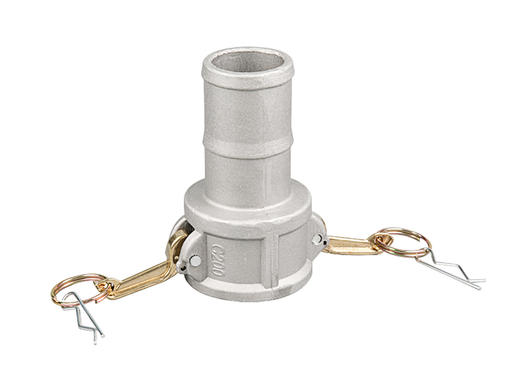 Aluminum Type C Camlock Coupling with Double BarbThis Type C aluminum camlock coupler features a double barb hose end, combining cam and groove locking with barbed retention. Suitable for industrial fluid transfer, it complies with A-A-59326 or DIN 2828 standards, with NBR gasket and steel plated pins.View Product →
Key Applications of Barbed Fittings
Barbed fittings are used across nearly every industry that moves fluid through flexible hoses. The most common applications include:
- Agricultural irrigation: connecting drip lines, sprayer hoses, and suction hoses. Polypropylene and nylon barbed fittings are preferred here for their chemical resistance, light weight, and corrosion-free service.
- Pneumatic systems: air compressor hoses, blow guns, and portable air tools often use double barb fittings with an external clamp. The fitting holds the hose under constant vibration from the compressor cycling.
- Marine and industrial water transfer: bilge pump hoses, coolant lines, and dock water connections typically use brass or stainless steel barbed fittings.
- Sandblast and surface preparation: high-wear abrasion service requires robust multi-barb fittings in aluminium or nylon, matched to heavy-wall blast hoses.
- Food and beverage transfer: food-grade barbed fittings, often in 316 stainless steel, connect hoses used for dairy, brewing, and juice transfer. The barb profile is typically fine-toothed and smooth to avoid crevices where bacteria could accumulate.
For those who need a barbed fitting integrated with a quick coupling system, the aluminium E-type camlock coupling with multiple barbs provides a practical solution when frequent hose changes are necessary.
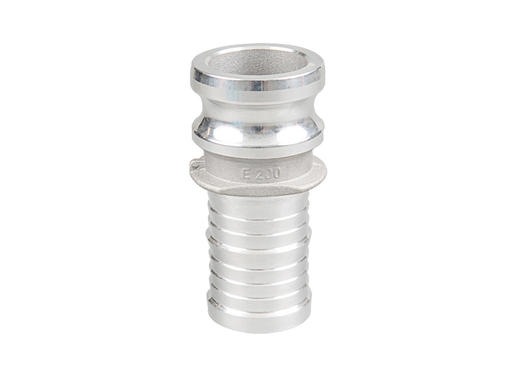 Aluminum Type E Camlock Coupling with Multiple BarbsThe aluminum Type E camlock coupling with multiple barbs offers quick hose changes and secure connection. Made to A-A-59326 or DIN 2828 standards, it includes steel plated pins, rings, and NBR gasket, with sand blast finish. Commonly used in chemical, oil, gas, and other industries.View Product →
Materials and Construction
The material of a barbed fitting determines its compatibility with the fluid, its resistance to corrosion, and its mechanical strength. Common material choices include:
| Material | Key Strength | Typical Barbs | Common Fluid Service |
|---|---|---|---|
| Brass | Excellent machinability, good corrosion resistance, ease of forming sharp barbs | Single or double | Water, compressed air, fuel, light chemical transfer |
| Stainless Steel | Highest corrosion resistance, no plating degradation, good at high temperatures | Double or multi | Chemicals, food grade, marine, high-temperature water |
| Aluminium | Light weight, good corrosion resistance, cost effective | Double or multi | Water, sandblast hoses, irrigation, low-pressure air |
| Polypropylene / Nylon | Chemical resistance, light weight, no rust, good for agricultural environments | Single or double | Agriculture, fertilizers, water treatment, low-pressure fluids |
Manufacturing methods matter too. Machined barbs tend to have sharper, more consistent profiles than cast or molded barbs. Sharp, cleanly cut barbs bite into the hose more effectively and create a tighter seal. For stainless steel barbed fittings, passivation after machining is the standard industrial protocol to remove iron contamination and maximize the corrosion resistance of the passive oxide layer.
How to Choose the Right Barbed Fitting
The selection process starts with three questions: what fluid are you moving, what is the operating pressure, and how often will the connection be disconnected? Answering these questions systematically will point you toward the right material, barb count, and end connection.
- Determine the hose material and ID. For a rubber hose, a double barb with an external clamp is usually the safest choice. For PVC or polyurethane tubing, a single barb often provides sufficient grip without the risk of splitting the tube during installation.
- Check the maximum working pressure. If the system exceeds 80 psi, external clamping becomes mandatory in almost every case. Multi-barb designs with clamps are rated to 150 psi in many industrial applications.
- Consider the fluid compatibility. Nylon and polypropylene fittings resist most agricultural chemicals, but stainless steel is required for many industrial solvents and food products.
- Evaluate the disconnect frequency. If the connection is made and broken frequently, a camlock-style barbed fitting with quick-release arms saves significant time compared to a standard barb plus clamp.
- Verify the barb diameter relative to hose ID. The barb O.D. should be approximately 0.5 to 1.5 mm larger than the nominal hose ID. A too-large barb can split thin-walled tubing; a too-small barb will leak or blow off under pressure.
For more detailed guidance on selecting the right camlock fitting, you can read our how to choose camlock coupling article, which covers matching material, size, and sealing elements in greater depth.
Installation Best Practices
Correct installation is the biggest factor in getting a reliable, leak-free barbed fitting connection. Improperly installed barbs are the leading cause of field failures in low-pressure hose systems. Here is a step-by-step method used across industrial maintenance teams:
- Cut the hose cleanly with a sharp knife or hose cutter. Avoid ragged cuts, as they prevent the barb from seating uniformly.
- Lubricate the hose ID and barb surface. Use a silicone-based lubricant or a small amount of the fluid being transferred. Never use petroleum-based grease with rubber hoses, as it can degrade the rubber.
- Push the hose fully onto the barb. The hose end should reach the base of the barbed section. For stiff hoses, warm the hose in hot water (60–80°C) or use a barbed fitting with multiple barbs to distribute the insertion force.
- Position the clamp at least 3–5 mm beyond the last barb. This ensures the clamp compresses the hose into a barb valley rather than over the barb tip, which maximizes the seal.
- Tighten the clamp to the recommended torque. For a worm gear clamp, this is typically 2.0–3.5 N·m. Over-tightening can crush the hose and cut through the carcass, especially on thin-walled tubes.
- Pressurize slowly and check for leaks. A soapy water test is the standard method for pneumatic systems; a dry paper wipe works well for water or chemical systems.
In camlock applications where a multi-barb hose end is used, the same installation rules apply, but the cam arms must also be fully engaged. See our aluminium C-type camlock coupling with multiple barbs for a product example designed for this exact purpose.
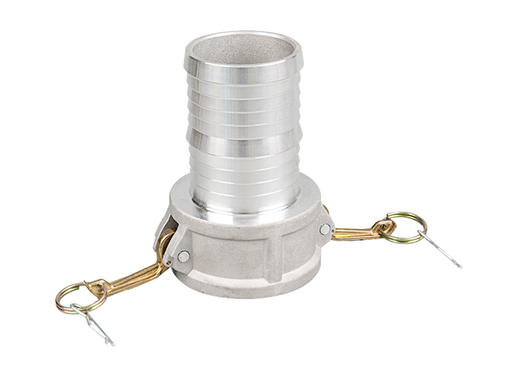 Aluminum Type C Camlock Coupling with Multiple BarbsThis Type C aluminum camlock coupling has multiple barbs on the hose side, ensuring strong grip and reliable sealing. Manufactured to A-A-59326 or DIN 2828, it features casting process, NBR gasket, and steel plated pins. Used widely in chemical, oil, gas, and agricultural applications.View Product →
Common Problems and Troubleshooting
The most frequent issue reported with barbed fittings is leakage at the hose-to-fitting junction. The second most common is hose blow-off under pressure. Both are almost always traceable to one of four root causes:
| Symptom | Likely Cause | Corrective Action |
|---|---|---|
| Leak at idle pressure | Hose ID is too large relative to barb O.D. | Measure the actual barb O.D.; specify a fitting with 0.5–1.0 mm larger diameter |
| Hose blows off | No clamp or insufficient clamp torque | Always use a clamp above 60 psi; verify clamp torque |
| Drip after repeated cycling | Hose wall has permanently deformed | Replace the fitting with a multi-barb design or increase clamp margin |
| Barb end chip or crack | Installation forced at low temperature | Warm the hose before insertion; use a barbed fitting with smoother transition |
Periodic inspection is important for barbed fittings in any process environment. Check for visible rust on stainless steel fittings, cracks on plastic barb tips, and softening or hardening of the hose end. When a fitting is replaced, always cut back the used hose section by at least 25 mm to ensure the new barbs bite into fresh, undamaged hose material. For a maintenance schedule tailored to camlock couplings, see our article on camlock coupling maintenance.
Frequently Asked Questions About Barbed Fittings
What is the maximum working pressure of a barbed fitting?
Without an external clamp, a typical single barb fitting is rated for around 30 to 60 psi in rubber hose service. With a correctly installed worm gear or spring clamp, double and multi-barb fittings are commonly used at 100 to 150 psi. Some specialty barbed fittings with cold-formed stainless steel geometry can reach higher pressures, but those applications usually move to compression or threaded fittings for safety margin.
Can a barbed fitting be reused?
Yes, with limitations. The fitting itself can be reused if the barbs are not deformed or chipped. The critical factor is the hose. Once a hose has been pushed onto a barbed fitting, the inner wall takes a permanent set around the barb profile. Reusing the same hose on a second fitting usually results in a weak seal at the old position. Best practice is to cut at least two barb widths off the end of the hose before reassembling.
How do I prevent a barbed fitting from leaking?
Four measures are critical: choose a barb diameter that creates a 0.5–1.5 mm interference with the hose ID, lubricate the hose during insertion, allow the hose to fully seat against the fitting collar, and always use a clamp positioned at least 3–5 mm beyond the last barb. Also consider the hose type: braided hoses require sharp, deep barbs, while thin-walled tubing needs a shallow barb profile to avoid splitting.
What is the difference between single barb and double barb fittings?
A single barb fitting has one ridge and is easier to insert, making it suitable for soft tubes and systems below 60 psi. A double barb fitting has two ridges that create more contact line area with the hose, providing roughly 40–60% higher pull-out resistance. Double barb designs are the recommended minimum for rubber hoses, pneumatic lines, and any connection that may see vibration or occasional pressure spikes.
When should I use a hose clamp with a barbed fitting?
Always use a clamp when the operating pressure exceeds 60 psi, when the hose is used for suction duty, when the fluid is a solvent or chemical that can soften rubber, or when the assembly is outdoors where temperature swings will cause the hose to expand and contract. Clamps are also mandatory in any application where a blow-off creates a safety hazard, such as compressed air supply lines or chemical transfer systems.