 英语
 俄语

Content
- 1 What a Camlock Connector Does Well and Where It Falls Short
- 2 Why Look for a Camlock Connector Alternative?
- 3 Storz Couplings: The Fire-Industry Standard Alternative
- 4 Guillemin Couplings: A Positive Latch for Industrial Fluid Lines
- 5 Bauer Couplings: The Workhorse for Irrigation and Dewatering
- 6 Pin Lug Couplings: The Low-Cost Answer for Light-Duty Lines
- 7 Threaded and Pneumatic Quick Couplings for Compressed Air Lines
- 8 Side-by-Side Comparison of Camlock Connector Alternatives
- 9 How to Match Coupling Material to Your Fluid and Pressure
- 10 Installation, Safety and Maintenance When Replacing Camlocks
- 11 Frequently Asked Questions about Camlock Connector Alternatives
- 11.1 Are Storz and camlock couplings interchangeable?
- 11.2 Which alternative can handle higher pressure than a camlock?
- 11.3 Can a Bauer coupling replace a camlock on a 4-inch irrigation pump?
- 11.4 Do I need to buy new hoses when switching from camlock?
- 11.5 What is the cheapest camlock connector alternative?
- 12 Bottom Line: Which Alternative Should You Choose?
There is no universal camlock connector alternative, and a supplier who claims one exists is not being straight with you. The correct replacement is decided by working pressure, chemical compatibility, and the connection standard your hose ends already use. Storz couplings are the first choice for fire protection and large-diameter water lines. Guillemin couplings give you a positively latched joint for industrial fluid transfer. Bauer couplings dominate irrigation, dewatering and slurry lines. Pin lug couplings are the low-cost answer for light suction and discharge duty. Before you switch, check the nominal coupling size (commonly 1/2 inch to 6 inches, or 12.5 mm to 152 mm), the hose inner diameter, and the gasket material that contacts your fluid. Those three details eliminate 80 percent of the compatibility problems people meet when moving away from camlock.
What a Camlock Connector Does Well and Where It Falls Short
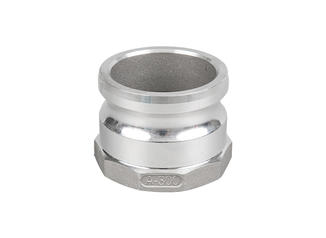
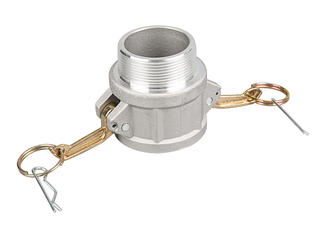
A camlock connector is a quick-disconnect hose coupling with two parts: a grooved adapter (the male half) and a coupler with two or three cams (the female half). Rotating the cam arms over the groove locks the joint, and the molded gasket inside the coupler provides the seal. Most camlocks sold today follow the dimensional profile described by MIL-A-A-59326D, which is why a Type A adapter from one workshop fits a Type C coupler from another.
Strengths that keep camlock popular
- Tool-free connection in seconds, even with heavy work gloves.
- Cross-manufacturer interchangeability under the common profile mentioned above.
- Six body styles (A, B, C, D, DC, DP, E, F) cover hose tail, threaded, flanged and blanking roles.
- Available in aluminum, brass, stainless steel, carbon steel, nylon and polypropylene.
Limitations that push teams toward alternatives
- Typical working pressure sits around 150 to 250 psi (10 to 17 bar), which is too low for hydraulic or high-pressure steam duty.
- The exposed cam handles can be knocked open if the line is bumped or vibrates.
- A worn cam arm or swollen gasket produces leaks that are hard to spot by eye.
- The profile does not always match fire, mining or compressed-air standards used in specific regions or industries.
Why Look for a Camlock Connector Alternative?
The decision is rarely about camlock being bad. It is usually about a specific requirement that camlock was not designed to meet. A mining installation may need a fitting that survives water hammer. A chemical plant may need a material that stays inert in strong solvents at 80 degrees C. A fire station may need a coupling that connects to existing Storz hose without an adapter hunt. Each of these points fingers at a different alternative.
Before spending money, understand the trade-off between connection speed and security. A camlock connects fast but relies on two small arms for the entire mechanical lock. Alternatives like Guillemin add a spring latch, while threaded couplings give up speed for a metal-to-metal seal. Our quick hose coupling versus traditional coupling comparison explains where speed wins and where it costs you reliability.
Storz Couplings: The Fire-Industry Standard Alternative
Storz is a symmetrical coupling: both halves are identical, each with two protruding lugs and a gasket recess. You press the two faces together and rotate one quarter turn. No clamp, no spanner, no loose ring. The original design dates to 1882 in Germany and remains the dominant connection on fire hoses across Europe, Asia and much of North America.
Two practical reasons make Storz a strong camlock replacement in water and fire service. First, because both halves are identical, the inventory is simplified; you order one half instead of paying for a male set and a female set. Second, the quarter-turn lugs sit flush against the body once engaged, so a snagged hose cannot easily release them.
Storz sizes commonly run from 1.5 to 6 inches. Working pressure for standard fire-fighting Storz fittings is typically rated at 16 bar (about 232 psi), which is close to or higher than many camlock setups of the same material. If the hose already has a camlock tail, you will need a camlock-to-Storz reducer or replace the hose shank.
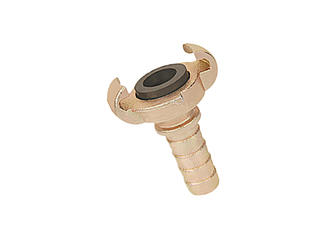
 Fire Hose Storz Coupling with Pressure Rating OptionsThis Storz coupling suits fire-fighting lines, rated around 16 bar and compatible with standard hose tails. It may require an adapter if the hose has a camlock end.View Product →
Guillemin Couplings: A Positive Latch for Industrial Fluid Lines
Guillemin couplings look similar to camlock at first glance, but the locking mechanism is different. Two arms rotate over a machined collar and close with a spring-loaded latch instead of just friction. That extra latch means the arms stay closed under vibration, and the joint does not rely on the operator remembering to check the cam position.
Guillemin is widely used in Europe, Africa and Asia for tanker truck unloading, dock transfer lines, chemical batching and fire-fighting water supplies. Materials include aluminum, brass, stainless steel and polypropylene. For aggressive fluids at moderate pressures, a stainless steel or brass Guillemin often outlasts an aluminum camlock because the latch keeps the gasket compressed evenly around the whole circumference.
The trade-off is speed of disconnection: you must release the latch before rotating the arms, which adds a few seconds per connection. If your crew connects and disconnects hundreds of times per shift, the accumulated time may matter more than the security gain.
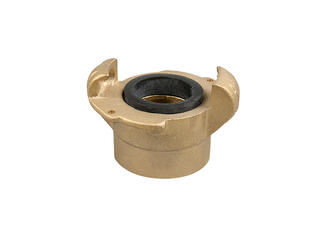
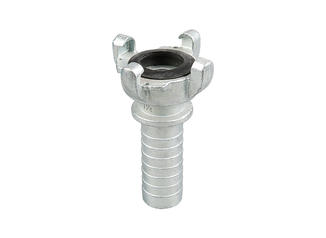
 Polypropylene Male Guillemin Coupling for Secure ConnectionsThis Guillemin coupling uses a spring-loaded latch for vibration-resistant locking. It suits applications where extra security is needed, though disconnection takes slightly longer.View Product →
Bauer Couplings: The Workhorse for Irrigation and Dewatering
Bauer couplings are built for large-bore hoses, typically 2 to 6 inches and sometimes larger. A toothed collar on one half, a rubber gasket, and a quick-acting lever on the other half produce a powerful clamping force when the lever is pulled closed. This is an irrigation and dewatering standard, where hoses are dragged over gravel, dirt and concrete.
Compared with camlock, Bauer distributes the clamping force over a wider surface area and is less sensitive to debris on the gasket. A Bauer joint can be connected while muddy and still seal, whereas a camlock needs a clean groove and a clean gasket to work properly. The negative side is weight; a Bauer coupling is noticeably heavier than an aluminum camlock of the same diameter.
Bauer is normally rated for lower pressures than camlock, often in the 6 to 10 bar (85 to 145 psi) range for standard agricultural models. That is adequate for flood irrigation or pumping water from a reservoir, and the mechanical advantage of the lever makes manual connection easy even on 6-inch lines.
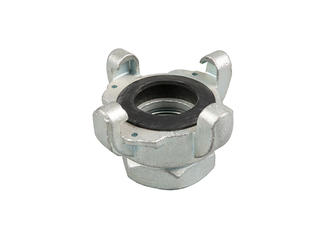
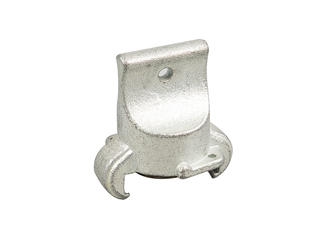
 Galvanized Carbon Steel Bauer Coupling for Large-Bore HosesThis Bauer coupling is built for 2-6 inch hoses in irrigation and dewatering. Its lever mechanism provides strong clamping, but pressure ratings are typically lower than camlock.View Product →
Pin Lug Couplings: The Low-Cost Answer for Light-Duty Lines
Pin lug is the simplest member of the camlock family. Instead of eccentric cams, two pins (one on each side) rotate into slots on the adapter. You pull the pins over the adapter and let them rest in the slot; gravity and hose pressure hold them in place. There is no over-center lock, so pin lugs are intended for low-pressure, non-surge service.
You will find pin lugs on oil circulation lines, lube oil return lines, coolant hoses on machines, and small transfer pumps. They are also useful as a cheap replacement where the original camlock was oversized for the job. The parts cost less, the body is easier to cast, and there is no cam arm to fatigue.
Keep pin lug below roughly 100 psi (7 bar) in water service. At higher pressures, the pin arm can bounce out of the slot under pressure pulsations, which is the main reason camlock replaced pin lug in many industrial applications decades ago.
Threaded and Pneumatic Quick Couplings for Compressed Air Lines
Compressed air is one of the most common places where camlocks are used but not truly necessary. A modular air hose coupling, in the European or universal style, snaps together in one motion and seals with an O-ring. Standard bore sizes run from 6 to 12 mm, and typical pressure ratings for these unit couplings are 10 to 20 bar depending on the model. Pneumatic couplings weigh less, cost less, and their connecting profile is designed for repeated daily connection, which a camlock is not.
For permanent branch lines, a threaded NPT or BSP fitting is cheaper and more compact than any quick coupling. Threads will not leak if properly sealed, and they handle vibration better than cams. The disadvantage is assembly time; every thread needs sealant and the correct torque. Use quick couplings on tool drops and threaded fittings on fixed pipes.
When you switch from camlock to an air coupling on the same hose, check the hose inner diameter. A 3/8 inch air line accepts standard 8 mm couplings, but a 1/2 inch line may require a reducing nipple, and the task is harder if the hose is reinforced with wire.
Side-by-Side Comparison of Camlock Connector Alternatives
The table below compares the main alternatives against a camlock baseline. Working pressures are typical ranges from common industrial catalog ratings, not guaranteed values for a specific product; check the datasheet for the exact model. Always apply a safety factor to the published rating before installation.
| Coupling type | Locking method | Typical max pressure | Common sizes | Primary applications | Relative cost |
|---|---|---|---|---|---|
| Camlock (baseline) | Cam arms | 150-250 psi (10-17 bar) | 1/2-6 inch | Water, chemicals, petroleum | Low |
| Storz | Quarter-turn lugs | 232 psi (16 bar) | 1.5-6 inch | Fire hoses, water supply | Medium |
| Guillemin | Spring-latched arms | 150-230 psi (10-16 bar) | 1-6 inch | Tankers, industrial fluids | Medium |
| Bauer | Quick-action lever | 85-145 psi (6-10 bar) | 2-6 inch | Irrigation, dewatering | Medium-high |
| Pin lug | Fixed pin arms | Up to 100 psi (7 bar) | 1/4-3 inch | Oil circulation, lube lines | Low |
| Threaded or pneumatic | Thread / O-ring push-connect | 145-300 psi (10-20 bar) | 1/4-1 inch | Compressed air, fixed lines | Low |
How to Match Coupling Material to Your Fluid and Pressure
Changing the coupling style is the perfect moment to re-evaluate the material, because the same part in a different metal can have a completely different pressure rating and chemical tolerance.
Aluminum
Light, low-cost, resistant to fresh water and dry air. Used for Storz and Guillemin water lines. Avoid with caustic chemicals and salt-water splash.
Brass
Machines well, resists seawater and many fuels, holds up in mining and marine environments. Heavier and roughly 2 to 3 times the price of aluminum for the same size.
Stainless Steel (304/316)
Best chemical compatibility and highest temperature tolerance among common materials. A stainless Guillemin or threaded fitting can exceed the pressure limit of an aluminum camlock. Costs the most and requires anti-seize on threads.
Polypropylene
Chemically inert to most acids, fertilizers and cleaning agents, and one-third the weight of brass. Use only at low pressure (usually below 10 bar) and moderate temperature; polypropylene softens above 80 degrees C.
Gaskets matter just as much. Buna-N (NBR) suits oil and water but not strong ozone; EPDM suits water, steam and brake fluids but not petroleum; fluorocarbon (FKM) resists aggressive chemicals and high temperatures. Verify the gasket material before you order a full batch.
Installation, Safety and Maintenance When Replacing Camlocks
Switching coupling types introduces new risks, mainly because operators are accustomed to camlock habits. Run a controlled procedure the first time.
- Depressurize the line, close isolation valves, and verify zero pressure with a gauge before breaking any joint.
- Check the hose end: replace the hose tail if the old camlock shank is larger or smaller than the new coupling tail; wrong bore causes flow restriction and hose failure.
- Lubricate the gasket with a compatible lubricant during assembly; never use petroleum grease on EPDM.
- Engage the locking mechanism fully and pull-test the joint before turning on the flow.
- For lines longer than 3 meters, add a whipcheck safety cable or wire across the joint to prevent hose whip if a joint fails.
Maintenance routines for alternatives are shorter than most people think.
- Check gaskets every three months; replace a gasket that has flattened, hardened or cracked.
- On aluminum fittings, wipe the bore and lugs dry after wet service to stop oxide pitting.
- On stainless steel threads, apply anti-seize compound to prevent galling.
- On Bauer and Guillemin, keep the levers and latch springs free of sand and debris.
- Never use any coupling as a lifting anchor; coupling bodies are not designed for axial loads other than fluid pressure.
Frequently Asked Questions about Camlock Connector Alternatives
Are Storz and camlock couplings interchangeable?
Not directly. The locking profiles are completely different. You need a camlock-to-Storz reducer or an adapter that has a camlock profile on one end and Storz lugs on the other, plus the correct gasket.
Which alternative can handle higher pressure than a camlock?
In general, stainless steel Guillemin couplings and NPT/BSP threaded fittings of the same nominal size exceed the pressure limit of aluminum camlock parts. A 1-inch NPT thread in a standard schedule 40 pipe is rated far above 250 psi, while a typical 1-inch aluminum camlock is rated around 250 psi. Confirmed figures depend on wall thickness and material grade.
Can a Bauer coupling replace a camlock on a 4-inch irrigation pump?
Yes, if the pump outlet gives you a flat flange profile or a hose shank of the same diameter. Bauer works best with suction and delivery hoses used in irrigation; a camlock-to-Bauer reducer handles the transition when the existing line uses camlock ends.
Do I need to buy new hoses when switching from camlock?
Only if the hose tail diameter changes. Many hoses use the same internal diameter for both camlock and Storz/Guillemin tails in the smaller sizes (1 to 3 inches). For 4-inch and larger, the hose tail layout can differ, so you may need a short nipple between hose and coupling.
What is the cheapest camlock connector alternative?
For low-pressure water, pin lug is usually the cheapest per joint. For compressed air, a push-to-connect pneumatic coupling costs less than a camlock of the same size. The cheapest option overall is a threaded NPT fitting on a fixed pipe, because it has no moving parts and no gasket to replace.
Bottom Line: Which Alternative Should You Choose?
Start from the application, not the price page. Choose Storz for fire-fighting and public water supply where quick symmetrical connection matters; Guillemin for industrial fluids that need a positive latch; Bauer for irrigation and dewatering on uneven ground; pin lug for low-cost light-duty lines; and threaded or push-to-connect air couplings for anything pneumatic. Write the working pressure, temperature and fluid compatibility on the specification sheet before you ask for quotations.
A supplier that carries the same coupling style across multiple materials makes the changeover easier. Browse our complete range of couplings, reducers, gaskets and accessories to match the alternative to your line, and keep one camlock-to-new-standard reducer in stock as a transition piece.