 英语
英语 俄语
俄语
Content
The Short Answer: Yes, and It Is Almost Inevitable
Hose clamps absolutely loosen over time. In fact, a hose clamp begins to lose its initial clamping force the moment you finish tightening it. This is not necessarily due to a defect in the clamp itself, but rather a result of the physical interplay between the metal band and the soft hose material.
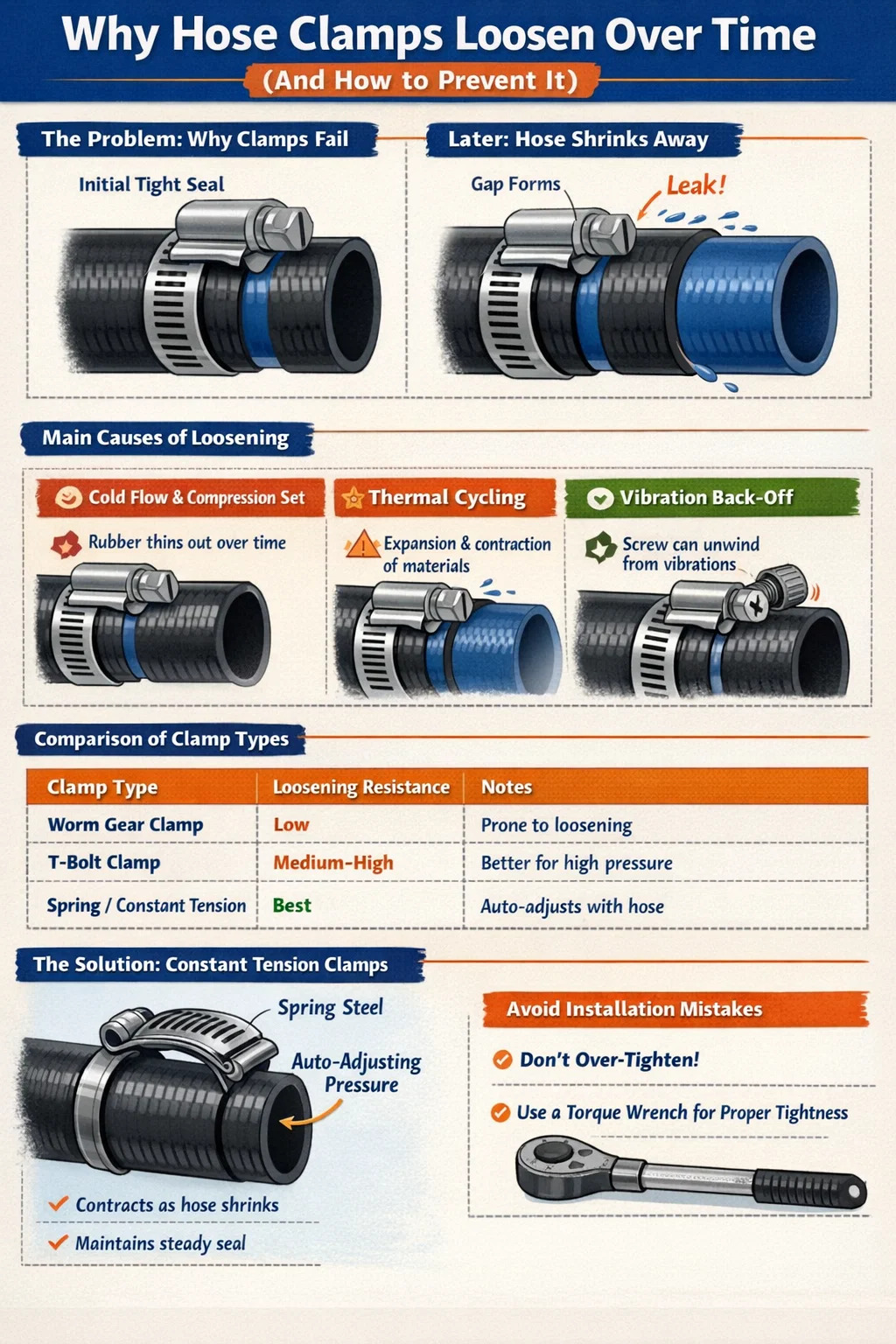
For most standard worm-gear hose clamps used in automotive, marine, or industrial applications, "loosening" does not always mean the screw is backing out (though that can happen). More often, the "loosening" is actually a loss of radial compression force. The clamp stays the same diameter, but the hose shrinks away from it. This phenomenon leads to the loss of the seal, resulting in coolant, oil, or air leaks long after the initial installation.
The Primary Culprit: Cold Flow and Compression Set
The most common reason a connection fails is a property of rubber and silicone known as "cold flow" or "compression set." When you tighten hose clamps, you are compressing the rubber wall of the hose between the metal band and the rigid fitting underneath. The rubber pushes back against the metal, creating a seal.
Over time, the molecular structure of the rubber relaxes. The material physically moves away from the area of high pressure (under the clamp band) to areas of lower pressure. This permanent deformation means the rubber becomes thinner under the band. Even if the screw on the hose clamps has not rotated a single degree, the clamping force—the actual pressure holding the fluid in—drops significantly.
Data from material testing shows that a standard rubber hose can lose up to 50% of its initial sealing torque within the first 24 to 48 hours of installation, purely due to the rubber settling into place. This is why mechanics frequently recommend retightening clamps a few days after installing a new radiator hose.
Thermal Cycling: The Expansion Trap
Environments with fluctuating temperatures are nightmares for static hose clamps. Consider an automotive cooling system. When the engine runs, the coolant hits 200°F (93°C). When the engine sits overnight in winter, it might drop to freezing.
Different materials expand at different rates. This is known as the Coefficient of Thermal Expansion (CTE).
- The Hose: Rubber and silicone expand significantly when hot.
- The Fitting: Aluminum or plastic expands moderately.
- The Clamp: Stainless steel expands, but often less than the hose.
When the system gets hot, the expanding hose presses harder against the rigid steel clamp. This increases the compression on the rubber, accelerating the "cold flow" mentioned earlier. The rubber gets squished even thinner. When the system cools down, the hose contracts. Since the rubber has been permanently thinned out during the heat cycle, it shrinks back to a smaller diameter than before. The hose clamps are now loose, and a leak path forms. This is why leaks often present themselves on cold mornings rather than when the engine is hot.
Vibration and Mechanical Back-Off
While material compression is the stealthy killer, vibration provides the brute force. In high-vibration environments—such as heavy machinery, diesel generators, or aircraft—the screw mechanism of a standard worm gear clamp can physically rotate backwards.
Standard worm gear hose clamps rely on friction between the screw threads and the band slots to hold their position. High-frequency vibration can momentarily reduce this friction, allowing the tension in the band to turn the screw slightly in the loosening direction. Over thousands of vibration cycles, this micro-movement results in a noticeably loose clamp.
To combat this, manufacturers developed specific clamp types designed to resist vibration better than the standard hardware store variety.
| Clamp Type | Mechanism of Loosening | Resistance Rating |
|---|---|---|
| Standard Worm Gear | Rubber compression & Screw back-off | Low |
| T-Bolt Clamp | Primarily rubber compression | Medium-High |
| Spring / Constant Tension | N/A (Compensates automatically) | Best |
The Solution: Constant Tension Hose Clamps
Since loosening is largely caused by the hose changing size (shrinking due to cold flow or thermal contraction), the only permanent fix is a clamp that changes size along with the hose. This is why automotive manufacturers almost exclusively use spring-type clamps (also called constant tension clamps) rather than worm gears on radiator hoses.
How They Work
Spring clamps are made of spring steel that is pre-tempered to a specific shape. They store potential energy. As the rubber hose compresses or shrinks, the spring steel releases that energy, constricting the diameter of the clamp. It actively follows the hose surface, maintaining a consistent radial load regardless of temperature changes or rubber relaxation.
For high-performance applications where a worm gear style is preferred for ease of installation, there are "constant tension worm gear" hybrids. These feature a series of Belleville washers (conical springs) on the screw bolt. If the hose shrinks, the washers expand to take up the slack, keeping the band tight.
Installation Habits That Cause Early Failure
Sometimes, the clamp loosens because it was installed incorrectly from the start. A major misconception is that "tighter is better." Over-tightening hose clamps is one of the fastest ways to induce loosening later.
When a clamp is torqued beyond its specification (typically 35 to 45 inch-pounds for standard sizes), the metal band stretches, and the rubber under the band is crushed beyond its elastic limit. Once the rubber structure is crushed, it loses its "memory" or ability to push back against the clamp. It dies. This dead rubber will shrink rapidly, leading to a loose joint almost immediately.
Using a torque wrench or a specialized nut driver, rather than a high-leverage ratchet, ensures the initial tension is sufficient to seal without destroying the hose's ability to maintain that seal over time.