 英语
英语 俄语
俄语
Content
- 1 Poly Pipe and Schedule 80 PVC Basics
- 2 Connection Types: Smooth, Barbed, and Threaded
- 3 Choosing the Right Fitting for Your Application
- 4 Step-by-Step Installation Methods
- 5 Material and Pressure Considerations
- 6 Frequently Asked Questions
- 6.1 Can I connect poly pipe to Schedule 80 PVC without a hose clamp?
- 6.2 Do threaded PVC fittings need PTFE tape?
- 6.3 What is the maximum pressure for a barbed camlock connecting poly pipe to Schedule 80 PVC?
- 6.4 Can the connection be buried underground?
- 6.5 How often should I retighten the hose clamp on a barbed fitting?
- 6.6 Is a camlock connection suitable for high-vibration environments?
- 7 Conclusion
When you need to join a flexible polyethylene (poly) pipe to a rigid Schedule 80 PVC line, the fitting style you choose directly affects pressure loss, leak resistance, and long-term serviceability. The right answer depends on your pipe diameter, system pressure, and how often you need to disconnect the line. For most water and chemical transfer applications, a barbed insert fitting secured with a stainless steel hose clamp is the most foolproof method. It grips the outer wall of the poly pipe, while the opposite end can be threaded or smooth. If your PVC pipe already has a female NPT or BSP thread, a threaded male adapter gives you a simple, rigid joint. For applications where quick connect/disconnect is valuable, a camlock coupler with a smooth bore offers the most practical solution. This guide explains how each connection type works and how to choose the best one for your system.
Poly Pipe and Schedule 80 PVC Basics
Poly pipe, commonly made from high-density polyethylene (HDPE), is classified into PE 80 and PE 100 material grades. It is known for excellent flexibility, impact resistance, and chemical tolerance. However, poly pipe cannot be directly solvent-welded to PVC because the two thermoplastics are chemically incompatible. Schedule 80 PVC is a rigid, high-wall-thickness pipe produced under ASTM D1785. It has a higher pressure rating than Schedule 40, making it a common choice for industrial process piping and compressed air lines.
Because these two materials cannot be fused together, a mechanical fitting must bridge the transition. The fitting must accommodate the slight dimensional differences between the outside diameter of the poly pipe and the inside diameter of the Schedule 80 PVC fitting. This is why the type of connection – smooth, barbed, or threaded – matters more than the material grade alone.
Connection Types: Smooth, Barbed, and Threaded
Each connection type has a distinct mechanical principle that determines its suitability. Let's examine them in detail.
Smooth Connection (Camlock)
A smooth camlock coupler uses two mating halves with a cam lever that compresses a gasket. The smooth bore minimizes turbulence and pressure drop. It is ideal for temporary transfer lines, tank-to-tank transfers, and any application where frequent disconnection is required. A smooth camlock does not rely on pipe threads or clamps, so installation takes seconds. It is the fastest and most reusable connection option. However, it requires both halves to match in size and type, and it should not be used in buried installations where soil movement can disengage the cams.
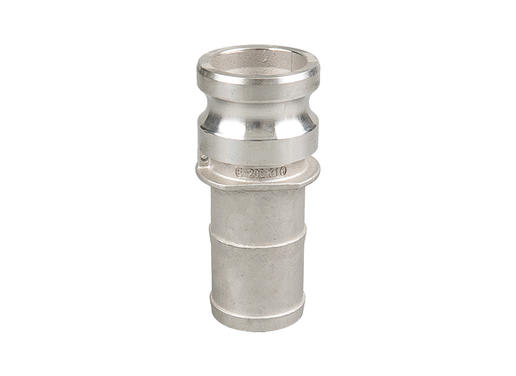 Stainless Steel Type E Camlock Coupling for Quick ConnectionsThis stainless steel camlock coupler offers a fast, tool-free connection for temporary transfer lines and tank-to-tank operations. Its smooth bore reduces turbulence, and the durable construction suits chemical, oil, gas, and agricultural applications.View Product →
Barbed Insert Connection
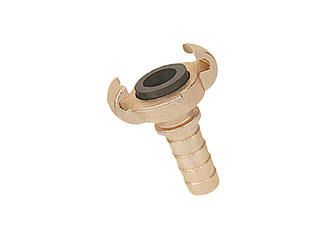
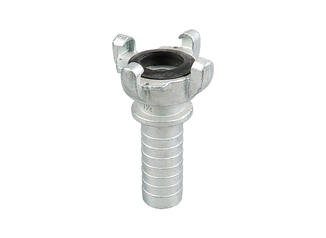
Barbed fittings have a series of annular ridges on one end that grip the poly pipe from the inside. The fitting is inserted into the pipe, and a hose clamp is installed over the outer surface. This creates a compression seal that is surprisingly durable. The barbed connection is widely used in agricultural irrigation, pump discharge lines, and low-to-medium pressure fluid transfer. It is the only direct way to join poly pipe without threading or welding. The key is to choose a clamp that matches the outside diameter of the pipe after the barb is inserted. Poly pipe has a degree of “creep” under long-term pressure, so the clamp must be checked and retightened during the first few weeks of service.
Threaded Connection
Threaded connections use male or female NPT or BSP threads on the fitting and the PVC pipe. On Schedule 80 PVC, the female thread is often molded or machined. A male threaded adapter with PTFE thread sealant provides a rigid, leak-tight joint. Threaded joints are ideal when you need to connect to an existing threaded PVC outlet or to a threaded equipment port. The main drawback is that PVC threads can be stripped or crack when over-tightened, so careful torque is required. Also, thread sealant is mandatory for leak-free performance.
| Connection Type | Mechanism | Main Benefit | Limitation |
|---|---|---|---|
| Smooth (Camlock) | Cam lever compresses gasket | Fast, reusable, no tools | Not for buried lines |
| Barbed Insert | Barb grips pipe + clamp | Reliable for poly pipe | Needs periodic clamp retightening |
| Threaded | Screw threads + sealant | Rigid direct connection | Risk of cracking if overtorqued |
Choosing the Right Fitting for Your Application
Selection should start with three questions: how much pressure is in the line, how often will you disconnect it, and what fluid is moving through it. If the system pressure is below 150 psi and the line will stay intact for years, a barbed insert with a hose clamp is the most economical and reliable choice. If you need to maintain the line and swap hoses frequently, a camlock coupling saves labor time. If you are connecting directly to a PVC valve or manifold with female threads, use a threaded adapter.
For aggressive chemicals, choose a fitting material that resists the media. Stainless steel fittings resist oxidation and can handle many acids and alkalies. Aluminum is lightweight and cost-effective for air and water. Polypropylene is the best choice for many chemical transfer lines because of its broad inertness. Our guide on how to choose a camlock coupling provides a step-by-step selection process that also applies to threaded and barbed options.
Step-by-Step Installation Methods
Proper installation is the single most important factor in preventing leaks. Below are the procedures for each connection type.
Installing a Barbed Fitting on Poly Pipe
- Cut the poly pipe squarely using a pipe cutter. A square cut ensures even grip on the barb.
- Clean the end of the pipe and remove any burrs or shavings.
- Warm the poly pipe slightly in cold weather if it is stiff. Soaking in hot water for a few minutes softens it and makes insertion easier.
- Push the barbed end fully into the pipe until the barb is completely covered.
- Place a hose clamp over the pipe at least 10 mm beyond the last barb gap.
- Tighten the clamp with a socket or nut driver. Do not use a screwdriver only – apply enough torque to compress the pipe wall against the barb.
- Retighten the clamp after 24 hours of service, then periodically thereafter. Poly pipe can generate a slight creep that relaxes the clamp.
Installing a Threaded Fitting on Schedule 80 PVC
- Clean the male and female threads with a wire brush to remove any dirt or mold flash.
- Wrap 3 to 4 turns of PTFE thread sealant tape clockwise (in the direction of the thread). Alternatively, use a suitable pipe thread sealant that is compatible with PVC.
- Screw the male adapter into the female PVC thread until it is hand-tight, then use a strap wrench to tighten one-half to one full turn. Avoid overtightening, which can crack the PVC socket.
- Test the joint for leaks before burying or covering it.
Installing a Smooth Camlock Connection
- Align the male and female camlock halves.
- Push the male adapter into the female coupler until the gasket makes contact.
- Rotate the cam levers down simultaneously to lock the halves together.
- Verify that the levers are fully down. A partially locked cam can lead to liquid loss under pressure.
For more detailed guidance on clamping, refer to our article on how to install hose couplings correctly. The same principles apply to camlock and barbed fittings.
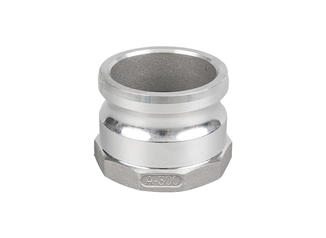
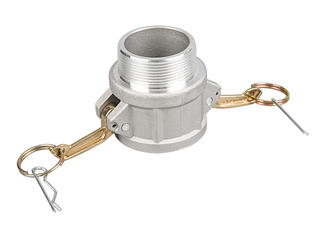
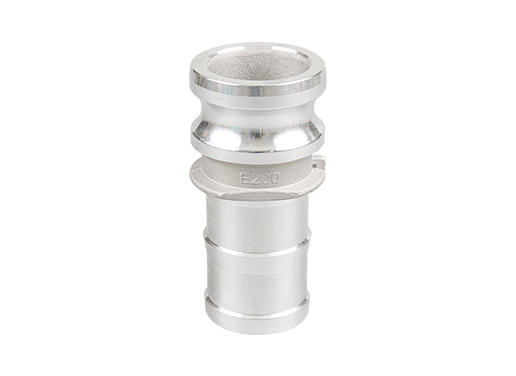 Aluminum Type E Camlock Coupling for Lightweight Fluid TransferThis aluminum camlock coupling provides a lightweight yet sturdy option for quick disconnections in low-to-medium pressure systems. Ideal for chemical, agricultural, and industrial use, it features a sandblasted finish and standard NBR gasket.View Product →
Material and Pressure Considerations
The material of the fitting also determines how much pressure it can withstand and how it interacts with the fluid. Let's compare the most common options for poly pipe-to-Schedule 80 PVC transitions.
Stainless Steel Fittings
Stainless steel camlock and barbed fittings offer the highest mechanical strength and corrosion resistance. They are ideal for outdoor installations, marine environments, and fluids with moderate acidity. Stainless steel is the default choice when the system will be open to sunlight, chemicals, or humidity.
Aluminum Fittings
Aluminum is lightweight and offers excellent value for water, air, and many fuel transfer applications. It is not suitable for aggressive acids or caustic solutions. Aluminum camlocks are very common farm and industrial couplings. The trade-off is that aluminum is not as durable as stainless steel under heavy scraping or impact.
Polypropylene Fittings
Polypropylene (PP) camlock and barbed fittings provide outstanding chemical resistance at a low cost. They are lighter than metal and are often used in fertilizer, pesticide, and industrial chemical lines. However, PP fittings have lower mechanical strength than metal, so they are best for low-pressure systems (typically up to 150 psi at room temperature).
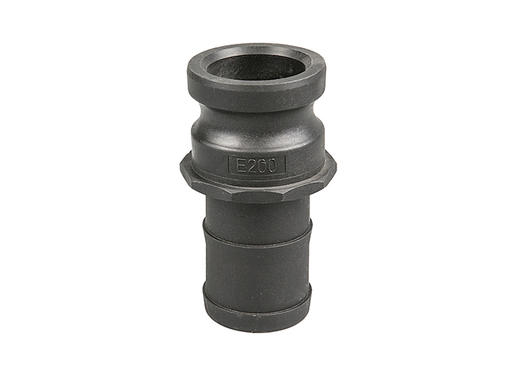 Polypropylene Type E Camlock Coupling for Chemical ResistanceThis polypropylene camlock adapter offers excellent chemical resistance at low cost, suitable for fertilizer, pesticide, and industrial chemical lines. It works with C, B, or D couplers and is best for low-pressure systems up to 150 psi.View Product →
Frequently Asked Questions
Can I connect poly pipe to Schedule 80 PVC without a hose clamp?
If you use a push-to-connect or compression fitting, you may not need a hose clamp. But for traditional barbed fittings, a clamp is always required. The clamp provides the external force that seals the barb against the poly pipe. Without it, the joint will weep under pressure.
Do threaded PVC fittings need PTFE tape?
Yes. NPT and BSP threads are not self-sealing. Use PTFE thread sealant tape or a pipe joint compound. The tape lubricates the threads and prevents galling, and it fills the spiral gaps between the threads.
What is the maximum pressure for a barbed camlock connecting poly pipe to Schedule 80 PVC?
There is no universal number. The maximum pressure depends on the hose clamp quality, the barb length, and the pipe wall thickness. In general, a properly fitted stainless steel hose clamp on a 2-inch poly pipe can handle 100 to 150 psi. For higher pressures, consider a flanged or threaded connection.
Can the connection be buried underground?
Barbed connections with hose clamps should not be buried. The clamp can loosen over time due to temperature changes, and a buried leak is impossible to detect visually. For buried lines, use a heat-fused poly pipe or an underground-rated compression fitting with a stainless steel insert.
How often should I retighten the hose clamp on a barbed fitting?
Retighten once after the first 24 hours of operation, then once after one week. After that, inspect the clamp quarterly for signs of movement or corrosion. If you notice a small drip, retighten immediately.
Is a camlock connection suitable for high-vibration environments?
No. Camlock couplers depend on friction and the cam lever angle to stay engaged. Under extreme vibration, the cams can work loose. For vibrating pumps or compressors, choose a threaded or barbed connection with additional cable ties or safety clips.
Conclusion
Choosing between smooth, barbed, and threaded fittings for connecting poly pipe to Schedule 80 PVC is a decision that should be made after evaluating pressure, fluid chemistry, and accessibility. A barbed insert with a quality hose clamp is the simplest and most economical way to join poly pipe. A threaded adapter is most reliable when the PVC side is already threaded. A smooth camlock connection serves best when rapid disconnection is a priority. Ningbo Chili Metal Products offers these connections in stainless steel, aluminum, and polypropylene, allowing you to match the fitting to the media being transferred. Always follow the installation steps above and inspect your joints regularly to keep the system leak-free.