 英语
 俄语

Content
- 1 The Five Crimp Hose Clamp Types at a Glance
- 2 Single Ear Crimp Clamps: The Assembly Line Default
- 3 Double Ear and Stepless Ear Clamps: Two Fixes for Two Problems
- 4 Crimp Ring and Swage Ring Clamps: The Lowest Profile Option
- 5 Crimp Ferrules: The Heavy-Duty End of the Crimp Family
- 6 Crimp Clamps vs Worm Gear, T-Bolt and Spring Clamps
- 7 Material Grade Is What Decides Service Life
- 8 Sizing, Tools and Crimp Tolerances
- 9 Application Map: Matching the Crimp to the Line
- 10 Inspection, Failure Modes and the Cost of a Bad Crimp
- 11 Frequently Asked Questions About Crimp Hose Clamps
- 11.1 Are crimp hose clamps stronger than screw-type clamps?
- 11.2 Can a crimped hose clamp be reused?
- 11.3 How do I know whether a crimp is tight enough?
- 11.4 What is the difference between an ear clamp and a crimp ring?
- 11.5 Which stainless grade should I choose for coastal use?
- 11.6 Do crimp clamps work on silicone hose?
- 12 Sourcing Crimp Clamps Without Guessing
Slip a worm gear clamp onto a 6 mm fuel return line and the screw housing pinches the hose wall. Over-tighten a T-bolt clamp on a 12 mm silicone coolant line and the band bites into the reinforcement. Both failures come from reaching for an adjustable clamp on a job that the factory solved with a crimp.
The direct answer to the question of crimp hose clamp types: there are five working families. Single ear clamps, double ear clamps, stepless ear clamps, crimp ring (swage ring) clamps, and crimp ferrules for industrial and hydraulic hose. Every one of them seals by permanently deforming metal instead of turning a screw, which is why they hold a fixed clamping load for the life of the assembly and never need re-torquing after a heat cycle.
The rest of this guide walks through how each type crimps, the size ranges it covers, the tooling it demands, the material grades that survive salt and chemicals, and the inspection checks that catch a bad crimp before it turns into a leak.
The Five Crimp Hose Clamp Types at a Glance
Before the detail, here is the map. The table below compares how each type clamps, roughly how wide a band size range it covers, and what tool closes it. Size ranges shift with band width and material thickness, so treat the numbers as planning figures rather than catalogue limits.
| Crimp Type | How It Clamps | Typical Band Range | Tool | Reusable |
|---|---|---|---|---|
| Single ear | One raised ear collapses to take up slack around a 360 degree band | 5 mm to 25 mm, band widths 5, 7 and 9 mm | Ear clamp pincer | No |
| Double ear | Two ears accept more take-up on thicker hose walls | 10 mm to 40 mm | Ear clamp pincer | No |
| Stepless ear | Seamless band, no step or overlap, even radial load | 3.5 mm to 20 mm | Stepless jaw pincer | No |
| Crimp ring / swage ring | Full circle ring swaged down to a set diameter, no ear | 6 mm to 50 mm, plus plumbing sizes | Swaging tool with go / no-go gauge | No |
| Crimp ferrule | Barrel crimped over a hose shank with a matched die set | 6 mm to 2 inch and above | Hydraulic crimper and dies | No |
One pattern stands out immediately: every crimp type is a single-use component. Unlike a worm gear clamp that can be backed off and retightened, a crimped connection is permanent by design. That is a feature, not a limitation, because a permanent deformation has nowhere to creep under vibration.
Single Ear Crimp Clamps: The Assembly Line Default
A single ear clamp is a stainless or galvanised band rolled into a circle with one raised loop standing proud of the circumference. The band carries no screw housing, no liner and no threaded barrel, so the clamp sits flat against the hose and occupies only the thickness of the metal.
How the ear does the work
When the pincer tool squeezes the ear, the loop closes and the band diameter shrinks. Because the ear is a formed loop rather than a straight section, it can only compress so far, which is exactly what gives the clamp its controlled take-up. The ear acts as a built-in torque limiter: a properly closed ear has been deformed past its elastic limit, so it will not spring back and lose grip the way a screw thread can.
Where single ear clamps belong
- Fuel return and vapour lines on small engines and passenger cars
- Vacuum and PCV circuits where a screw housing would foul a nearby component
- Coolant bypass hoses and heater lines on soft EPDM rubber
- Appliance water inlets, irrigation micro-lines and pneumatic signal tubing
The practical limit is diameter. Past roughly 25 mm the band starts to lose the hoop stiffness needed to compress a stiff hose evenly, and a double ear or a crimp ferrule does the job better.
Double Ear and Stepless Ear Clamps: Two Fixes for Two Problems
These two are often lumped together in catalogue listings, but they solve different problems and are not interchangeable.
Double ear clamps add take-up range
A double ear clamp carries two raised loops. Two ears mean two points of compression, so the clamp can absorb more hose wall variation and more swell during service. This matters on thicker-walled hose, on assemblies where the hose outside diameter tolerance is wide, and on lines that see thermal expansion and contraction. The trade-off is a taller profile and a crimp that needs a slightly wider jaw opening.
Stepless ear clamps eliminate the step
A stepless ear clamp is formed from a band with no overlapping joint, so the sealing load is even around the full 360 degrees. There is no step to dig into a soft hose, no notch that concentrates stress, and no layered metal that can trap fluid. Distributor technical notes on crimp ring and stepless designs describe the sealing element as a near-perfect circle with no additional tabs or stacked material, and that geometry is precisely why stepless clamps show up on small-diameter, precision fluid lines.
Choosing between them
- Soft hose, tight bend radius, small diameter under 20 mm: stepless ear
- Thick wall, wide diameter tolerance, thermal cycling: double ear
- Standard OEM replacement on a common 8 to 16 mm line: single ear
Crimp Ring and Swage Ring Clamps: The Lowest Profile Option
A crimp ring is exactly what the name suggests: a plain circular ring with no ear, no screw and no fastener of any kind. It is swaged down onto the hose and fitting with a purpose-made tool that compresses the entire ring to a controlled diameter. Plumbing trades will recognise the same principle from press-fit and crimp ring systems used on water distribution tubing, where the tooling is paired with a go / no-go gauge.
The advantage over an ear clamp is profile and balance. A crimp ring sits flush, presents no snagging point, and distributes load evenly. The disadvantage is that the crimp diameter is fixed by the tool, so the ring diameter must match the hose and fitting combination precisely. There is no take-up range to absorb a tolerance stack-up.
- Best on low-pressure fluid, air and water lines where a smooth exterior prevents abrasion
- Common on soft copper and polymer tubing as well as rubber hose
- Requires caliper verification at two points, ideally 90 degrees apart
Crimp Ferrules: The Heavy-Duty End of the Crimp Family
A crimp ferrule, sometimes called a barrel or sleeve, is a cylindrical metal shell pushed over the hose end and then compressed with a hydraulic crimper. The ferrule bites into the hose cover and compresses the reinforcement against the fitting shank underneath, creating a mechanical lock rather than a simple band of pressure.
This is where the crimp family gets serious. Hydraulic assemblies with two-wire braid or four-spiral reinforcement are routinely rated in the hundreds of bar, and that rating depends entirely on the crimp diameter being within the die specification. A few tenths of a millimetre off target can mean either a hose that blows off under pressure or a hose whose inner tube has been crushed and will fail from the inside out.
Ferrules also appear on sandblast hose, chemical transfer hose and large-bore water suction hose, where a conventional clamp simply cannot generate enough uniform force. Because the ferrule is chosen with the fitting, the hose and the die set as a matched trio, buyers should source them as an assembly rather than mixing brands and sizes.
Crimp Clamps vs Worm Gear, T-Bolt and Spring Clamps
The honest comparison is not "crimp is better" but "crimp is permanent and adjustable clamps are not." Industry comparisons of pinch clamps and worm drive clamps make the distinction plainly: a crimped pinch clamp cannot be adjusted after installation, and any change in fit requires removing the clamp and fitting a new one, while a worm drive clamp can be turned in or out at any time.
That single property drives the whole decision. Where the line will never be serviced by the end user, a crimp wins on cost, weight and vibration resistance. Where a technician needs to break the joint in the field, an adjustable clamp is the only practical answer, and a serviceable adjustable hose clamp with a proper housing and rolled band edges is the right call.
 stainless steel adjustable hose clampsAdditional InformationView Product →
T-bolt clamps sit between the two worlds. They are adjustable like a worm gear clamp but apply far higher and more even force, which makes them the standard choice for charge-air and coolant hose on boosted engines. Spring clamps use a tempered band that maintains tension as the hose ages, which is why they dominate on factory coolant lines where thermal cycling is constant. A broader overview of hose clamp types across all these families is worth reading if you are comparing crimp styles against adjustable designs.
For a full walkthrough of the alternative families, see this guide to the main types of hose clamps used across automotive and industrial assembly.
Material Grade Is What Decides Service Life
Two clamps with identical geometry can behave completely differently after a year outdoors. The band material, not the crimp design, usually decides which one survives.
| Material | Corrosion Behaviour | Typical Environment |
|---|---|---|
| Galvanised carbon steel | Zinc coating protects until it is scratched; rust starts at cut edges | Dry indoor machinery, vehicle interiors |
| 301 / 201 stainless | Moderate resistance, prone to pitting near salt and chlorides | Cost-sensitive indoor OEM assembly |
| 304 stainless | Good all-round resistance to water, most fuels and mild chemicals | General industrial, irrigation, automotive underbody |
| 316 stainless | Molybdenum addition resists chloride pitting and crevice attack | Marine, coastal, chemical and wash-down areas |
| Nylon / polymer | No rust, non-marking, limited temperature ceiling | Light-duty fluid lines, irrigation and spray systems |
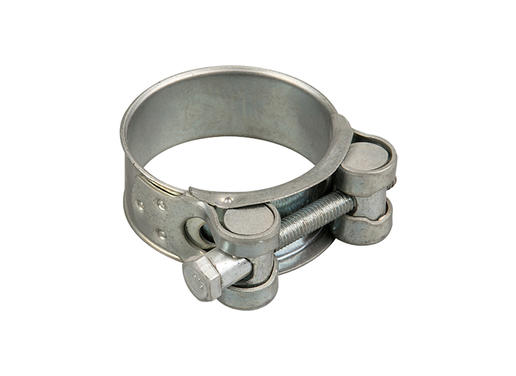
A practical rule from the field: if the assembly will ever see salt spray or wash-down chemicals, jump straight to 316 rather than hoping a coated carbon steel survives. Where a stamped, adjustable band is needed instead of a crimp, a well-finished stainless steel hose clamp with rolled edges and a 304 or 316 band will hold up far better than a zinc-plated equivalent.
 Stainless steel hose clampAdditional InformationView Product →
Sizing, Tools and Crimp Tolerances
Most crimp failures traced back to installation are actually sizing failures. Work through these steps in order and the odds of a leak drop sharply.
- Measure the hose outside diameter with the hose relaxed, not stretched over the fitting. Stretch reduces wall thickness and throws the reading off.
- Match the clamp to the crimped diameter, not the free diameter. An ear clamp listed as 14 to 16 mm must land inside that window once the ear is closed.
- Choose band width against pressure. A 5 mm band suits a 6 mm fuel line; a 9 mm band is the minimum sensible choice once you move to a 20 mm coolant hose.
- Use the correct jaw geometry. Stepless ear clamps need a jaw that closes the ear squarely; a standard pincer will tilt the ear and produce an uneven seal.
- Check the closed ear width with a gauge, or the crimp diameter with calipers on a ferrule. Visual inspection alone will not catch a 0.2 mm deviation.
- Never reuse a crimped clamp. Once the metal has yielded, a second crimp gives unpredictable load.
Application Map: Matching the Crimp to the Line
Crimp choices tend to follow the industry rather than the other way around. These are the pairings that show up most often in real assemblies.
- Automotive: single ear and stepless ear clamps on fuel, vacuum, coolant bypass and washer lines; crimp ferrules on power steering and air conditioning assemblies
- Marine: 316 stainless ear clamps on fuel, bilge and fresh water circuits where chloride exposure is constant
- Mining and surface preparation: crimp ferrules and heavy bands on abrasive sandblast and slurry hose
- Agriculture: crimp rings and polymer ear clamps on irrigation and sprayer lines where rust staining is unacceptable
- Chemical transfer: 316 ferrules on stainless fittings, paired with the correct hose liner to avoid galvanic issues
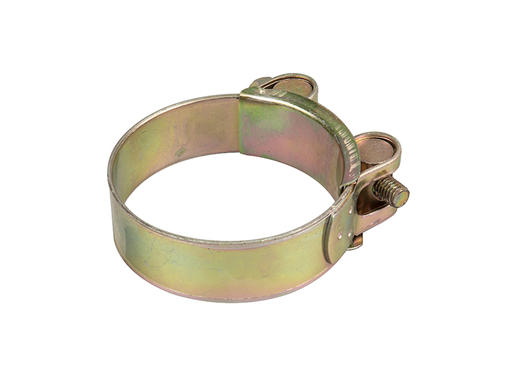
On lines that combine high pressure with regular hose replacement, a heavy-duty clamp in place of a crimp can be the more economical answer. A heavy duty hose clamp built with a thicker band and a stronger housing covers that middle ground between a crimp ferrule and an ordinary worm gear clamp.
 Heavy duty clampAdditional InformationView Product →
Inspection, Failure Modes and the Cost of a Bad Crimp
Crimp defects fall into a small number of recognisable patterns, and each has a distinct symptom.
- Under-crimp: the ear is only partly closed, the residual gap is too wide, and the joint weeps at low temperature or weeps after the first cold start. The hose can also pull off the fitting under pressure.
- Over-crimp: the band cuts into the cover, the reinforcement is crushed, and failure appears later as a split at the clamp line rather than a leak at the fitting.
- Wrong material: red rust streaks on a coastal installation, or brown staining around a stainless band in contact with a dissimilar metal.
- Wrong size: a clamp at the very edge of its range. The ear either bottoms out before the hose is gripped or never reaches its yield point.
For scheduled maintenance, a crimp connection does not need re-torquing the way a threaded clamp does, but it does need a visual check for fretting, cover cracking and corrosion staining at every service interval. Where a crimp has failed, the correct repair is a new clamp of the same type and size, with the hose end trimmed back past any damaged cover.
Frequently Asked Questions About Crimp Hose Clamps
Are crimp hose clamps stronger than screw-type clamps?
For a given band width, a crimp usually holds better under vibration because there is no threaded joint to loosen. The exception is high-pressure smooth-bore connections, where a T-bolt clamp can reach higher clamping loads than a small ear clamp. Strength depends on band width and material as much as on the mechanism.
Can a crimped hose clamp be reused?
No. Once the ear or ring has yielded, the metal has no reliable way to return to its original geometry, and a second crimp produces an unpredictable load. Cut the clamp off and fit a new one.
How do I know whether a crimp is tight enough?
Use a gauge rather than your eyes. Ear clamps are checked against the specified closed ear width, crimp rings against a go / no-go gauge, and ferrules by measuring the crimp diameter with calipers at two points roughly 90 degrees apart. A crimp that looks perfectly closed can still be outside tolerance.
What is the difference between an ear clamp and a crimp ring?
An ear clamp is closed by collapsing a formed loop, which limits the clamping force and gives a small amount of take-up. A crimp ring has no ear at all and is swaged down to a fixed diameter, which gives a lower profile and a more even radial load but no tolerance for a mismatched hose and fitting.
Which stainless grade should I choose for coastal use?
316 stainless. Its molybdenum content resists the chloride pitting that attacks 304 in salt air and wash-down environments. The cost difference per clamp is small compared with the labour of replacing a rusted connection.
Do crimp clamps work on silicone hose?
Yes, but silicone is soft and slippery, so band width matters more than usual. Use a wider band, avoid over-crimping, and consider a stepless design so there is no step to cut into the wall. Silicone also needs a clamp that can follow its thermal movement, which is why a spring clamp is sometimes preferred on coolant lines.
Sourcing Crimp Clamps Without Guessing
The most common procurement mistake is ordering by hose size alone. A crimp clamp order needs four pieces of information: the crimped diameter window, the band width, the material grade, and the hose type. Suppliers who ask for all four are the ones who will not ship a clamp that bottoms out on the first installation.
For buyers assembling a mixed programme across automotive, irrigation and industrial lines, it helps to consolidate the clamp range with one supplier so that band materials, plating and tolerances stay consistent from batch to batch. A full hose clamp range covering adjustable, heavy duty, spray and stainless variants makes that consolidation practical, and it avoids the situation where a 304 band from one source meets a 316 band from another on the same machine.
Finally, keep a small stock of the three or four crimp sizes used most often on your equipment, plus a spare pincer jaw and a gauge. A leaking fuel line at 6 mm and a weeping coolant hose at 22 mm will rarely wait for a delivery, and the correct clamp in the right size costs far less than the downtime caused by substituting whatever is on the shelf.