 英语
英语 俄语
俄语
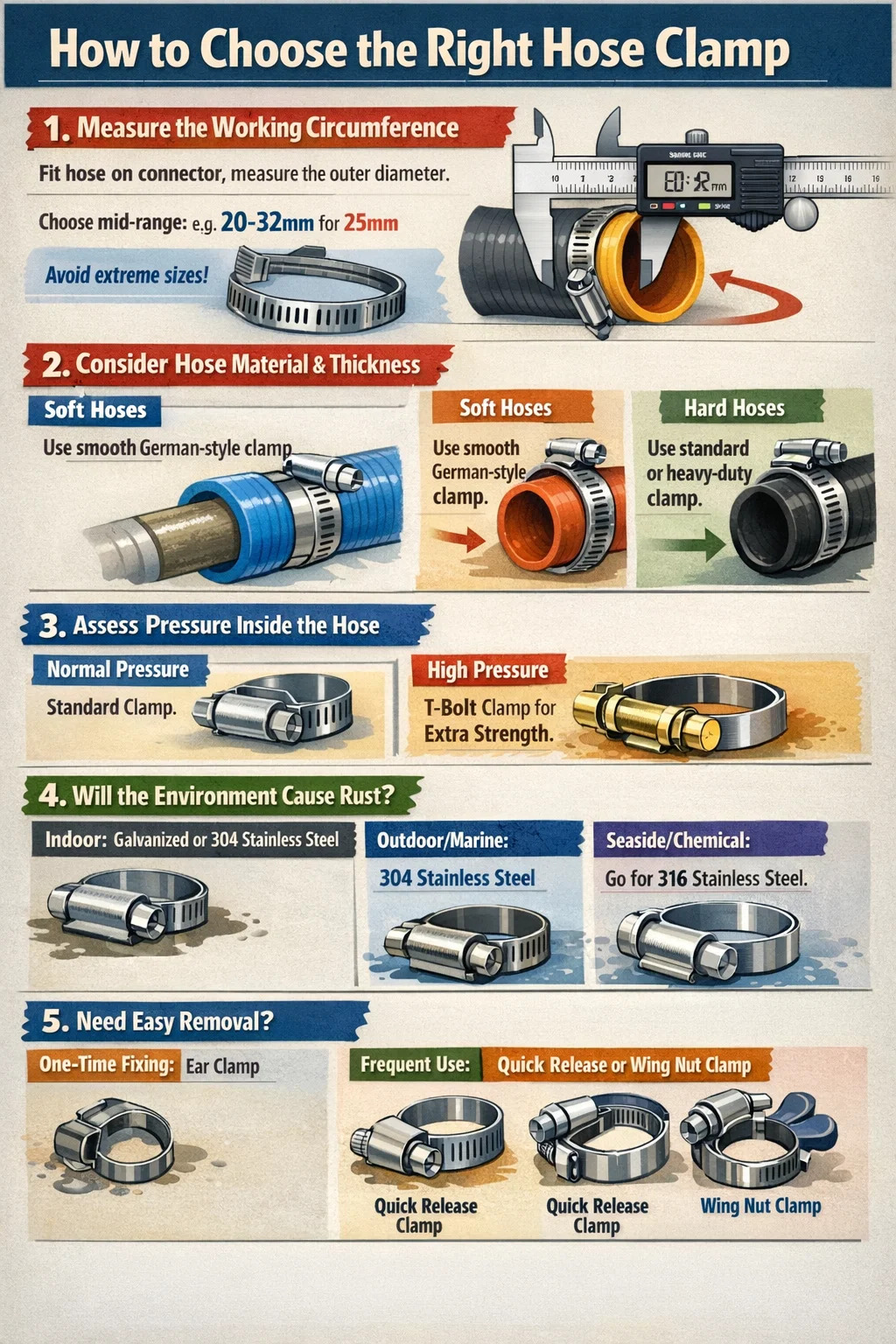
Choosing a hose clamp seems simple enough; you might think you can just grab any one that fits. But in reality, there are many pitfalls. People often buy clamps that are either too loose (even when tightened all the way) or too tight, damaging the hose, or even rusting and breaking over time.
To choose the "just right" clamp, you need to follow these steps:
1. Accurately measure the "working circumference" (most important)
Many people choose the wrong size because they only measure the hose itself or the connector.
The correct method: You must first fit the soft hose onto the hard pipe connector. The hose will expand slightly at this point. You need to measure the outer diameter after the hose is fitted.
Selection range: Each hose clamp has an adjustment range (e.g., 20-32mm). The size you measure should ideally fall in the middle of the clamp's range.
For example, if you measure 25mm, a 20-32mm clamp is perfect.
Never choose the "extreme value." If your hose is 32mm, and you buy a clamp with a maximum size of 32mm, installation will be very difficult, or even impossible.
2. Consider the hose's material and thickness
Different hose materials require different types of clamps to avoid problems.
Soft hoses (e.g., silicone hoses, very soft rubber): These hoses are delicate and easily damaged by excessive pressure. Avoid ordinary American-style clamps with many perforations on the band; these holes can scratch and damage the hose surface. Always choose a German-style hose clamp with a smooth inner surface, or one with a liner to prevent damage.
Hard hoses (e.g., thick rubber hoses, plastic pipes): These are more durable, and ordinary worm gear clamps or heavy-duty clamps will work well. A stronger grip is actually more stable.
3. Consider the pressure inside the hose
The pressure of the fluid flowing through the hose determines how strong a clamp you need.
Normal pressure (garden hoses, washing machine drains): A standard hose clamp costing a couple of dollars is sufficient; just make sure it's tight enough to prevent leaks. High-pressure applications (automotive turbochargers, industrial pumps): In these high-pressure environments, ordinary hose clamps may break or come loose. In this case, you must choose T-bolt clamps. These use thick bolts for tightening, providing greater strength and specifically designed to prevent pipe bursts.
4. The most easily overlooked factor: Will the environment cause rust?
Many hose clamps break not from being overstretched, but from rusting.
Indoor dry environments: Galvanized iron or ordinary stainless steel clamps are fine; they are inexpensive and practical.
Outdoor, bathroom, or under-car environments: You must use 304 stainless steel. There's a big pitfall to watch out for here: some hose clamps advertised as stainless steel only have a stainless steel band, while the screw is made of iron (partially stainless steel). After prolonged use, the screw will rust and even break. When buying, it's best to test with a magnet or buy "all-stainless steel" clamps.
Seaside or chemical environments: Don't hesitate, go straight for 316 stainless steel, otherwise, they will corrode within a few months.
5. Do you need to disassemble it frequently?
One-time fixing: If you don't plan to remove the pipe after installation, ear-type clamps are the easiest; simply clamp them on, and they're done. They are also small and won't snag on other things.
Frequent cleaning or replacement: For example, filter pipes or equipment that requires frequent disassembly and cleaning, use hand-tightened wing-nut hose clamps (with a butterfly-shaped plastic handle) or quick-release clamps. You can work with them by hand without needing a screwdriver every time.