 英语
 俄语

Content
- 1 Pipe Threads Do Two Different Jobs
- 2 NPT and NPTF: The North American Tapered Family
- 3 BSPT and BSPP: The Two Halves of the British Standard Pipe Family
- 4 Metric Pipe Threads and O-Ring Ports
- 5 Straight Threads That Only Look Like Pipe Threads
- 6 Pipe Thread Comparison Chart
- 7 Nominal Size Against Actual Thread Size
- 8 How to Identify an Unknown Pipe Thread in Five Steps
- 9 Where Thread Mistakes Cost the Most Money
- 10 Matching the Thread to the Coupling and the Hose
- 11 Frequently Asked Questions About Pipe Threads
- 11.1 Are NPT and BSP the same thread?
- 11.2 What is the difference between NPT and NPTF?
- 11.3 Can I use PTFE tape on BSPP threads?
- 11.4 How many turns should a tapered pipe thread engage?
- 11.5 What does a G thread mean?
- 11.6 How do I tell a tapered thread from a parallel one without tools?
- 11.7 Why do stainless steel pipe threads seize so easily?
Two fittings both stamped 1/2 inch will screw together two full turns and then leak. That single fact explains a large share of failed hose assemblies, because 1/2 inch describes a nominal bore, not a thread form. A 1/2 inch NPT male and a 1/2 inch BSP female share the same 14 threads per inch, so they start to engage, yet their thread angles and outside diameters are different and the joint never becomes pressure tight.
Here is the answer before the detail. In industrial hose, pump, valve and fluid transfer work you will meet four pipe thread families, which are NPT and NPTF from North America, BSPT and BSPP from the British and international standards, metric parallel threads used mainly on DIN and ISO ports, and the Japanese JIS PT thread. Tapered threads seal on the thread flanks themselves, normally with a sealant. Parallel threads do not seal on the thread at all, and they need a gasket, bonded washer or O-ring at the shoulder. That one difference decides how far you tighten a joint, what you put on the threads, and which spare part you order.
The rest of this guide covers each family in turn, the sizes that actually show up on purchase orders, two comparison charts you can keep near the bench, and a five step method for identifying an unknown thread with nothing more than a caliper and a pitch gauge.
Pipe Threads Do Two Different Jobs
Every thread on a pipe, hose fitting or port is either a sealing thread or a fastening thread. Sealing threads, also called jointing threads, are shaped to make the joint pressure tight on their own. Fastening threads simply hold two parts together and hand the sealing job to another element such as a washer, an O-ring or a cone.
Tapered sealing threads, which include NPT and BSPT, are cut with a 1 in 16 taper on diameter, the same as 3/4 inch per foot. The American family uses a 60 degree included angle, while the British family follows the 55 degree Whitworth form. Because the diameters shrink as the fitting turns in, the flanks of the threads press against each other and close the spiral gap.
Two practical consequences follow from that geometry. A tapered joint has a narrow working range, so hand tight plus one or two turns with a wrench is normal, while two full turns past hand tight will often split a casting or cold weld the threads together. The joint also depends on sealant filling the remaining spiral path, which is why a tapered thread will weep under pressure even when it feels tight.
- Tapered thread that needs sealant: NPT, BSPT, JIS PT, metric tapered, and the dryseal variant NPTF.
- Parallel thread that needs a washer or O-ring: BSPP, metric parallel, NPSM swivel, SAE O-ring boss.
- Parallel thread with a metal cone seal: SAE J514 JIC 37 degree flare.
NPT and NPTF: The North American Tapered Family
NPT stands for National Pipe Taper and is defined by ASME B1.20.1. It is the default pipe thread in the United States, Canada and Mexico, and it travels with exported pumps, compressors, valves and spray equipment. The thread form is 60 degrees with flattened crests and roots, which leaves a small helical gap that must be filled by sealant.
NPTF, defined by ASME B1.20.3, is the dryseal version of the same thread. The crest of one thread interferes with the root of the other, so the gap closes on metal contact and no sealant is required. NPTF shows up in fuel systems, hydraulic reservoirs and refrigeration work. An NPTF male will usually assemble into an NPT female, but the reverse is not reliable, and a dryseal joint that has been made up dry should be inspected before it is reused.
Pitch is fixed by the standard, and the numbers are worth memorising because nominal size is not a diameter. 1/8 inch NPT has 27 threads per inch, 1/4 and 3/8 inch have 18, 1/2 and 3/4 inch have 14, and everything from 1 inch to 2 inch has 11.5. A 1/4 inch NPT male measures roughly 13.7 mm across the outside thread, and a 1/2 inch NPT male measures roughly 21.3 mm.
Straight versions also exist. NPS and NPSM are parallel threads with the same basic sizes as NPT, and they seal with a gasket or a swivel washer instead of thread interference. That similarity is a common trap, because a 1/4 inch NPSM swivel and a 1/4 inch NPT male are both 18 threads per inch on the same nominal diameter and will start to turn into one another.
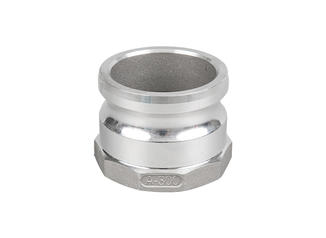
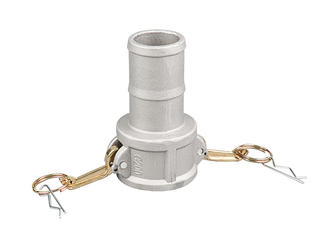
Threaded camlock adapters are among the simplest ways to connect an NPT port to a cam and groove hose line. Our aluminium Type B camlock coupling is a male adapter with a female NPT thread, offered in a range of standard sizes for fluid transfer duty.
 Aluminum type B camlock couplingAdditional InformationView Product →
BSPT and BSPP: The Two Halves of the British Standard Pipe Family
BSP is one name for two threads that cannot be interchanged. BSPT is the tapered version, specified in ISO 7-1 and formerly in BS 21, with a 55 degree Whitworth form and a 1 in 16 taper. BSPP is the parallel version, specified in ISO 228-1, with the same 55 degree form but a constant diameter along its whole length.
The designations carry the meaning. On a drawing, R marks an external tapered thread, Rc an internal tapered thread, Rp an internal parallel thread, and G a parallel thread that can be male or female. A tolerance letter is often added, so G1/2 A is an external 1/2 inch parallel thread in the finer class and G1/2 B is the coarser class. If the drawing says R1/2, you are holding a tapered male thread. If it says G1/2, the thread is parallel and the seal lives somewhere else.
Sealing follows directly from that. A BSPT male into a BSPT female behaves like NPT, needing sealant and a controlled amount of tightening. A BSPP male into a BSPP female will screw in fully by hand and will leak unless a bonded washer or an O-ring compresses against the flat shoulder of the port. This is one of the most frequent assembly errors on water, air and coolant lines, because the joint feels perfect while it is being made up.
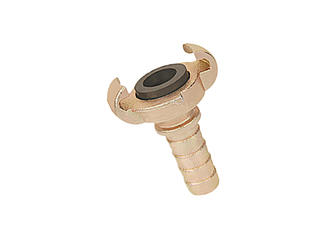
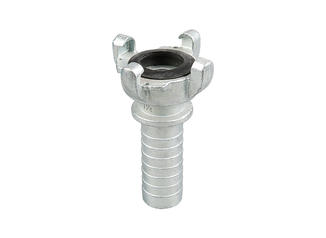
BSP dominates in the United Kingdom, most of Europe, Australia, India and much of the Middle East, and it appears in irrigation and fire protection equipment worldwide. European air hose couplings are a familiar example, since they are threaded to BSP rather than NPT and are widely used on compressed air networks.
 European air hose couplingAdditional InformationView Product →
Metric Pipe Threads and O-Ring Ports
Metric pipe threads are parallel and use the ordinary 60 degree metric profile in a fine pitch. Sizes you will find on manifolds, cylinders and valve blocks include M10x1, M12x1.5, M14x1.5, M16x1.5, M18x1.5, M22x1.5, M27x2, M33x2, M42x2 and M52x2. The figure after the letter M and the x is the pitch in millimetres, so there is no threads per inch value to look up and an inch pitch gauge is useless on these ports.
Sealing is always handled by a separate element. DIN 3852-1 ports take a sealing washer, either solid copper or a bonded rubber and steel type, that crushes against the flat shoulder of the port. ISO 9974 ports achieve the same result with slightly different geometry, and many modern manifolds use an O-ring seated in a recess in the port face. The rule to remember is simple: the thread carries the load, and the washer or O-ring stops the leak.
Metric tapered threads appear on some older European equipment and in a few legacy drawings, but they are far less common than the parallel versions. Japan uses its own tapered thread, JIS PT per JIS B 0203, which shares the 55 degree angle with BSPT and is close enough in dimensions to catch people out. It remains a separate specification, so a PT fitting should never be assumed interchangeable with an R fitting.
Straight Threads That Only Look Like Pipe Threads
Hydraulic and pneumatic equipment adds a group of straight threads that share basic sizes with pipe threads but seal in a completely different way. Confusing them with pipe threads produces the same result as mixing NPT with BSP, which is a joint that assembles and then drips.
- SAE J1926 and ISO 11926 O-ring boss ports use a straight UNF thread, often 7/16-20 or 9/16-18, with an O-ring seated in a chamfer at the base of the port.
- SAE J514 JIC 37 degree fittings use a straight thread plus a metal cone that mates with a machined cone in the port, so sealing happens at the cone.
- NPSM swivel nuts use the same straight thread form as NPT and seal on a washer or a gasket face rather than on the threads.
Two of these are easy to confuse with pipe threads. The obvious case is NPSM against NPT, since both are 60 degree threads at 18 or 14 threads per inch on the same basic diameter. The less obvious case is a small O-ring boss port sitting next to a 1/4 inch NPT port, where the pitches are 20 and 18 threads per inch. A pitch gauge settles the question in seconds, and guessing costs a replaced manifold.
Pipe Thread Comparison Chart
The table below is the fastest way to narrow down an unknown thread before you reach for a gauge. Read across from the standard you suspect and compare the sealing method with what you see on the fitting or port.
| Thread family | Standard | Angle | Form | How it seals | Main markets |
|---|---|---|---|---|---|
| NPT | ASME B1.20.1 | 60 degrees | Taper 1:16 | Thread interference plus sealant | USA, Canada, Mexico |
| NPTF | ASME B1.20.3 | 60 degrees | Taper 1:16 | Dryseal crest to root contact | USA, fuel and refrigeration |
| BSPT (R, Rc) | ISO 7-1 | 55 degrees | Taper 1:16 | Thread interference plus sealant | UK, Europe, Australia |
| BSPP (G) | ISO 228-1 | 55 degrees | Parallel | Bonded washer or O-ring at shoulder | Europe, UK, Asia, water lines |
| Metric parallel | ISO 965, DIN 3852-1 | 60 degrees | Parallel | Sealing washer or O-ring | Germany, Europe, Asia |
| JIS PT | JIS B 0203 | 55 degrees | Taper | Thread interference plus sealant | Japan, parts of Asia |
| SAE O-ring boss | SAE J1926, ISO 11926 | 60 degrees UNF | Parallel | O-ring in port chamfer | Mobile hydraulics worldwide |
| JIC 37 degree | SAE J514 | 60 degrees UNF | Parallel | Metal cone on cone | Hydraulics worldwide |
Nominal Size Against Actual Thread Size
The second reason threads get mixed up is that the same nominal size produces different physical dimensions in different standards. Even the smallest size differs, and above 3/4 inch the pitch changes as well.
| Nominal size | NPT threads per inch | NPT outside diameter (mm) | BSP threads per inch | BSP outside diameter (mm) |
|---|---|---|---|---|
| 1/8 | 27 | 10.3 | 28 | 9.7 |
| 1/4 | 18 | 13.7 | 19 | 13.2 |
| 3/8 | 18 | 17.1 | 19 | 16.7 |
| 1/2 | 14 | 21.3 | 14 | 21.0 |
| 3/4 | 14 | 26.7 | 14 | 26.4 |
| 1 | 11.5 | 33.4 | 11 | 33.2 |
| 1-1/4 | 11.5 | 42.2 | 11 | 41.9 |
| 1-1/2 | 11.5 | 48.3 | 11 | 47.8 |
| 2 | 11.5 | 60.3 | 11 | 59.6 |
Notice the 1/2 inch row. Both standards list 14 threads per inch, and the diameters are only 0.3 mm apart, which is why half inch NPT and half inch BSP feel like they fit. The thread angle is still 60 degrees against 55 degrees, so the flanks only touch along a narrow line and the joint will not hold pressure.
How to Identify an Unknown Pipe Thread in Five Steps
Field identification is not guesswork if you follow the same order every time. It takes about two minutes per fitting once the habit is set.
- Decide whether the thread is male or female, then look at the sealing face. A flat shoulder or a chamfered port face usually means the seal is a washer or O-ring and the thread itself is parallel.
- Check for taper. Measure across the first and the last full thread with a caliper. A 1 in 16 taper changes the diameter by about 1 mm over 16 mm of length, while a parallel thread shows no change at all.
- Measure the pitch with a gauge. Use a threads per inch gauge for inch systems and a metric gauge for millimetre pitches, because the two are not convertible by eye.
- Measure the outside diameter of a male thread, or the inside diameter of a female thread, and compare against the published charts for the standards you suspect.
- Confirm against a labelled master fitting kept in the tool crib, then write the full designation on the drawing and the purchase order, for example 1/2 inch NPT male or G1/2 A male.
A reference set covering NPT, BSPT, BSPP, metric parallel and O-ring boss costs very little compared with one shutdown caused by a wrong adapter, and it removes the argument about which thread is which.
Where Thread Mistakes Cost the Most Money
Thread errors rarely show up at the moment of purchase. They show up during commissioning, during a night shift, or after a pressure test has already been signed off. The five failure modes below cover most of what we see in enquiries from traders and end users.
- Part numbering risk. NPT, BSPT and BSPP versions of the same nominal size are often one character apart in an ERP system, so a single keying error ships a fitting that assembles and then weeps.
- Over-tightening. Chasing a tapered weep with a longer wrench cracks brass and cast aluminium ports, and the port usually costs more than the fitting.
- Galling. Stainless steel on stainless steel without anti-seize can seize within one assembly, and both parts then have to be cut off.
- Sealant in the wrong place. Wrapping PTFE tape on a BSPP thread does not fix a leak, because the leak path is at the shoulder, not through the thread.
- Mixed bins. Storing NPT and BSP versions of the same adapter in one container almost guarantees a wrong pick during a breakdown.
The cheapest control is documentation. Add the full thread designation, the standard number and the material to every line of the bill of materials, and ask suppliers to confirm the designation in writing before production starts.
Matching the Thread to the Coupling and the Hose
In a practical hose assembly, the pipe thread is only one end of the story. The other end connects to the hose, and that connection might be a barbed insert, a cam and groove end, a flange or a clamp. Getting the assembly right means starting from the port on the equipment, matching the thread and the seal, then working outwards to the hose bore, the working pressure and the material.
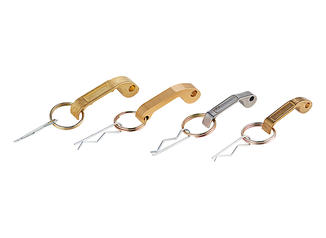
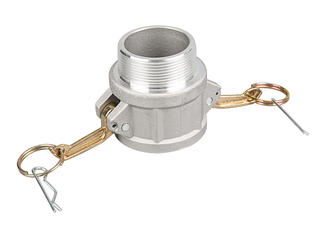
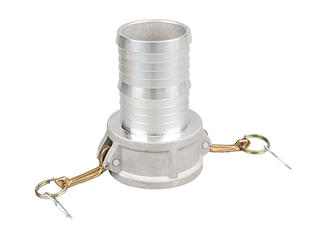
For a female port, a male threaded adapter is needed, and brass Type D camlock coupling is a typical choice, with an external thread that mates with the port and a cam and groove body that accepts the matching coupler. Aluminium versions suit light weight and fast handling, stainless steel suits corrosive media, and brass sits between the two on cost and durability.
The same decision process applies to any threaded adapter, and the logic in how to choose camlock coupling runs parallel to thread selection: start from the connection on the equipment, then the hose, then the material, then the safety accessories such as pins and safety cables.
 Brass type D camlock couplingAdditional InformationView Product →
Frequently Asked Questions About Pipe Threads
Are NPT and BSP the same thread?
No. NPT uses a 60 degree thread angle, and BSP uses the 55 degree Whitworth form. At 1/2 inch and 3/4 inch they share a pitch of 14 threads per inch, which is why they seem to fit, but the thread flanks meet on a narrow line and the joint will not seal reliably. At 1 inch and above, the pitch also differs at 11.5 against 11 threads per inch.
What is the difference between NPT and NPTF?
NPT needs a sealant because the crest and root of the thread are truncated and leave a spiral gap. NPTF is the dryseal version, where crest and root are designed to interfere, so the joint seals on metal contact without tape or dope. An NPTF male usually assembles into an NPT female, but the pairing is not guaranteed to be leak free under high pressure.
Can I use PTFE tape on BSPP threads?
Tape will not solve a leak on a parallel thread, because the sealing surface is the flat shoulder where the washer or O-ring sits. A small amount of tape can help with thread friction on stainless parts, but the actual seal still comes from the washer. If a BSPP joint drips, replace the bonded washer before adding anything to the threads.
How many turns should a tapered pipe thread engage?
A typical tapered joint makes up three to four turns by hand and then one to two turns with a wrench. Leaving one or two thread crests visible outside the port is normal and correct. Driving it further does not improve the seal and risks cracking the port or galling the threads.
What does a G thread mean?
The letter G marks a parallel pipe thread to ISO 228-1, so G1/2 is a 1/2 inch parallel thread. It is often paired with a sealing washer, which is why a G threaded port usually has a machined flat face around the hole. A letter after the size, such as G1/2 A, describes the tolerance class.
How do I tell a tapered thread from a parallel one without tools?
Look along the thread from the side. A tapered thread narrows visibly toward the nose, and a parallel thread keeps the same diameter to the end. You can also rest the thread on a flat surface: a tapered thread rocks, while a parallel thread sits still along its whole length.
Why do stainless steel pipe threads seize so easily?
Stainless steel forms a tough oxide layer that can cold weld under the high contact pressure of a tapered thread. The usual answer is a nickel based anti-seize compound on the male thread, applied before assembly, plus a light touch with the wrench. Two turns past hand tight is more than enough on stainless parts.
Pipe threads reward a little precision up front. Confirm the standard, the pitch and the sealing method before the order leaves the desk, keep labelled master fittings in the crib, and never let a tapered joint do the work of a washer. That routine prevents most leaks before a single wrench is picked up.
Our own production has been running since 2004 in Cixi, Ningbo, roughly 100 km from Ningbo Port and 120 km from Shanghai Port, supplying camlock couplings, Storz couplings, Guillemin couplings, pin lug couplings, Bauer couplings, air hose couplings, sandblast couplings, hose clamps, ferrules, strainers and related accessories to importers and distributors in North America, Europe, Australia, Southeast Asia, the Middle East and South Africa. If you want to know how we work on quality control and customer support, our corporate values explain the standards we hold ourselves to. Send us the thread designation, the material and the working pressure, and we will confirm the exact adapter for your line.