 英语
英语 俄语
俄语
Content
- 1 How to Measure Cam Lock Fitting Size: The Direct Answer
- 2 Understanding Cam Lock Fitting Types Before You Measure
- 3 Tools You Need to Measure a Camlock Coupling Accurately
- 4 Step-by-Step: Measuring a Female Camlock Coupler (Type B, C, D)
- 5 Step-by-Step: Measuring a Male Camlock Adapter (Type A, E, F)
- 6 How to Measure the Hose Shank End of a Cam Lock Fitting
- 7 Matching Thread Size to Camlock Fitting Size: NPT vs. BSPP
- 8 Common Sizing Mistakes and How to Avoid Them
- 9 How Camlock Fitting Material Affects Dimensions
- 10 Measuring Cam Lock Fitting Size for Reducer and Adapter Applications
- 11 Pressure Rating and Size: What the Numbers Mean Together
- 12 Identifying Cam Lock Fitting Size Without a Caliper
- 13 Frequently Asked Questions About Measuring Cam Lock Fitting Size
- 13.1 Is camlock fitting size the same as pipe size?
- 13.2 Can I measure a camlock fitting size in millimeters?
- 13.3 What if my measurement falls between two standard sizes?
- 13.4 Do stainless steel and aluminum camlocks of the same size interchange?
- 13.5 How do I measure a camlock fitting that is still attached to a hose or pipe?
How to Measure Cam Lock Fitting Size: The Direct Answer
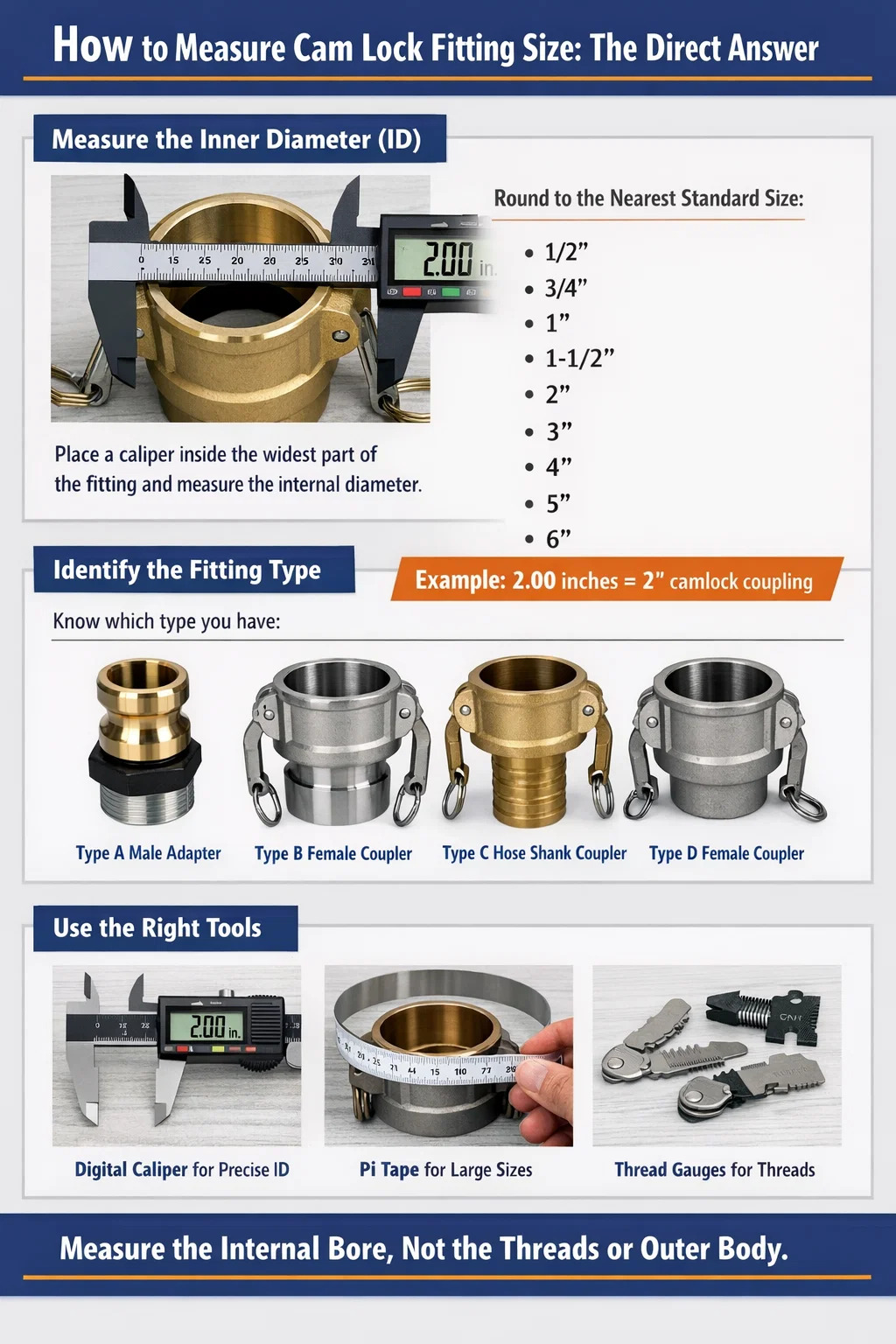
To measure a cam lock fitting size, you need to measure the inside diameter (ID) of the coupling — not the outside threads or the outer body. Place a caliper or ruler across the widest interior opening of the fitting. That number, rounded to the nearest standard size, is your cam lock fitting size. Standard sizes run from 1/2 inch up to 6 inches, with the most common sizes being 1 inch, 1.5 inch, 2 inch, 3 inch, and 4 inch. If you measure 2.0 inches across the inside bore, you have a 2-inch camlock coupling.
That said, getting this measurement right depends on the type of fitting you are holding (male or female, adapter or coupler), the material it is made of, and whether you need to match it to a hose, pipe, or tank fitting on the other end. This guide walks through every scenario in detail so you get the right size every time.
Understanding Cam Lock Fitting Types Before You Measure
Before taking any measurements, you need to identify which type of camlock fitting you are working with. There are seven standard cam and groove coupling types defined by MIL-C-27487 and later by ASME B16.6. Each type has a different configuration, and knowing yours will tell you exactly where to place your measuring tool.
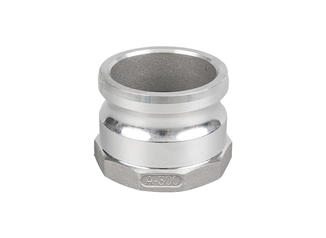
- Type A — Male adapter with male NPT thread on one end; measure the cam groove end (the cam lock side).
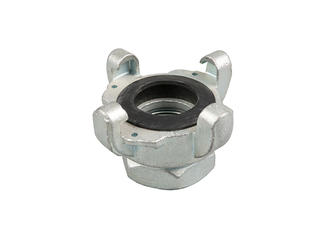
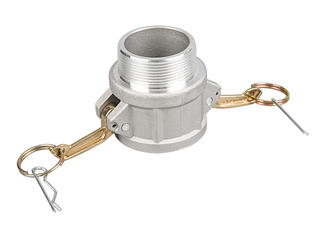
- Type B — Female coupler with female NPT; measure the internal groove housing diameter.
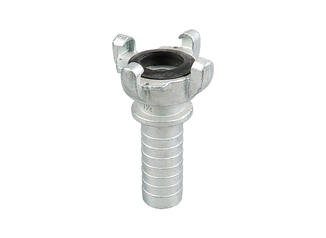
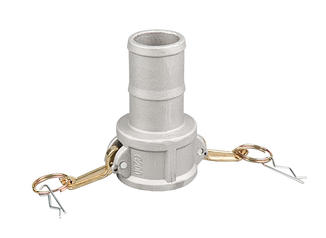
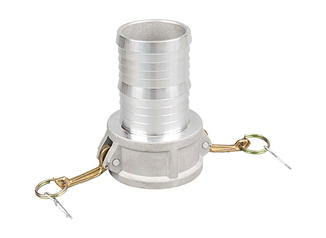
- Type C — Female coupler with hose shank; measure the hose shank end for hose compatibility, and the cam groove end for coupling size.
- Type D — Female coupler with female BSPP thread; measure the internal bore at the cam lock groove.
- Type E — Male adapter with hose shank; measure the cam groove end.
- Type F — Male adapter with male BSPP thread; measure the cam groove end.
- Type DC (Dust Cap) and DP (Dust Plug) — Protective end caps; measure the female socket inner bore for DC, or the male plug outer diameter for DP.
The critical point across all types: the nominal cam lock coupling size always refers to the inner bore diameter of the cam groove section, not the thread size, not the hose barb size, and not the outer body diameter. Confusing these leads to ordering mismatches, especially when switching between NPT-threaded adapters and hose shank types.
Tools You Need to Measure a Camlock Coupling Accurately
A standard ruler or tape measure will give you a rough answer for larger sizes (3 inch and above), but for 1 inch, 1.5 inch, or 2 inch cam and groove couplings, the difference between sizes is only half an inch — a margin that is easy to miss with a tape measure alone. Here is what to use:
Digital Vernier Caliper
The best tool for the job. A digital caliper reads to 0.01 mm or 0.001 inch. Open the jaws, insert the inside-measuring tips into the bore of the camlock fitting, and read the display. This eliminates human parallax error. Look for a caliper with at least a 6-inch (150 mm) range; most cam lock sizes will fall within this range. For 5-inch and 6-inch camlock couplings, you may need a 8-inch caliper or a pi tape.
Pi Tape (Circumference Tape)
For large-diameter cam and groove fittings, a pi tape wraps around the outer body and directly reads the equivalent diameter. This is useful when you cannot get a caliper inside the bore, such as when measuring a fitting that is still connected in a piping system. However, pi tapes measure the outer diameter (OD), not the bore — so you still need to know the wall thickness to get the inner diameter. For standard aluminum or stainless steel camlock fittings, wall thickness is specified in published dimensional tables by size.
Thread Gauge
If you are trying to match the threaded end of a camlock adapter (Type A, B, D, or F) to an existing pipe thread, a thread pitch gauge is essential. It identifies whether you have NPT, BSPP, or metric threads. This does not tell you the cam lock coupling size directly, but it confirms the thread connection on the non-cam end so you can select the right Type A or Type B adapter to match.
Step-by-Step: Measuring a Female Camlock Coupler (Type B, C, D)
Female couplers are the most common component people need to measure, since they are typically installed on the receiving end of a hose or pipe system and must be replaced or duplicated.
- Set the camlock coupler flat on a workbench with the cam groove opening facing up.
- Open your digital caliper jaws to the inside-measuring position (the smaller set of jaws on the top of most calipers).
- Insert the inside-measuring jaws into the bore opening of the camlock coupling — this is the round hole in the center that the male adapter slides into.
- Spread the jaws until they lightly contact the inner walls of the bore at the widest point. Do not force the measurement.
- Read the measurement and round to the nearest standard size. For example, if you measure 2.06 inches, you have a 2-inch cam lock coupling. If you measure 3.09 inches, you have a 3-inch.
- Cross-check by looking at the cam lock arms (levers). Standard 2-inch aluminum camlock couplers have cam arms approximately 1.5 inches long; 3-inch couplers have cam arms roughly 2 inches long. These dimensions are manufacturer-standardized, so they serve as a quick visual sanity check.
If the coupling is corroded, damaged, or has a lip that prevents caliper insertion, measure the outer diameter of the male plug that fits into it (if available), then subtract twice the wall thickness for that size per published dimensional standards.
Step-by-Step: Measuring a Male Camlock Adapter (Type A, E, F)
Male camlock adapters have the plug end that inserts into the female coupler. The outer diameter of this plug is what mates with the female coupler bore, so measuring the outer diameter of the male adapter gives you the nominal size when matched to the standard dimensional table.
- Hold the male camlock adapter with the plug end facing you.
- Use the outside-measuring jaws of your digital caliper (the main large jaws at the bottom).
- Close the jaws around the cylindrical plug section — the smooth, round portion that slides into the female coupler. Do not measure across the cam groove grooves themselves; measure the smooth barrel section.
- Read the outer diameter. Use the table below to convert this OD reading to a nominal camlock fitting size.
| Nominal Size | Male Plug OD (inches) | Male Plug OD (mm) | Female Bore ID (inches) |
|---|---|---|---|
| 1/2" | 0.75 | 19.1 | 0.50 |
| 3/4" | 1.00 | 25.4 | 0.75 |
| 1" | 1.25 | 31.8 | 1.00 |
| 1-1/2" | 1.75 | 44.5 | 1.50 |
| 2" | 2.25 | 57.2 | 2.00 |
| 2-1/2" | 2.75 | 69.9 | 2.50 |
| 3" | 3.25 | 82.6 | 3.00 |
| 4" | 4.25 | 108.0 | 4.00 |
| 5" | 5.25 | 133.4 | 5.00 |
| 6" | 6.25 | 158.8 | 6.00 |
Notice that the male plug OD is consistently about 0.25 inches larger than the nominal size. This is intentional — it provides the sealing clearance that, combined with the gasket inside the female coupler, creates a leak-free connection. Never use the plug OD as the ordering size; always convert to the nominal using this table or a manufacturer's dimensional chart.
How to Measure the Hose Shank End of a Cam Lock Fitting
Type C and Type E cam and groove couplings have a hose shank (also called a hose barb or hose tail) on one end. This end connects directly to a rubber hose, layflat hose, or suction hose. Measuring the hose shank correctly ensures the hose does not pull off under pressure — a common failure point when the wrong size shank is used.
Measure the Hose Shank Outer Diameter
Use outside calipers or a digital caliper. Measure the largest outer diameter of the hose barb — typically at the first (largest) barb ring near the body of the fitting. This OD should match the inner diameter (ID) of the hose you are clamping onto it. For example, a Type C 2-inch cam lock coupling will have a hose shank OD of approximately 2.20 to 2.25 inches, designed to fit inside a 2-inch ID layflat or suction hose.
Why the Hose ID and Shank OD Must Be Compatible
If the hose shank OD is significantly smaller than the hose ID, the hose will not grip the barbs properly and the connection will fail under suction or surge pressure. Industry practice recommends the hose shank OD to be no more than 5% larger than the hose ID for a secure mechanical grip without splitting the hose during installation. For a 2-inch hose (ID = 2.000 inches), the shank OD should be between 2.00 and 2.10 inches. Many industrial hose clamp systems are rated for specific cam and groove sizes — check the clamp torque specification for your hose material (rubber, PVC, or composite).
Layflat Hose vs. Suction Hose Shank Lengths
Hose shank length varies by manufacturer and duty rating. Light-duty camlock fittings (used in agriculture and water transfer) typically have shorter shanks — around 1.5 to 2 inches for 2-inch size. Heavy-duty industrial cam lock fittings for chemical transfer or petroleum applications have longer shanks (2.5 to 3.5 inches) to accommodate double-clamping, which is required when working above 50 PSI on suction lines. Measure the shank length from the body shoulder to the tip and compare it to the hose wall thickness plus any required overlap spec.
Matching Thread Size to Camlock Fitting Size: NPT vs. BSPP
For Type A, B, D, and F cam lock fittings, the threaded end must match the pipe thread on your system. Thread size does not always equal the nominal camlock coupling size, which confuses many buyers. Here is how to measure and match thread size correctly.
Measuring NPT Thread Size
NPT (National Pipe Taper) threads are tapered — they get slightly narrower as they go deeper into the fitting. To identify the NPT size, measure the outer diameter of a male NPT thread at the first full thread from the end. Then consult a standard NPT thread chart. For example, a 1-inch NPT male thread has an OD of approximately 1.315 inches at the first thread, even though the pipe it fits onto is nominally "1 inch." A 2-inch NPT male thread measures roughly 2.375 inches OD. The thread count per inch (TPI) also confirms the size — use a thread pitch gauge for this.
Measuring BSPP Thread Size
BSPP (British Standard Pipe Parallel) threads are parallel, not tapered. They seal via a face seal or O-ring, not thread engagement. Measure the OD of a male BSPP thread — a 1-inch BSPP has an OD of 1.309 inches, very close to NPT but with a different thread pitch (11 TPI for BSPP vs. 11.5 TPI for 1-inch NPT). Using a thread gauge is essential here — visually, BSPP and NPT look nearly identical. Mixing them causes leaks and can damage threads. BSPP camlock fittings are common in European and Australian markets, while NPT is standard in North America.
| Nominal Size | NPT Male OD (in) | NPT TPI | BSPP Male OD (in) | BSPP TPI |
|---|---|---|---|---|
| 1/2" | 0.840 | 14 | 0.825 | 14 |
| 3/4" | 1.050 | 14 | 1.041 | 14 |
| 1" | 1.315 | 11.5 | 1.309 | 11 |
| 1-1/2" | 1.900 | 11.5 | 1.882 | 11 |
| 2" | 2.375 | 11.5 | 2.347 | 11 |
| 3" | 3.500 | 8 | 3.460 | 11 |
The takeaway: a 2-inch NPT thread and a 2-inch BSPP thread have nearly the same outer diameter but different pitch angles. You cannot reliably distinguish them by OD measurement alone. Always use a thread gauge or attempt hand-threading into a known female thread to confirm engagement without force.
Common Sizing Mistakes and How to Avoid Them
Even experienced maintenance technicians make sizing errors when dealing with cam lock fittings, particularly when they come from mixed inventory, different countries of manufacture, or unknown legacy installations. Here are the most frequent mistakes:
Measuring the Outer Body Diameter Instead of the Bore
The outer body of a camlock coupling is significantly larger than the nominal size. A 2-inch aluminum camlock coupler has an outer body diameter of approximately 3.5 to 3.75 inches, depending on the manufacturer. If you measure the outside of the body and call that the size, you will order a 3.5-inch coupling and it will not connect to your existing 2-inch fittings. Always measure the bore, not the body.
Confusing Hose ID with Camlock Coupling Size
A 2-inch layflat hose has an inner diameter of 2 inches when pressurized. The cam and groove coupler that attaches to it is also nominally a 2-inch camlock fitting. In this case, the sizing aligns — but for suction hose, the nominal hose size refers to the inner diameter, and the wall thickness can be substantial. A 3-inch suction hose may have an ID of 3 inches but an OD of 3.75 inches. Do not try to slide a 3-inch hose shank into the outer bore — it goes inside the hose, not outside it.
Assuming All Brands Use Identical Dimensions
While most reputable camlock fitting manufacturers conform to MIL-C-27487 or ASME standards, dimensional tolerances vary. Some low-cost import cam lock couplings are slightly undersized on the plug OD, which creates play in the cam arms and reduces seal reliability. If you measure a used fitting from an unknown source, compare it against a published dimensional table rather than assuming it is at nominal spec. A 2-inch nominal camlock fitting should have a female bore ID between 1.990 and 2.010 inches on a quality fitting; values outside this range indicate a non-standard or worn fitting.
Ignoring Gasket Wear When Measuring Used Fittings
Used camlock couplers may have swollen, compressed, or missing gaskets. The gasket inside the female coupler sits at the inner bore and can protrude slightly, making the measured bore diameter appear smaller than it is. If you are sizing a used fitting, remove the gasket before measuring the bore, then factor in the gasket thickness separately. Standard cam lock gaskets for 2-inch couplers are typically 3/16 inch (4.8 mm) thick and 2.0 inches in inner diameter. Replacing a worn gasket with the correct size is a maintenance step that restores seal performance without replacing the entire fitting.
How Camlock Fitting Material Affects Dimensions
Cam and groove couplings are manufactured in aluminum, stainless steel (304 and 316), brass, polypropylene, and PTFE-lined versions. The nominal sizes are the same across materials, but the wall thicknesses differ — which affects the outer body diameter and the weight, not the bore dimension you need for coupling compatibility.
- Aluminum camlock fittings are the lightest and most common. Wall thickness is minimal for the size — a 2-inch aluminum camlock coupling weighs approximately 0.35 to 0.45 lbs. Used in agriculture, water transfer, and general-purpose liquid handling up to about 150 PSI.
- Stainless steel cam lock fittings (316 SS) have thicker walls and are heavier. A 2-inch 316 SS camlock coupler weighs roughly 1.0 to 1.3 lbs. Used in chemical, pharmaceutical, and food-grade applications where corrosion resistance and cleanliness are required. The bore ID is the same nominal size, but the outer body is visibly more robust.
- Polypropylene camlock fittings are chemically resistant to many acids and solvents but are rated for lower pressures — typically 75 PSI at 70°F for 2-inch size. The body is larger in OD due to the lower tensile strength of plastic requiring more material volume. Measure the bore the same way, but check the pressure and temperature rating carefully before use.
- Brass cam and groove couplings fall between aluminum and stainless in weight and cost. They are compatible with petroleum products and compressed air. Measuring procedures are identical — bore ID is the sizing dimension.
When sourcing a replacement camlock coupling, specifying the material alongside the size is essential. A 2-inch aluminum camlock and a 2-inch stainless camlock will mate correctly with each other (same bore/plug dimensions), but mixing materials in corrosive environments can accelerate galvanic corrosion — stainless and aluminum in contact with seawater or chloride solutions will degrade the aluminum preferentially.
Measuring Cam Lock Fitting Size for Reducer and Adapter Applications
Reducer camlock fittings allow you to connect two different-size cam and groove couplings or transition between a camlock connection and a different pipe size. These are common when a pump has a 3-inch camlock outlet but the hose system is 2-inch, or when filling a container through a 4-inch camlock port with a 2-inch transfer line.
When measuring a reducer, you need two measurements:
- The large end — the camlock coupling end connecting to the larger part of your system. Measure this bore as described above.
- The small end — this may be another camlock coupling, a threaded connection, or a hose shank. Measure accordingly using the appropriate method for the end type.
Specify reducers as "large size x small size." For example, a reducer from 3-inch female camlock to 2-inch male NPT thread is ordered as a "3x2 Type B to NPT" or similar. Confirm both measurements before ordering because returns on custom or specialty camlock reducers are often not possible from industrial suppliers.
One practical tip: if you are working in a chemical plant or petroleum facility and need to document an existing piping connection, photograph the coupling with a ruler or caliper in frame. This gives you a reference measurement you can review later without having to return to the field with a tool. Many maintenance teams keep a laminated camlock sizing reference card near their fitting storage area — a table of bore IDs and plug ODs for all standard sizes that technicians can use for quick identification without a caliper.
Pressure Rating and Size: What the Numbers Mean Together
Camlock fitting size and pressure rating are directly related. As the nominal bore size increases, the maximum working pressure for a given material drops. This is because larger bores create more surface area over which the internal pressure acts, placing greater force on the cam arms and the gasket. A 1-inch aluminum camlock fitting is typically rated at 250 PSI, while a 4-inch aluminum camlock fitting of the same material is rated at 75 PSI. For a 6-inch aluminum camlock, the working pressure may be as low as 40 PSI.
If your system operates at higher pressures, you need to either use stainless steel camlock fittings (which hold higher pressure for the same size due to greater material strength) or step up to a different coupling type rated for higher duty — such as a screw-lock cam coupling or a dry-disconnect coupling. Knowing the correct size is the first step; verifying that the size you need can handle your system pressure is equally critical before specifying or ordering.
| Nominal Size | Aluminum (PSI) | Stainless 316 (PSI) | Polypropylene (PSI) | Brass (PSI) |
|---|---|---|---|---|
| 1/2" | 250 | 300 | 150 | 250 |
| 1" | 250 | 300 | 150 | 250 |
| 1-1/2" | 200 | 250 | 125 | 200 |
| 2" | 150 | 200 | 100 | 150 |
| 3" | 100 | 150 | 75 | 100 |
| 4" | 75 | 100 | 50 | 75 |
| 6" | 40 | 60 | 25 | N/A |
Identifying Cam Lock Fitting Size Without a Caliper
Sometimes you need to identify a camlock coupling size in the field without measurement tools. Here are practical visual and physical methods:
The Coin Test for Small Sizes
A US quarter has a diameter of 0.955 inches. It fits inside a 1-inch cam lock coupler bore with slight clearance but will not fit inside a 3/4-inch bore. A US half-dollar (1.205 inches) will fit inside a 1.5-inch camlock bore but not a 1-inch. These rough comparisons work for emergency sizing when tools are unavailable, but should not be used for final specification.
Counting Cam Arms and Checking Their Length
All standard cam lock female couplers have two cam arms. The length of the cam arm pivot increases proportionally with size. For 1-inch couplers, cam arms are typically around 1.1 to 1.2 inches from pivot pin to pin. For 4-inch couplers, cam arms are 2.5 to 3 inches. This gives a rough size indicator if you have a ruler.
Check the Stamping or Casting Mark
Most reputable manufacturers stamp the nominal size directly onto the camlock fitting body. Look for a number (1, 1.5, 2, 3, 4, etc.) or a fraction (1/2, 3/4) stamped or cast into the side of the coupler body. On aluminum fittings, this is often on the flat section between the body and the cam arm pivot. On stainless steel fittings, it is typically laser-etched or electrochemically marked. If the marking is present, it gives you the nominal size without measurement — but verify it against physical measurement if the fitting is from an unknown or unverified source.
Test-Fit with a Known Adapter
If you have a set of known-size camlock adapters in your toolbox, test-fitting is the most reliable no-measurement method. A correctly sized male adapter will engage the female cam arms fully, with the cam pins seating cleanly into the groove. If the adapter drops through without catching the cam arms, it is undersized. If it cannot fully insert, it is oversized. There should be no play once the cam arms are locked — a loose connection after locking indicates a worn fitting or a slight mismatch in size.
Frequently Asked Questions About Measuring Cam Lock Fitting Size
Is camlock fitting size the same as pipe size?
For the most part, yes — the nominal camlock coupling size matches the nominal pipe size (NPS) for the same number. A 2-inch camlock fitting will connect to a 2-inch pipe (2-inch NPS), which has an actual outer diameter of 2.375 inches. The bore of the camlock fitting is approximately 2 inches, which matches the inner diameter of 2-inch Schedule 40 pipe (2.067 inches). The alignment is close enough for standard compatibility, but for high-precision flow calculations, always use the actual bore ID, not the nominal number.
Can I measure a camlock fitting size in millimeters?
Yes. Many international suppliers list camlock fitting sizes in millimeters. The most common metric camlock sizes are 25 mm (1 inch), 38 mm (1.5 inch), 50 mm (2 inch), 75 mm (3 inch), and 100 mm (4 inch). If your caliper reads in millimeters, measure the bore and round to the nearest standard metric camlock size. Note that metric camlock fittings may follow the same MIL-C-27487 standard as inch-sized versions, just expressed differently — a 50 mm camlock and a 2-inch camlock are interchangeable in most cases.
What if my measurement falls between two standard sizes?
Standard cam lock fitting sizes have gaps between them — there is no 2.5-inch size in many catalogs (though 2-1/2" does exist in some lines). If your bore measurement is between 2 and 3 inches, re-measure carefully — you likely have a 2-inch or 3-inch fitting with some wear or corrosion. A measurement of 2.35 inches could be a worn 2.5-inch fitting or a slightly non-standard import. Contact the fitting supplier with your exact measurement and ask for a dimensional verification against their product specification sheet.
Do stainless steel and aluminum camlocks of the same size interchange?
Yes, in terms of coupling compatibility. A 2-inch aluminum male camlock adapter will lock into a 2-inch stainless steel female coupler correctly, because both conform to the same dimensional standard. The cam pin positions, groove depth, and plug diameter are standardized across materials. However, for corrosive service environments, mixing aluminum and stainless components can cause galvanic corrosion over time, particularly in salt water or acidic media. Specify all-stainless or all-aluminum systems in those environments.
How do I measure a camlock fitting that is still attached to a hose or pipe?
If the female coupler is connected and you cannot remove it, measure the male adapter that mates into it — use the outer plug diameter and refer to the sizing table above. If neither end is accessible, measure the outer body diameter of the camlock coupling with a caliper or pi tape, then reference a manufacturer's dimensional table for body OD by size. Body OD is not as standardized as bore ID across manufacturers, but for a given brand's product line, it is consistent enough to identify the size in most cases.