 英语
英语 俄语
俄语
Content
- 1 The Short Answer: What Separates Male Threads from Female Threads
- 2 How Male and Female Threads Are Defined
- 3 Thread Standards That Apply to Camlock Coupling Connections
- 4 Camlock Coupling Types and Their Thread Configurations
- 5 How to Measure Male and Female Threads Correctly
- 6 Sealing Methods for Male and Female Threaded Connections
- 7 Material Choices for Threaded Camlock Couplings
- 8 Common Thread Connection Mistakes in Camlock Coupling Installations
- 9 How Thread Gender Determines Camlock Coupling Selection for Common Applications
- 10 Inspection and Maintenance of Threaded Camlock Coupling Connections
- 11 Practical Guide to Specifying the Right Threaded Camlock Coupling
- 12 Summary of Key Points
The Short Answer: What Separates Male Threads from Female Threads
Male threads sit on the outside of a fitting, pipe, or connector. Female threads are cut into the inside of a part. When you screw two threaded components together, the male thread enters the female thread — that basic mechanical relationship governs nearly every threaded fluid connection in industrial, agricultural, and municipal systems worldwide.
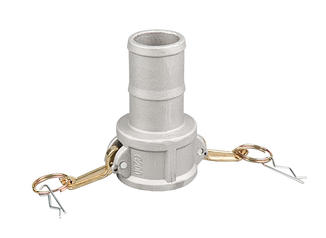
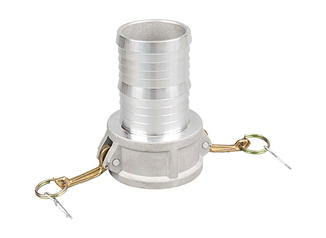
In the context of camlock couplings — also called cam and groove couplings — this distinction matters enormously. A camlock coupling consists of an adapter (the male half) and a coupler (the female half). The adapter inserts into the coupler, and two cam arms lock the connection in place without threads. However, the end connections of camlock adapters and couplers that attach to pipes, hoses, or tanks are almost always threaded — either male or female — and selecting the wrong thread type, size, or standard causes leaks, cross-threading, and equipment damage.
This article covers everything you need to know about male and female threads in practical fluid handling: how they work, how to measure them correctly, which thread standards apply to camlock coupling connections, common sealing methods, and mistakes to avoid on the job.
How Male and Female Threads Are Defined
Thread geometry is standardized across most of the world, but the naming convention is straightforward and consistent regardless of the standard you are using.
Male Threads (External Threads)
Male threads are helical ridges wrapped around the exterior of a cylindrical surface. You can see them and touch them directly. On a pipe fitting, the male thread is the portion that screws into a valve, coupling, or port. On a camlock adapter — for example, a Type A adapter — the threaded shank that connects to the pipe or hose has male threads on its outer surface. The thread profile, measured as the outside diameter and thread pitch, determines compatibility.
Female Threads (Internal Threads)
Female threads are cut into the bore of a fitting, port, or connector body. You cannot see the full thread profile without looking directly into the opening. Female threads receive the male component and grip it from the outside. On a camlock coupler, the end that attaches to a pipe or manifold frequently carries female threads that accept a nipple or male adapter. Thread size on female connections is measured as the inner diameter of the thread and must match the outer diameter of the corresponding male part.
Visual Identification at a Glance
| Feature | Male Thread | Female Thread |
|---|---|---|
| Location | Outside of part | Inside of part |
| Also called | External thread | Internal thread |
| Measurement | Outside diameter (OD) | Inside diameter (ID) |
| Common marking | MPT, MIP, MNPT, BSP(M) | FPT, FIP, FNPT, BSP(F) |
| Camlock role | Adapter shank connection | Coupler end connection |
Thread Standards That Apply to Camlock Coupling Connections
Camlock couplings themselves are standardized under MIL-C-27487 (the original US military specification) and its commercial successor, ANSI/ASME B70.2. The cam-and-groove interface is interchangeable between manufacturers. However, the threaded end connections — both male and female — follow separate pipe thread standards depending on the region and application.
NPT — National Pipe Taper Thread
NPT is the dominant standard in North America. Both male NPT (MNPT or MPT) and female NPT (FNPT or FPT) threads taper at 1° 47' (approximately 1 in 16) per side, which means the thread wedges tighter as it is turned. This taper provides a mechanical seal when combined with thread sealant tape (PTFE) or pipe dope. NPT threads are not inherently pressure-tight without a sealant because the thread form itself does not seal — only the taper wedging action does, and that requires a filler material in the thread voids.
A 2-inch NPT male thread, for example, has an actual outside diameter of approximately 2.347 inches, not 2 inches. This is a critical point: pipe thread sizes are nominal, not actual. A 2-inch camlock coupling with NPT threads does not have a 2-inch thread diameter anywhere on the part.
BSPP and BSPT — British Standard Pipe Threads
In Europe, Australia, and much of Asia, camlock couplings are supplied with BSP threads. There are two variants:
- BSPT (British Standard Pipe Taper) — similar in concept to NPT but uses a different thread angle (55° versus NPT's 60°) and a different taper rate. Not interchangeable with NPT.
- BSPP (British Standard Pipe Parallel) — also called G thread, these threads are cylindrical rather than tapered. Sealing is achieved through a bonded seal, O-ring, or flat-face gasket at the end face rather than thread wedging. BSPP male threads screw into BSPP female ports but require a sealing element.
Mixing NPT male threads with BSPP female threads — or vice versa — is a common and costly mistake. They appear similar and will partially engage, but they are not compatible. The thread pitch and angle differences mean they cannot seal, and forcing them can strip both parts.
Other Thread Standards You May Encounter
- JIS (Japanese Industrial Standard) — used in Japan and some Southeast Asian markets; similar to BSPP but with slight dimensional differences.
- DIN threads — German standard threads sometimes found on European industrial equipment.
- Metric threads (ISO) — used for some instrumentation and small fittings, less common in larger camlock coupling applications.
Camlock Coupling Types and Their Thread Configurations
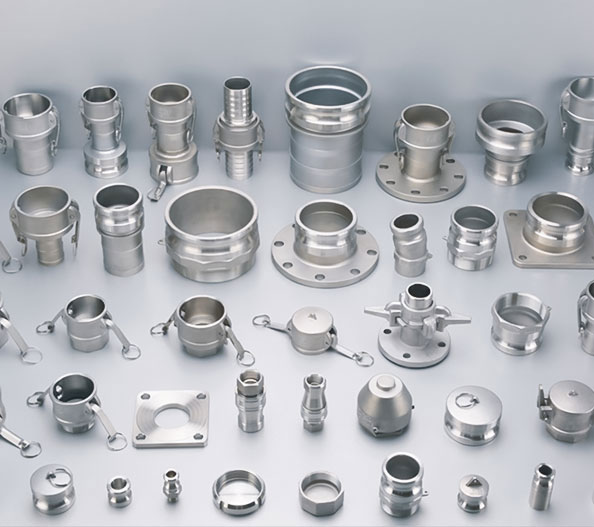
Understanding the letter designations of camlock coupling types is essential when ordering or specifying parts. Each type defines which end of the coupling is the cam-and-groove interface and which end is the threaded pipe connection — and whether that threaded end is male or female.
| Type | Cam End | Pipe/Hose End | Thread Gender |
|---|---|---|---|
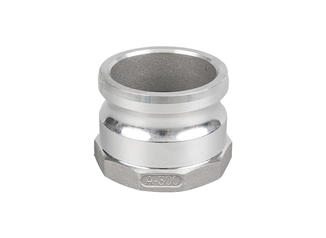
| Type A | Adapter (male cam) | Male thread (MPT) | Male |
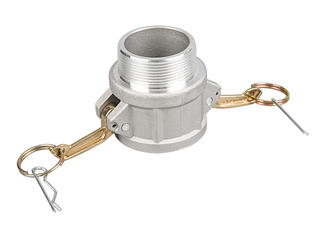
| Type B | Coupler (female cam) | Female thread (FPT) | Female |
| Type C | Adapter (male cam) | Female thread (FPT) | Female |
| Type D | Coupler (female cam) | Female thread (FPT) | Female |
| Type E | Adapter (male cam) | Male thread (MPT) | Male |
| Type F | Coupler (female cam) | Male thread (MPT) | Male |
Types A and E both have male threads on their pipe connection end — the key difference is that Type A has an adapter (male cam) end, while Type E is an adapter with a male thread end designed for hose attachment. Types B, C, and D all have female threads on the pipe end. Type F has a coupler (female cam) end with a male threaded pipe connection — useful when you need to thread directly into a female port on a tank or pump and still create a quick-connect camlock socket at the other end.
How to Measure Male and Female Threads Correctly
Measuring threads correctly is one of the most practical skills in pipe and fitting work. Errors here lead to wrong orders, return shipping costs, and project delays. The process differs slightly between male and female threads.
Measuring Male Thread Diameter
Use calipers to measure the outside diameter (OD) of the threaded portion at the crest — the peak — of the thread. Do not measure at the root (the valley between threads). For a 1-inch NPT male thread, the actual OD at the start of the thread is approximately 1.315 inches. Once you have this measurement, consult an NPT or BSP thread chart to identify the nominal pipe size (NPS) that corresponds to it.
Measuring Female Thread Diameter
Measuring female threads is more difficult because you are working inside the bore. Use the inside jaws of a caliper to measure the inner diameter at the crest of the internal thread. For a 1-inch female NPT thread, this measurement will be approximately 1.285 inches at the start of the thread. Again, this does not equal the nominal pipe size of 1 inch — it must be cross-referenced against a thread specification table.
Counting Threads Per Inch (TPI)
In addition to diameter, thread pitch is required for full identification. For NPT threads, TPI is standardized by size:
- 1/8 inch NPT: 27 TPI
- 1/4 inch NPT: 18 TPI
- 3/8 inch NPT: 18 TPI
- 1/2 inch NPT: 14 TPI
- 3/4 inch NPT: 14 TPI
- 1 inch NPT: 11.5 TPI
- 2 inch NPT: 11.5 TPI
- 3 inch NPT: 8 TPI
- 4 inch NPT: 8 TPI
Use a thread pitch gauge — a set of metal combs with known TPI values — to confirm the count. Place a comb tooth-side against the thread profile; the one that sits flush with zero gaps is the correct TPI.
Confirming Thread Standard: NPT vs BSP
If you are unsure whether a thread is NPT or BSP, use two reference gauges or known fittings. A 1-inch NPT male will not fully engage a 1-inch BSPP female coupler and vice versa — they will feel loose or cross-thread. Never force a connection that does not turn smoothly by hand for at least three full rotations. Forcing incompatible threads causes galling and permanent damage, particularly on aluminum camlock couplings and stainless fittings.
Sealing Methods for Male and Female Threaded Connections
The thread type determines how sealing is achieved. This is a critical operational point — an incorrectly sealed threaded camlock connection will leak under pressure regardless of how tightly it is torqued.
NPT Male and Female Thread Sealing
Because NPT threads are tapered, the male thread progressively wedges into the female thread as tightening occurs. The seal is formed in the thread flanks, but tiny spiral leak paths remain between thread crests and roots. PTFE tape (thread seal tape) or liquid pipe sealant must always be applied to the male thread before assembly. Apply PTFE tape in the direction of the thread, wrapping clockwise when looking at the male end — typically two to three wraps for pipe sizes up to 1 inch, and three to four wraps for larger sizes. Liquid sealant (pipe dope) is preferred for high-pressure or high-temperature applications above 250°F (121°C).
BSPP Male and Female Thread Sealing
Parallel BSP threads do not wedge and therefore cannot seal through thread engagement alone. Sealing options include:
- Bonded seal (Dowty washer) — a metal washer with an inner elastomeric ring that compresses between the male thread end face and the female thread bottom face. Reliable and reusable several times.
- O-ring face seal — an O-ring seated in a groove on the male fitting face seals against the flat face of the female port.
- PTFE tape on parallel threads — acceptable as a temporary solution or for low-pressure water applications, but not recommended for pressure systems above 150 PSI.
Sealing Within the Camlock Coupling Itself
It is worth separating the two sealing zones in a camlock coupling installation. The cam-and-groove connection seals via a groove gasket — typically EPDM, Buna-N (NBR), Viton, or silicone — seated inside the coupler body. This gasket seals the cam interface, not the threaded pipe end. The threaded end of the same camlock coupler or adapter must be sealed independently using the appropriate sealant method for that thread standard. Two distinct sealing points, two distinct solutions.

Material Choices for Threaded Camlock Couplings
The material of the camlock coupling body affects how the male and female threads perform over time, particularly regarding galling, corrosion, and temperature limits.
Aluminum
Aluminum camlock couplings with NPT threads are the most widely used in agriculture, chemical transfer, and food processing. Aluminum is lightweight and resists corrosion in many environments. However, aluminum male and female threads are vulnerable to galling — a form of adhesive wear where thread surfaces cold-weld during tightening. Never over-torque aluminum threaded connections. For a 2-inch aluminum NPT male into a female port, hand-tight plus two to three wrench turns is typically sufficient. Beyond that, the threads can seize permanently.
Stainless Steel (304 and 316)
Stainless steel camlock couplings are used in food and beverage, pharmaceutical, and marine applications. The male and female threads in stainless are more durable than aluminum but are equally prone to galling if assembled dry or overtightened. Anti-seize compound applied to the male thread before assembly prevents galling. 316 stainless provides superior chloride resistance compared to 304, making it the preferred choice for seawater, brine, or saline fluid transfer where thread corrosion is a concern.
Brass
Brass camlock couplings thread smoothly due to the material's natural lubricity. Brass male and female threads resist galling well and are compatible with water, compressed air, and petroleum products. However, brass is not recommended for acetone, ammonia, or acidic chemicals. Brass camlock couplings are heavier than aluminum but typically available at a lower cost than stainless.
Polypropylene and Nylon
Plastic camlock couplings are lightweight and chemically resistant to a wide range of acids and bases. The male and female threads in plastic parts require more care — thread tolerances are slightly looser than metal, and over-torquing cracks the body. Plastic camlock fittings are typically rated to lower working pressures, commonly 75 to 150 PSI at 70°F (21°C) versus 250 PSI or more for metal equivalents.
Common Thread Connection Mistakes in Camlock Coupling Installations
Even experienced technicians make threading errors when working with camlock coupling systems. These are the most frequent — and most avoidable — mistakes.
Cross-Threading Male into Female
Cross-threading occurs when a male thread is started at an angle to the female thread axis. The first thread engagement locks at a skewed position, and subsequent turns cut false threads rather than following the original helical path. Signs of cross-threading include resistance after only one or two turns, a gritty sensation, and the inability to hand-tighten smoothly. Prevention: always start by turning the male fitting counterclockwise until you feel the threads drop into alignment (a slight click), then turn clockwise to engage. This technique works on NPT, BSPP, and all other pipe thread forms.
Using NPT Male Threads in BSPP Female Ports
As noted earlier, NPT and BSPP threads appear dimensionally close but are not compatible. At smaller sizes (1/4 and 3/8 inch), the error is particularly common because hand-engagement feels similar initially. The result is a connection that may hold briefly at low pressure but will leak or fail under load. If you are ordering camlock coupling adapters for European equipment, confirm the thread standard before purchase. Many suppliers offer the same camlock coupling types in both NPT and BSP variants — specify explicitly.
Applying PTFE Tape to Female Threads
PTFE tape belongs on the male thread only. Applying it to the female thread results in bunching, improper seating, and poor sealing. Some users apply tape to both male and female threads thinking more tape equals better sealing — it does not. Excess tape can break off inside the line and contaminate the fluid system or block instrumentation ports.
Confusing Nominal Size with Actual Thread Diameter
A 3-inch NPT male thread has an actual OD of approximately 3.500 inches at the thread start. If a technician measures 3.5 inches on a male fitting and assumes it is a 3.5-inch thread, they will order the wrong female coupling. Always use a thread chart to convert measured OD to nominal pipe size before ordering. Camlock couplings are sized by nominal bore (1 inch, 1.5 inch, 2 inch, 3 inch, etc.) which corresponds to the nominal pipe thread size on the connection end.
Ignoring Torque Specifications
Over-tightening is the leading cause of cracked female bosses on camlock couplings, particularly in aluminum and plastic. Under-tightening causes leaks at the threaded end even when the cam-and-groove connection itself is secure. Torque specifications for NPT threaded connections in camlock coupling bodies vary by material and size, but a general guide for aluminum NPT threaded fittings is:
- 1/2 inch NPT: 20–30 ft-lb
- 1 inch NPT: 40–55 ft-lb
- 2 inch NPT: 90–110 ft-lb
- 3 inch NPT: 130–160 ft-lb
Always consult the coupling manufacturer's specific data sheet, as wall thickness and alloy composition affect these values.
How Thread Gender Determines Camlock Coupling Selection for Common Applications
Selecting the right camlock coupling type is fundamentally a thread-gender decision. Here is how that plays out in real-world applications.
Connecting a Camlock Coupling to a Tank with a Female NPT Port
If the tank outlet is a 2-inch female NPT port and you want to attach a camlock adapter so you can quick-connect a hose, you need a camlock Type A (male cam adapter) with a 2-inch male NPT thread on the pipe end. The male NPT thread on the Type A screws into the female NPT port on the tank. The cam end of the Type A then accepts any standard 2-inch female camlock coupler.
Connecting a Camlock Coupling to a Pump with a Male NPT Outlet
If the pump discharge port is a 2-inch male NPT nipple sticking out of the pump body, you need a camlock Type B (female cam coupler) with a 2-inch female NPT thread on the pipe end. The female NPT on the Type B threads onto the male NPT nipple on the pump. The cam end of the Type B accepts any standard 2-inch male camlock adapter.
Building a Hose-to-Hose Camlock Assembly
For flexible hose connections, the camlock fittings are typically swaged or crimped directly onto the hose ends — one end gets a camlock adapter (male cam), the other gets a camlock coupler (female cam). The hose shank end of these fittings has a barb or shank designed for hose attachment, not a threaded end, so the male vs female thread question applies to the pipe connection side, not the hose attachment side. However, if hose tail adapters are used, the thread gender question applies the same way as for pipe connections.
Dry-Disconnect and Pressurized Line Applications
In pressurized fluid transfer — fuel loading, chemical delivery — camlock couplings are combined with dust caps and dust plugs to seal open ends. The female camlock coupler accepts a dust plug (male cam end). The male camlock adapter accepts a dust cap (female cam end). Thread gender on the pipe connection end of these caps and plugs must still match the port or pipe they attach to, following the same male-into-female rule as all threaded connections.
Inspection and Maintenance of Threaded Camlock Coupling Connections
Threads degrade over time. In camlock coupling systems that are connected and disconnected frequently — as is the design intent — the cam-and-groove interface typically sees more wear than the threaded pipe connections, because the cam connection handles thousands of cycles while the threaded connection is often installed once and left in place. Despite this, threaded connections on camlock systems should be inspected on a defined schedule.
Signs of Thread Wear on Male Fittings
- Visible thread flattening or rounding at the crest
- Galling marks or material transfer visible on the thread surface
- Corrosion pitting that has removed thread material
- Inability to achieve a leak-free seal even with fresh PTFE tape
Signs of Thread Wear on Female Fittings
- Male fitting turns too easily — fewer than the expected number of thread engagements
- Visible cracks in the female boss or port wall, especially in aluminum
- Rust or oxidation inside the bore obscuring thread profile
- Persistent seepage at the thread joint after proper assembly and torquing
A damaged male or female thread cannot be reliably repaired in the field. Helicoil inserts can restore female threads in some materials, but for safety-critical fluid transfer applications, replacement of the camlock coupling fitting is the correct course of action. The cost of a replacement 2-inch aluminum camlock adapter is significantly lower than the cost of a chemical spill, fuel leak, or production shutdown caused by a failed connection.
Practical Guide to Specifying the Right Threaded Camlock Coupling
When ordering a camlock coupling for a specific application, the following information is required to select a part that will connect, seal, and perform reliably.
- Camlock coupling type (A, B, C, D, E, F) — determines which end is the cam-and-groove interface and which is the threaded pipe connection
- Nominal size — typically 1/2 inch through 6 inches for standard camlock couplings; confirm that the nominal size matches both the cam end and the thread end
- Thread standard — NPT, BSPP, BSPT, or other; specify explicitly, never assume
- Thread gender — male (MPT/MNPT) or female (FPT/FNPT); this is determined by the port or pipe you are connecting to
- Body material — aluminum, stainless 304, stainless 316, brass, polypropylene, or nylon; based on fluid compatibility and pressure/temperature requirements
- Gasket material — for the cam-and-groove interface; EPDM for water, NBR/Buna-N for petroleum products, Viton for aggressive chemicals, silicone for food-grade applications
- Working pressure and temperature — confirm the coupling rating meets or exceeds the system operating conditions with an appropriate safety factor
With these seven data points, any reputable camlock coupling supplier can identify the exact part number required. If even one item is missing — particularly thread gender or thread standard — the wrong part will arrive and delays follow.
Summary of Key Points
Male threads are external, female threads are internal — and this straightforward distinction drives every threaded connection decision in camlock coupling systems. The camlock coupling itself connects without threads, but every pipe or hose connection on the threaded end of a camlock adapter or coupler depends on correct thread type, gender, standard, and sealing method.
The most critical rules to apply on every installation:
- Always confirm thread standard (NPT vs BSP) before connecting — they are not interchangeable
- Measure thread OD (male) or ID (female) and convert to nominal size using a thread chart
- Apply PTFE tape only to the male thread, never to the female
- Do not over-torque — particularly aluminum and plastic camlock coupling bodies
- Seal the cam-and-groove joint and the threaded pipe connection independently — they are two separate sealing points
- Replace — do not patch — damaged threaded camlock fitting components in critical fluid systems
Getting the thread gender right is not a minor detail. In a 3-inch camlock coupling on a fuel transfer system operating at 150 PSI, a mismatched or improperly sealed threaded connection is a safety hazard. In a food-grade dairy line, it is a contamination risk. In a chemical processing plant, it is a regulatory violation. Male vs female thread selection, made correctly from the start, eliminates these risks entirely.