 英语
英语 俄语
俄语
Content
There's a wide variety of hose clamps on the market, but the most common and practical ones you'll encounter are these "three main types." Let's set aside the specialized industrial types and focus on these three most common hose clamps, and see what their characteristics are.
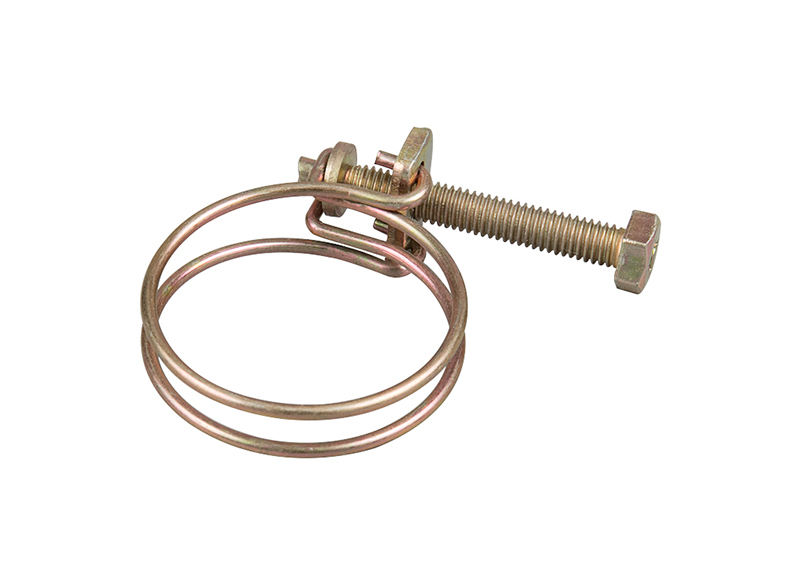
1. Worm Gear Clamps – The most common "all-rounder"
This is probably the most familiar type. The structure is very simple: a stainless steel band with slots or indentations, and a "worm gear" head with a screw.
How to identify it: Its characteristic feature is the screw head, which you can tighten with a flathead screwdriver, Phillips head screwdriver, or socket wrench.
How to use it: Turning the screw clockwise causes the band to be pulled in like a belt, making the circle smaller and tightening the hose.
Advantages: It has the highest tolerance for error. Because it's adjustable, it's okay if you buy one that's a little too big; just tighten it a few more turns. It can also be repeatedly disassembled and reused. For repairing water pipes or replacing gas pipes at home, this type of hose clamp is the first choice.
Caution: Don't overtighten it. Sometimes, too much force can strip the threads on the band or damage the surface of the hose, leading to leaks.
2. Spring Clamps – The "automatic transmission" of car parts
This type of clamp looks like a steel ring with two outward-facing "handles." You often see these black or shiny silver rings under the hood of a car.
How to identify it: There are no screws; it relies entirely on the elasticity of the steel to clamp. In its natural state, it's smaller than the pipe.
How to use it: During installation, you need to use pliers or special clamps to squeeze the two "handles," making the ring larger. After fitting it onto the pipe, release the pliers, and it will automatically clamp tightly.
Advantages: Its greatest advantage is its ability to handle "thermal expansion and contraction." For example, in a car's radiator hose system, the hose expands when hot and contracts when cold. Screw clamps are rigid; the hose might loosen if it shrinks. However, these spring hose clamps maintain a constant tension. They contract when the hose shrinks and expand when the hose expands, always maintaining a seal without requiring re-tightening.
Note: The specifications must be a perfect fit. Unlike screw-type clamps that can be adjusted, even a slight difference in size means it either won't fit or won't clamp tightly enough.
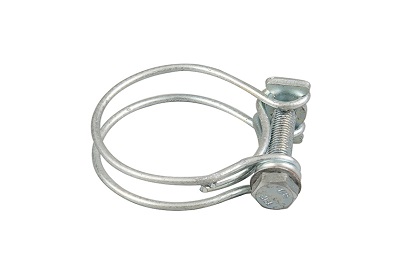
3. Ear Clamps – The one-time "no-nonsense" option
This is the type we just discussed. It has a very compact structure, looks clean, and has no unnecessary protrusions.
How to identify: A metal ring with one or two raised square "ears" (single-ear is most common).
How to use: After positioning, use special pliers to flatten the "ear." Flattening the ear reduces the diameter of the ring, locking the hose in place.
Advantages: Excellent sealing performance, and because there is no screw structure, it won't loosen due to vibration. For applications where you don't plan to move the hose again, or in tight spaces where a screwdriver is difficult to use, these hose clamps are the best choice.
Note: There's no going back. This type is single-use; once clamped, removing it requires forcibly cutting and destroying it with pliers, making it impossible to reuse. Therefore, be sure to confirm the position before installation.