 英语
英语 俄语
俄语
Content
- 1 What Is A Bushing Fitting
- 2 The Anatomy Of A Bushing Fitting
- 3 Common Bushing Fitting Styles
- 4 Materials Used For Bushing Fittings
- 5 How Bushing Fittings Are Manufactured
- 6 Standards Bodies Behind Bushing Fitting Sizing
- 7 Thread Standards And Compatibility
- 8 Bushing Fittings Versus Camlock Fitting Connections
- 9 Bushing Fittings Compared To Other Adapter Fittings
- 10 Common Mistakes When Selecting Or Installing Bushings
- 11 Industry-Specific Use Cases For Bushing Fittings
- 12 Temperature And Pressure Considerations
- 13 Inspecting And Maintaining Bushing Connections
- 14 Buying Guide: What To Check Before Ordering
- 15 Where Bushing Fittings Are Used
- 16 Installing A Bushing Fitting Correctly
- 17 Choosing The Right Bushing Size
- 18 Frequently Asked Questions
- 18.1 What is the difference between a bushing and a reducer?
- 18.2 Can a bushing fitting handle high pressure applications?
- 18.3 Why does my bushing leak even after using thread sealant?
- 18.4 Is a flush bushing weaker than a hex bushing?
- 18.5 Can I connect a camlock fitting directly to a tank without a bushing?
- 18.6 Do bushing fittings come in metric sizes?
- 18.7 How many bushings can be stacked together?
- 18.8 What is the difference between a hex bushing and a flush bushing in terms of installation?
- 18.9 Can a bushing fitting be used on a gas line?
- 18.10 Why is the larger size always listed first when describing a bushing?
- 18.11 Is it safe to reuse a bushing after removing it from a fitting?
- 18.12 What causes a bushing to seize and become difficult to remove?
- 18.13 Do bushing fittings affect flow rate?
What Is A Bushing Fitting
A bushing fitting is a small adapter fitting used to join two pipe or hose connections of different sizes, typically by stepping down a larger female thread to a smaller male thread (or the reverse, depending on the bushing style). It does not change the direction of flow and it does not add a branch; its only job is to bridge a size mismatch between two threaded components so they can be connected without replacing an entire fitting run.
In practical terms, a bushing looks like a short hexagonal or round-bodied plug with external threads on one end (or both ends, in the case of a reducing nipple-style bushing) and internal threads sized to accept the next fitting in the line. Plumbers, machine builders, and industrial maintenance technicians reach for a bushing whenever a port, valve, or tank opening is larger than the pipe or hose they need to attach to it.
The Anatomy Of A Bushing Fitting
Every bushing fitting has two defining dimensions: the larger thread size, usually called the body size or female size, and the smaller thread size, called the reduced size or male size. Manufacturers list both numbers together, such as a 1 inch by 1/2 inch bushing, with the larger figure always stated first.
- Hex body: Most bushings use a hexagonal outer profile so a wrench can grip and tighten the fitting without slipping, since the threads themselves cannot be gripped directly once seated.
- Female threads: Located on the larger end, these threads accept a male-threaded pipe, valve, or tank boss.
- Male threads: Located on the smaller end (or recessed inside a face bushing), these mate into the next fitting, hose barb, or gauge.
- Shoulder or flange: A raised ring between the two threaded sections that gives the wrench a flat surface to bear against during installation.
The internal bore of a bushing steps down abruptly rather than tapering gradually, which is one of the reasons bushings are reserved for short connection points rather than long runs where a smoother transition would reduce turbulence.
Common Bushing Fitting Styles
| Style | Smaller Thread Location | Typical Use |
|---|---|---|
| Hex reducing bushing | Recessed, sits inside the larger thread | Tank ports, pump housings, valve bodies |
| Flush bushing | Flush with the outer face, no shoulder | Tight clearance areas where a hex shoulder would interfere |
| Face bushing | Set into the open face of the larger thread | Applications needing a shorter overall length |
| Double reducing bushing | Different reductions on each end | Stepping down through two or more size changes in one fitting |
Hex reducing bushings remain the most commonly stocked style because the protruding shoulder gives installers a reliable wrench grip even in awkward, low-visibility positions such as the underside of a tank or behind a pump bracket.
Materials Used For Bushing Fittings
Material choice changes how a bushing performs under pressure, temperature, and chemical exposure. The same bushing geometry is typically offered across several material families so it can be matched to the rest of the piping system.
Brass
Resists corrosion in water and mild chemical service, machines cleanly, and is a frequent choice where dezincification is not a concern.
Stainless Steel
Handles higher temperatures and aggressive media, common in food, chemical, and marine settings where brass would degrade faster.
Carbon Steel
Favored for higher pressure ratings in industrial piping where corrosion resistance is secondary to mechanical strength.
PVC / CPVC
Lightweight and corrosion-proof for low-pressure water and drainage lines, though limited in temperature range compared to metal options.
Nylon / Polypropylene
Used where weight reduction and chemical resistance matter more than high pressure capacity, often in pneumatic or low-pressure fluid lines.
Mixing dissimilar metals, for example threading a brass bushing into a galvanized steel port, can accelerate galvanic corrosion over time, so matching material families is generally the safer long-term choice for wet or outdoor installations.
How Bushing Fittings Are Manufactured
The manufacturing method behind a bushing fitting has a direct effect on its strength, dimensional consistency, and price point, which is why two bushings of the same nominal size and material can still behave differently under load.
Forged Bushings
Forged bushings start as a solid metal blank that is pressed into shape under high force while heated, which aligns the metal's internal grain structure along the contours of the part. This grain alignment is what gives forged bushings their reputation for handling pressure spikes and vibration better than machined or cast equivalents, which is why forged construction is common in high-pressure hydraulic and steam applications.
Machined (Bar Stock) Bushings
Machined bushings are cut directly from round or hex bar stock on a lathe or CNC machine. This method produces very tight dimensional tolerances and a clean thread finish, making bar stock bushings a frequent choice for instrumentation and gauge connections where a precise, leak-free fit matters more than raw pressure capacity.
Cast Bushings
Cast bushings are formed by pouring molten metal into a mold shaped like the finished part. Casting is the most economical method for high-volume production and works well for lower-pressure plumbing and general-purpose applications, though cast parts can contain microscopic porosity that, in rare cases, becomes a leak path under sustained high pressure.
Injection-Molded Plastic Bushings
Plastic bushings made from PVC, CPVC, nylon, or polypropylene are produced by injection molding, where molten plastic is forced into a precision mold under pressure. This process allows for consistent wall thickness and thread geometry at a much lower unit cost than metal, which is why plastic bushings dominate residential plumbing and low-pressure irrigation work.
Standards Bodies Behind Bushing Fitting Sizing
Bushing fittings are not designed in isolation; their dimensions, tolerances, and pressure ratings trace back to published standards maintained by recognized standards organizations, which is part of why a bushing bought from one supplier fits correctly with a port made by an entirely different manufacturer.
| Organization | Region | Relevant Standard |
|---|---|---|
| ASME / ANSI | United States | ASME B1.20.1 (NPT thread form) |
| ISO | International | ISO 7-1 (parallel and taper pipe threads) |
| BSI | United Kingdom / Commonwealth | BS 21 (BSP thread form) |
| DIN | Germany / Europe | DIN 2999 (pipe thread tolerances) |
Knowing which standard governs a given installation matters most when sourcing replacement parts internationally, since a bushing manufactured to one regional standard may carry the same nominal size label as one built to another while differing slightly in thread pitch or taper angle.
Thread Standards And Compatibility
Thread compatibility is the single most common point of confusion with bushing fittings, because two threads can look similar while following entirely different standards.
- NPT (National Pipe Taper): The most widely used standard in North America, relying on a tapered thread that wedges tight as it is tightened, sealed with thread compound or tape.
- NPSM (National Pipe Straight Mechanical): A straight, non-tapered thread used where a free-spinning mechanical joint is needed rather than a pressure seal at the threads themselves.
- BSP (British Standard Pipe): Common outside North America, available in both tapered (BSPT) and parallel (BSPP) variants that are not interchangeable with NPT despite looking similar at a glance.
Forcing an NPT bushing into a BSP port, or vice versa, may thread partially before binding or leaking, since the angle and pitch of the two standards differ even when nominal sizes match. Always confirm the thread standard on both the existing port and the new bushing before ordering, particularly on imported equipment where BSP threads are more likely to appear.
Bushing Fittings Versus Camlock Fitting Connections
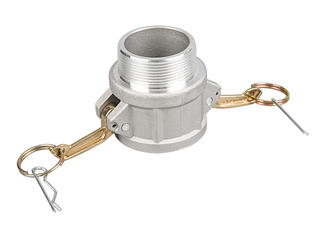
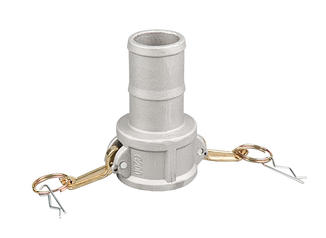
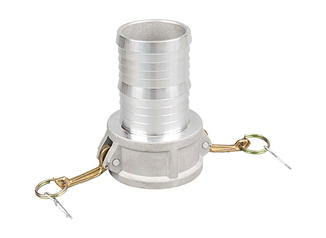
A camlock fitting solves a different problem than a bushing. Where a bushing permanently reduces a threaded port to a smaller threaded size, a camlock fitting is a quick-connect coupling designed for fast, tool-free attachment and disconnection of hoses, most often in transfer applications like fuel delivery, agricultural spraying, and tanker offloading.
The two fitting types frequently appear together rather than in competition. A common configuration uses a bushing to step a large tank port down to a standard pipe thread, and then a camlock adapter threads onto that reduced size so the hose end can be locked and released by hand using the camlock's cam arms. In this setup, the bushing handles the size transition while the camlock fitting handles rapid connection and disconnection.
| Aspect | Bushing Fitting | Camlock Fitting |
|---|---|---|
| Primary purpose | Reduce or adapt thread size | Fast hose connect and disconnect |
| Tools required | Wrench, thread sealant | None for routine connect/disconnect |
| Disconnect frequency | Rarely disconnected once installed | Designed for repeated disconnection |
| Typical setting | Fixed plumbing, tanks, pump ports | Tanker trucks, IBC totes, transfer hoses |
Bushing Fittings Compared To Other Adapter Fittings
Bushings are one of several adapter-style fittings used to resolve size or connection mismatches, and choosing the wrong one for the job is a frequent source of installation headaches.
Bushing vs. Reducing Coupling
A reducing coupling joins two pipe ends in a straight line, both typically the same gender style (slip or socket), while a bushing always pairs one male thread with one female thread and is meant to seat directly inside a port rather than between two pipe lengths.
Bushing vs. Adapter Fitting
A general adapter fitting changes connection type, for example threaded to push-to-connect, without necessarily changing size, whereas a bushing's defining job is specifically a size change within the same general thread family.
Bushing vs. Reducing Tee or Elbow
Reducing tees and elbows combine a size change with a directional or branching change in one part, while a bushing never alters flow direction and never adds a branch, making it the simpler, single-purpose option when direction does not need to change.
Bushing vs. Nipple
A nipple is a short length of pipe threaded on both ends, usually the same size on each end, used to extend a connection point outward, while a bushing's two ends are different sizes and it is not meant to add length so much as to step down diameter.
Common Mistakes When Selecting Or Installing Bushings
Field experience across plumbing, irrigation, and industrial maintenance points to a recurring set of errors that account for the majority of bushing-related callbacks and failures.
| Mistake | Likely Consequence |
|---|---|
| Mixing NPT and BSP threads without checking | Partial thread engagement, persistent leaking |
| Overtightening a plastic bushing into a metal port | Cracked fitting body, sudden failure under pressure |
| Skipping thread sealant on a tapered thread joint | Slow seepage even though threads appear tight |
| Pairing dissimilar metals in a wet environment | Accelerated galvanic corrosion at the joint |
| Choosing a bushing rated below system pressure | Fitting becomes the weakest point in the line |
| Stacking three or more bushings in series | Multiplied leak points, reduced mechanical strength |
Industry-Specific Use Cases For Bushing Fittings
Agricultural And Irrigation Systems
Irrigation mainlines are frequently built from larger-diameter PVC, then reduced down through a series of bushings to feed smaller drip lines, sprinkler risers, or filter housings. In this setting, plastic bushings dominate because of their corrosion resistance against fertilizers and water treatment chemicals.
Fuel And Chemical Transfer
Tanker trucks, drums, and storage tanks used for fuel and chemical transfer commonly use a bushing to step the tank's large bung opening down to a size compatible with a camlock fitting, allowing a transfer hose to be connected and disconnected quickly without compromising the integrity of the tank opening itself.
HVAC And Refrigeration
Compressor housings and refrigerant lines often arrive with larger factory-standard ports than the field tubing requires, so a bushing rated for the refrigerant type and pressure class bridges that gap during installation or retrofit work.
Marine And Offshore Equipment
Saltwater exposure makes corrosion resistance the priority in marine settings, which is why stainless steel and bronze bushings are favored over standard brass or carbon steel on boats, docks, and offshore platforms.
Food And Beverage Processing
Sanitary processing lines use stainless steel bushings almost exclusively, both for corrosion resistance and because stainless surfaces are easier to clean to the standards required in food-contact environments.
Temperature And Pressure Considerations
Every bushing material has an operating envelope defined by both maximum pressure and maximum temperature, and the two figures are not independent; pressure ratings typically fall as temperature rises because most materials lose mechanical strength as they heat up.
- Brass: Performs reliably up to roughly 400°F in many pressure classes, though specific ratings vary by wall thickness and manufacturer.
- Stainless steel: Maintains strength at higher temperatures than brass and is the typical choice when service temperature exceeds what brass or plastic can handle.
- PVC: Generally limited to around 140°F before softening becomes a concern, making it unsuitable for hot water or steam lines.
- CPVC: Tolerates higher temperatures than standard PVC, often suitable for hot water distribution up to roughly 200°F.
Always check a manufacturer's pressure-temperature rating chart for the exact bushing being used rather than relying on general material guidelines, since wall thickness, thread engagement length, and manufacturing method all shift the real-world rating up or down from these typical ranges.
Inspecting And Maintaining Bushing Connections
Bushings are generally considered permanent or semi-permanent fittings, but periodic inspection still catches problems before they become failures.
- Visually check for white or green crusting around brass and copper bushings, which indicates a slow weeping leak even if no active dripping is visible.
- Look for hairline cracks radiating from the hex shoulder on plastic bushings, especially in installations exposed to UV light or freeze-thaw cycling.
- Check for rust staining or pitting on carbon steel bushings used outdoors or in humid environments, which signals the protective coating has worn through.
- Re-torque connections after the first thermal cycle on new installations, since initial heating and cooling can slightly relax thread engagement.
- Replace rather than re-seal a bushing that has been removed and reinstalled more than once, since repeated thread engagement gradually degrades the seal surface.
Where Bushing Fittings Are Used
Tank And Vessel Ports
Storage tanks, totes, and pressure vessels are often manufactured with a single large standard port that gets reduced down to whatever pipe size the surrounding system actually uses.
Pump And Motor Housings
Pump suction and discharge ports are sized for flow capacity, which is frequently larger than the pipe diameter needed at the point of use, making a bushing the simplest fix.
Gauge And Sensor Installation
Pressure gauges, thermometers, and sensors usually have small thread sizes, so a bushing steps a larger process connection down to accept the instrument.
Retrofit And Repair Work
When replacing an old fitting with a newer part that uses a different size standard, a bushing avoids re-machining or replacing the surrounding pipework entirely.
Installing A Bushing Fitting Correctly
Most installation problems with bushings trace back to sealing technique rather than the fitting itself. The following sequence reflects standard practice for tapered thread bushings.
- Inspect both thread sets for burrs, debris, or damage before assembly, since even a small nick can create a leak path.
- Apply thread sealant or PTFE tape to the male threads only, wrapping in the direction of thread engagement so it does not unwind during installation.
- Hand-tighten the bushing into the port until resistance is felt, confirming the threads are engaging straight rather than cross-threaded.
- Use a wrench on the hex body to finish tightening, typically one to two additional turns past hand-tight for tapered threads, without overtightening to the point of cracking a cast or plastic port.
- Pressure test the connection before placing the system into full service, watching for slow drips at the thread line rather than only checking for an obvious spray.
Overtightening is a more frequent cause of failure than undertightening, particularly with brass bushings threaded into cast iron or plastic housings, since the softer or more brittle base material can crack under excess torque well before the thread seal would have failed on its own.
Choosing The Right Bushing Size
Sizing a bushing correctly means identifying three things: the existing port size, the desired reduced size, and the thread standard on both ends.
- Measure, don't guess: Thread size is based on nominal pipe size, not the actual outer diameter, so a caliper reading on the outside of a fitting will not directly match a labeled size without a reference chart.
- Confirm gender: Note whether the existing port is male or female threaded, since the bushing needs the opposite gender on that end to mate correctly.
- Check maximum reduction: Extremely large jumps in size, such as reducing a 3 inch port down to 1/4 inch in a single bushing, are sometimes unavailable and may require two bushings stepped in sequence.
- Match pressure rating: A bushing rated for a lower pressure than the rest of the system becomes the weak point in that line, regardless of how well it is installed.

Frequently Asked Questions
What is the difference between a bushing and a reducer?
A reducing bushing has two threaded ends of different sizes designed to fit inside a port, while a reducer (sometimes called a reducing coupling) typically joins two lengths of pipe in a straight run and may use slip, weld, or socket connections rather than two separate male and female threads in one short body.
Can a bushing fitting handle high pressure applications?
Many bushings are rated for the same pressure class as the surrounding pipe schedule, but the rating depends entirely on material and thread engagement length, so checking the manufacturer's pressure rating for the specific size and material is necessary before use in high-pressure service.
Why does my bushing leak even after using thread sealant?
The most common causes are cross-threading during installation, insufficient thread engagement from undertightening, or a mismatch between thread standards such as NPT and BSP that allows partial engagement without a true seal.
Is a flush bushing weaker than a hex bushing?
A flush bushing is not inherently weaker; it simply lacks the protruding shoulder, which means it requires a specialized internal wrench or tool for installation rather than a standard external hex wrench.
Can I connect a camlock fitting directly to a tank without a bushing?
Only if the tank's port thread size already matches a standard camlock adapter size; if the port is larger or smaller than the available camlock sizes, a bushing is needed first to bring the connection to a compatible size.
Do bushing fittings come in metric sizes?
Yes, metric bushings are produced for use with metric pipe thread standards such as BSP or DIN, and these are not directly interchangeable with imperial NPT sizes despite occasional visual similarity.
How many bushings can be stacked together?
While two bushings can technically be threaded together to achieve a larger size reduction, each additional joint introduces another potential leak point and reduces overall mechanical strength, so a single properly sized bushing is preferred whenever one is available.
What is the difference between a hex bushing and a flush bushing in terms of installation?
A hex bushing is installed with a standard external wrench gripping the protruding hex shoulder, while a flush bushing has no external shoulder and instead requires a special internal spanner or bushing wrench that engages slots or a hex recess inside the larger end.
Can a bushing fitting be used on a gas line?
Bushings rated and labeled for gas service exist and are used in gas piping, but the rating, material, and sealant must specifically be approved for gas applications, since standard plumbing sealants and some plastic materials are not appropriate for fuel gas service.
Why is the larger size always listed first when describing a bushing?
Listing the larger size first follows the convention of naming the female (body) thread before the male (reduced) thread, which mirrors how the part threads into an existing port before accepting the smaller connection.
Is it safe to reuse a bushing after removing it from a fitting?
A bushing can often be reused once if the threads are undamaged and fresh sealant is applied, but threads that show wear, galling, or deformation from the first installation should be replaced rather than reused to avoid a compromised seal.
What causes a bushing to seize and become difficult to remove?
Seizing is usually caused by corrosion between dissimilar metals, thread sealant that has fully cured and bonded over time, or simple overtightening during the original installation, and penetrating oil along with controlled heat is the typical first step before attempting removal.
Do bushing fittings affect flow rate?
Stepping down to a smaller bore does reduce the cross-sectional area available for flow, which can increase velocity and pressure drop at that point, so a bushing reducing too aggressively for the application can become a flow-restricting bottleneck even though it is not designed as a flow control device.