 英语
英语 俄语
俄语
Content
- 1 What Is a Camlock Coupling?
- 2 The Seven Standard Camlock Coupling Types Explained
- 3 How a Camlock Coupling Actually Works
- 4 Camlock Coupling Materials and When to Use Each
- 5 Gasket Materials in Camlock Couplings — Why They Matter as Much as the Body
- 6 Industry Applications of Camlock Couplings
- 7 Camlock Coupling Size Selection — Getting the Flow Rate Right
- 8 Camlock Coupling vs Other Quick-Connect Fitting Types
- 9 Common Camlock Coupling Problems and How to Fix Them
- 10 Inspection, Maintenance, and Safety Practices for Camlock Couplings
- 11 How to Read a Camlock Coupling Part Number
- 12 Frequently Misunderstood Facts About Camlock Couplings
What Is a Camlock Coupling?
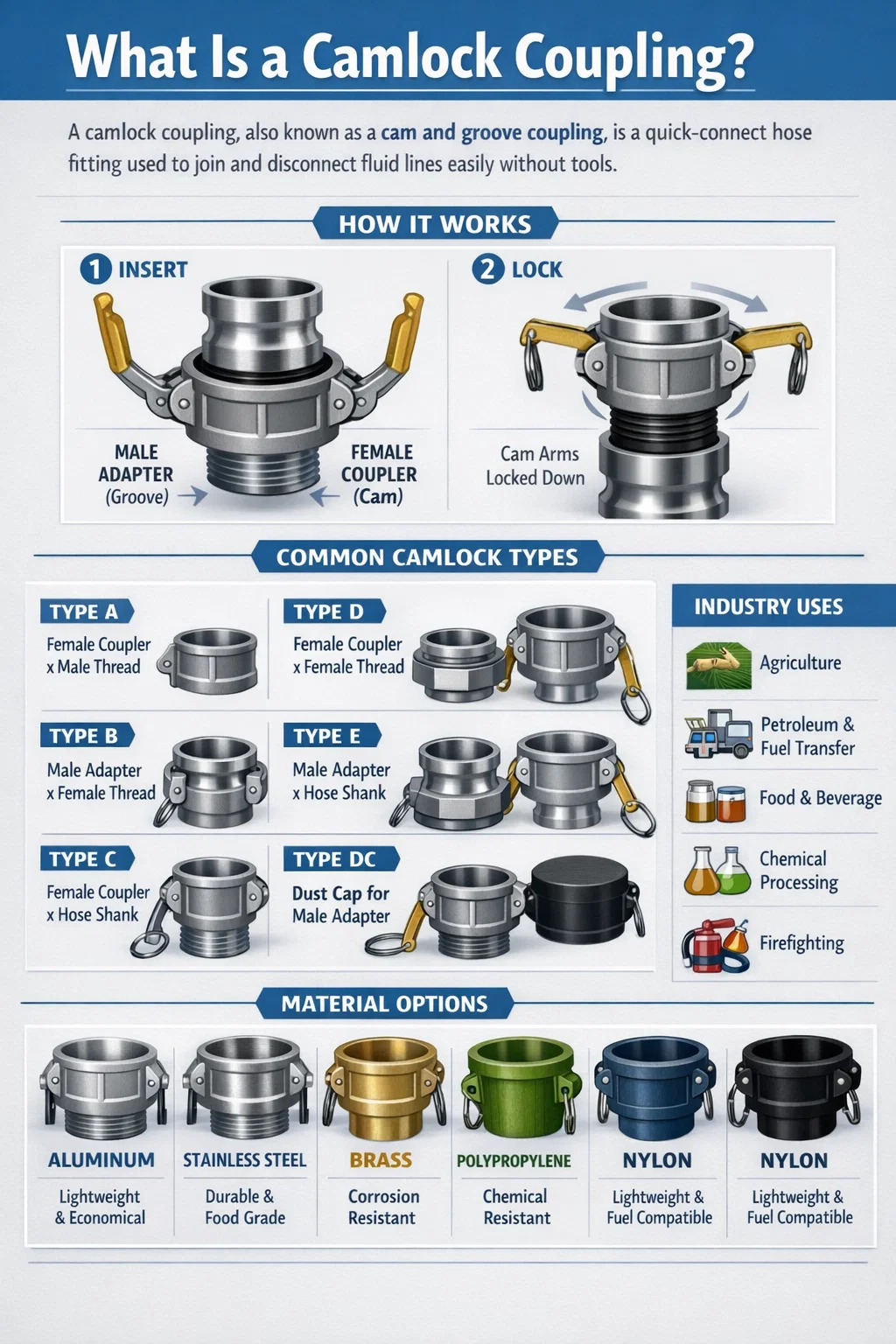
A camlock coupling — also called a cam and groove coupling — is a type of hose fitting that allows two fluid-transfer lines to be connected or disconnected quickly without tools. The design relies on a male adapter (the "groove" side) that inserts into a female coupler (the "cam" side), after which two lever arms are pressed down to lock the connection in place. The entire process typically takes under five seconds, which is why camlock couplings are the preferred choice in agriculture, petroleum transfer, chemical processing, food and beverage production, and fire suppression systems worldwide.
The camlock coupling standard is governed by MIL-C-27487, a U.S. military specification later adopted as ANSI/ASME B1.20.1 and the globally recognized ISO 9974 framework. Because manufacturers worldwide follow the same dimensional standard, a camlock adapter from one brand mates correctly with a coupler from another, making the system highly interoperable.
Sizes range from ½ inch up to 6 inches in standard production, with specialty manufacturers producing sizes up to 12 inches for industrial bulk transfer. Pressure ratings vary significantly by material and size — aluminum camlocks in ½-inch are often rated up to 250 PSI, while a 4-inch stainless steel version may be rated at 75 PSI due to the increased force on the cam arms at larger diameters.
The Seven Standard Camlock Coupling Types Explained
Every camlock coupling falls into one of seven standardized configurations, each identified by a letter. Understanding these types is essential before purchasing because mixing up the type leads to connections that simply will not work.
| Type | Description | Common Use |
|---|---|---|
| Type A | Female coupler × Male MPT (external thread) | Connecting to threaded pipe outlets |
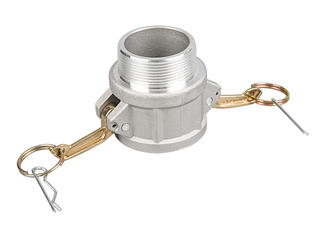
| Type B | Male adapter × Female FPT (internal thread) | Attaching to female-threaded pipe ends |
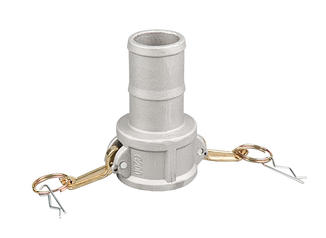
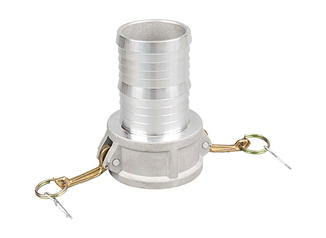
| Type C | Female coupler × Hose shank (barbed end) | Hose-to-camlock connections |
| Type D | Male adapter × Hose shank (barbed end) | Hose tail male side connections |
| Type E | Male adapter × Male MPT (external thread) | Male-to-male threaded transitions |
| Type F | Female coupler × Female FPT (internal thread) | Female-to-female threaded transitions |
| Type DC (Dust Cap) | Protective cap for male adapters | Storage, contamination prevention |
In practice, the most commonly ordered types are Type C and Type D for hose-to-hose assemblies, and Type A and Type B for connections to fixed pipe systems. Dust caps and dust plugs — sometimes called Type DC and DP — are also high-volume items because every open port on a camlock system should be capped during storage to prevent contamination and gasket degradation.
How a Camlock Coupling Actually Works
The mechanics of a camlock coupling are straightforward, but understanding them helps operators use and maintain the fittings correctly.
The Connection Process
- Lift both cam lever arms on the female coupler to the open (raised) position.
- Insert the male adapter groove section fully into the female coupler body.
- Press both cam arms down simultaneously until they click or sit flush against the coupler body.
- Give a gentle tug on the connection to verify the cam lobes have engaged the grooves on the male adapter.
When the cam arms are pressed down, the elliptical cam lobes rotate inward and downward into the precision-machined grooves on the male adapter. This action compresses the internal gasket (typically EPDM, Buna-N, or PTFE) against the seating face of the male adapter, creating a leak-resistant seal. The geometry of the cam lobe means that internal fluid pressure actually increases the sealing force — the higher the pressure, the tighter the gasket is pressed.
Disconnection
To disconnect, the operator simply lifts both cam arms simultaneously, which rotates the lobes out of the grooves and releases the male adapter. Never disconnect a camlock coupling while the system is under pressure. Even a small residual pressure can cause the male adapter to eject forcefully when the arms are lifted. Proper procedure requires depressurizing and draining the line before disconnection.
Camlock Coupling Materials and When to Use Each
Material selection is the most critical decision when specifying a camlock coupling. The wrong material can result in chemical attack, corrosion, contamination of the transferred fluid, or premature mechanical failure. Below is a practical breakdown of the five most common materials.
Aluminum Camlock Couplings
Aluminum is the most widely used camlock material globally, primarily because of its excellent weight-to-strength ratio and low cost. A 2-inch aluminum camlock weighs roughly 40% less than an equivalent stainless steel fitting. It handles water, petroleum products, diesel fuel, fertilizer solutions, and most mild chemicals well. However, aluminum reacts aggressively with strong acids and alkalis, and it is not suitable for potable water systems in many jurisdictions without specific food-grade anodizing. Common pressure ratings: 75–150 PSI depending on size.
Stainless Steel Camlock Couplings
316 stainless steel camlocks are the standard choice for food-grade, pharmaceutical, dairy, wine, and marine applications. The material resists a broad spectrum of chemicals, is easy to clean and sterilize, and does not contaminate transferred fluids. It is significantly heavier and more expensive than aluminum — typically 3–4× the cost — but its longevity in corrosive environments makes it cost-effective over time. 304 stainless is also available at slightly lower cost but with reduced chloride corrosion resistance.
Brass Camlock Couplings
Brass is a traditional choice for water transfer, compressed air, and low-pressure general industrial applications. It machines well and offers good corrosion resistance in water systems. Brass should not be used with ammonia-based fluids (fertilizers) as ammonia causes stress corrosion cracking. It is also not permitted in certain potable water applications due to lead content in some brass alloys — always verify compliance with NSF/ANSI 61 for drinking water use.
Polypropylene (PP) Camlock Couplings
Polypropylene camlocks are the go-to option for highly corrosive chemicals — acids, alkalis, bleach, and many solvents that would attack metal fittings. They are lightweight and inexpensive but have significant limitations: maximum operating temperature of approximately 150°F (65°C), lower pressure ratings (typically 50–75 PSI), and susceptibility to UV degradation over time. They are common in chemical dosing, water treatment, and temporary irrigation setups.
Nylon Camlock Couplings
Nylon offers slightly better mechanical strength than polypropylene and handles a somewhat wider temperature range. It is frequently used in fuel transfer (gasoline, diesel) and water applications where a lightweight, non-sparking fitting is required. Like PP, nylon is not suitable for concentrated acids or oxidizing chemicals, and pressure ratings drop significantly at elevated temperatures.
Gasket Materials in Camlock Couplings — Why They Matter as Much as the Body
The gasket inside the female coupler is the actual sealing element. Even a perfectly made camlock coupling will leak if the gasket material is incompatible with the fluid being transferred. There are four main gasket materials used in camlocks:
- Buna-N (Nitrile, NBR): The standard gasket for petroleum products, oils, fuels, and water. Temperature range approximately -40°F to 250°F (-40°C to 121°C). Not suitable for ketones, esters, or brake fluid.
- EPDM (Ethylene Propylene): Preferred for hot water, steam, mild acids, alkalis, and many chemicals. Excellent ozone and UV resistance. Temperature range up to 300°F (149°C). Not compatible with petroleum-based fluids — the rubber swells and degrades rapidly.
- PTFE (Teflon): Near-universal chemical resistance. Used in aggressive chemical transfer, pharmaceutical applications, and high-purity fluid handling. Temperature range -100°F to 450°F (-73°C to 232°C). More expensive and less resilient mechanically — PTFE gaskets are more easily damaged by overtightening or misalignment.
- Viton (FKM): Excellent resistance to aromatic hydrocarbons, chlorinated solvents, and fuels. Temperature range up to 400°F (204°C). Significantly more expensive than Buna-N but essential in aviation fuel and high-temperature chemical service.
Most suppliers ship camlock couplings with Buna-N gaskets as the default. If your application involves hot water, steam, or chemicals, always specify the required gasket material at the time of ordering rather than assuming a replacement can be easily sourced later.
Industry Applications of Camlock Couplings
Camlock couplings appear in nearly every industry that involves fluid movement. Below are the sectors where they are most heavily used, along with the specific reasons for their adoption.
Agriculture and Irrigation
In large-scale agriculture, irrigation systems and fertilizer transfer rigs are moved and reconfigured constantly throughout the growing season. Aluminum camlock couplings in 2-inch and 3-inch sizes are standard on lay-flat irrigation hose systems. A single farm operation may have hundreds of connection points, and the ability to reconfigure the system without tools saves enormous amounts of labor time. Aluminum is also lightweight enough that workers can carry assembled hose sections without risk of repetitive strain injury.
Petroleum and Fuel Transfer
Fuel truck loading arms, petroleum depot transfer lines, and refueling systems at airports and construction sites rely on camlock couplings. API standards for petroleum transfer specify camlock-style connections at bulk loading terminals. In these environments, the speed of connection matters directly for throughput — a tanker truck that loads faster means more deliveries per day. Aluminum and stainless steel fittings with Buna-N or Viton gaskets are standard in this sector.
Food, Beverage, and Dairy
Stainless steel camlock couplings with EPDM gaskets are widely used in breweries, dairies, juice processing, and edible oil transfer. The ability to connect and disconnect transfer hoses quickly during CIP (Clean-in-Place) cycles significantly reduces downtime. The smooth internal bore of stainless camlocks minimizes product retention and bacterial growth sites. Many food-grade applications require fittings certified to 3-A Sanitary Standards, which specify surface finish requirements (typically Ra ≤ 32 µin / 0.8 µm).
Chemical Processing
Chemical plants use polypropylene, PVDF, and stainless steel camlocks for transferring acids, alkalis, solvents, and process chemicals. The key advantage here is the contained connection — unlike threaded fittings that require wrench torque and thread sealant (which can degrade in chemical service), camlock couplings make leak-resistant connections without contact with the fluid's vapor zone during connection. This reduces operator exposure to hazardous chemicals.
Fire Suppression and Emergency Response
Municipal fire departments and industrial fire brigades use camlock couplings on foam concentrate lines and water supply connections because they can be made up and broken down under field conditions by personnel wearing gloves. In wildfire suppression operations, helicopter bucket fill stations, portable pump intake lines, and water tender discharge points all commonly use 3-inch and 4-inch aluminum camlock fittings.
Construction and Dewatering
Dewatering pumps on construction sites use camlock connections on their discharge lines because the system must be moved as excavation progresses. A 6-inch aluminum camlock coupling on a submersible pump discharge can flow over 2,000 gallons per minute in properly designed dewatering setups. The ability to extend or reconfigure the discharge line without shutting down the pump (using a spare spool piece) is a significant operational advantage.
Camlock Coupling Size Selection — Getting the Flow Rate Right
Selecting the correct camlock size goes beyond matching the hose diameter. Undersized fittings create excessive velocity and pressure drop; oversized fittings are heavier, more expensive, and may introduce flow turbulence. The table below provides approximate maximum recommended flow rates for common camlock sizes in water service as a starting reference point — actual values depend on hose length, fluid viscosity, and allowable pressure drop.
| Camlock Size | Approx. Inner Diameter | Typical Max Flow (GPM) | Common Application |
|---|---|---|---|
| ¾ inch | 0.75 in | 25–40 | Chemical dosing, small pumps |
| 1 inch | 1.00 in | 50–80 | Irrigation headers, fuel transfer |
| 1½ inch | 1.50 in | 100–180 | Tank trucks, pump discharge |
| 2 inch | 2.00 in | 200–350 | Agriculture, petroleum loading |
| 3 inch | 3.00 in | 500–800 | Dewatering, large tanker loading |
| 4 inch | 4.00 in | 900–1,400 | Industrial dewatering, bulk transfer |
| 6 inch | 6.00 in | 1,800–2,500+ | Mine dewatering, municipal bypass |
A common engineering rule of thumb is to keep fluid velocity in the hose or pipe at or below 8 feet per second (2.4 m/s) for water to avoid water hammer, excessive pressure drop, and hose wear. Use this velocity limit along with your required flow rate to calculate the minimum inner diameter needed, then select the next standard camlock size up.
Camlock Coupling vs Other Quick-Connect Fitting Types
Camlock couplings are not the only quick-disconnect fitting type on the market. Understanding how they compare to alternatives helps clarify why they dominate in certain applications and fall short in others.
Camlock vs Storz Coupling
Storz couplings are symmetric — both halves are identical and connect by a quarter-turn twist. They are the standard in European fire service and are excellent for high-pressure, large-diameter hose connections. However, Storz fittings are generally more expensive, heavier, and not interchangeable with the camlock ecosystem. Camlock is more economical for lower-pressure bulk transfer; Storz is preferred for fire attack lines and high-pressure water mains.
Camlock vs Dry Break (Dry Disconnect) Coupling
Dry break couplings incorporate internal valves on both halves that close automatically when the coupling is disconnected, preventing fluid spill. They are mandatory in aviation refueling and many chemical handling applications where even a small spill is unacceptable. Standard camlock couplings are not dry-break — they will spill residual fluid in the hose upon disconnection. Dry-break camlocks exist as a specialty product but cost significantly more than standard units.
Camlock vs Threaded (NPT/BSP) Connections
Threaded connections are permanent or semi-permanent — they require wrenches, thread sealant (PTFE tape or pipe dope), and significant time to assemble and disassemble. They are appropriate for fixed piping systems and very high-pressure service. Camlock couplings are vastly faster for any application that requires regular connection and disconnection. Many industrial installations use threaded connections for the fixed pipe infrastructure and camlock fittings at all connection points where hoses are regularly attached and removed.
Common Camlock Coupling Problems and How to Fix Them
Even well-specified camlock couplings fail prematurely or develop problems when improperly used or maintained. The following are the most frequently encountered issues in the field.
Leaking at the Connection Point
The most common cause is a worn, hardened, or chemically degraded gasket. Gaskets in camlock couplings should be inspected before every use and replaced at the first sign of cracking, flattening, or swelling. Buna-N gaskets in petroleum service typically last 1–3 years depending on exposure frequency and UV light. EPDM gaskets in steam or hot water service may need replacement annually. Replacement gaskets cost pennies compared to the consequences of a leak.
Leaking can also result from a damaged male adapter groove — if the groove has been struck, corroded, or deformed, the cam lobe cannot seat properly and the gasket will not compress evenly. In this case, the adapter must be replaced.
Cam Arms That Will Not Stay Down
If the cam arms spring back up when released, the cam lobe may be worn, the groove on the male adapter may be damaged, or the coupling may be the wrong size combination (e.g., a metric male inserted into an inch-size female). Check that both halves are the same size and standard. If the parts are correct, inspect the cam lobes for wear — aluminum camlocks used repeatedly in gritty environments wear faster than stainless steel units.
Difficulty Disconnecting Under Cold Conditions
In cold climates, residual moisture can freeze between the cam arms and the coupler body, making disconnection very difficult without applying heat. This is especially problematic with aluminum fittings in outdoor irrigation use. Applying a food-safe silicone lubricant to the cam arm pivot points before seasonal storage significantly reduces this problem.
Galvanic Corrosion Between Dissimilar Metals
Connecting an aluminum female coupler to a stainless steel male adapter (or vice versa) creates a galvanic cell, particularly in the presence of water or electrolyte solutions. Over time, the aluminum component corrodes preferentially. In permanent or semi-permanent installations in wet environments, use matched materials throughout. For temporary connections where cross-material pairing is unavoidable, inspect both halves for corrosion damage after each use.
Inspection, Maintenance, and Safety Practices for Camlock Couplings
A disciplined inspection and maintenance program extends the service life of camlock couplings substantially and prevents dangerous failures during operation.
Pre-Use Inspection Checklist
- Inspect the gasket for cracking, hardening, swelling, or chemical damage — replace if any defect is found.
- Check the male adapter groove for nicks, dents, or corrosion that would prevent the cam lobes from seating fully.
- Verify the cam arms open and close smoothly and that the pivot pins are not bent or severely worn.
- Confirm that dust caps or plugs are present and undamaged on any stored fittings — a contaminated gasket seat can cause immediate leakage.
- Check the body for cracks, particularly on plastic (PP/nylon) camlocks that have been exposed to UV light or impact.
Pressure Testing After Assembly
In critical applications — chemical transfer, petroleum loading, or high-flow dewatering — it is good practice to pressure-test a new hose assembly to 1.5× the working pressure before putting it into service. Observe all connection points for weeping or seepage during the hold period (typically 5 minutes minimum). Any leakage indicates a gasket or fitting problem that must be resolved before operation.
Storage Best Practices
Store camlock couplings in a cool, dry location out of direct sunlight. UV radiation degrades elastomeric gaskets even without chemical exposure — EPDM and Buna-N gaskets stored in direct sunlight can harden and crack within a single season in high-UV environments. Rack or hang metal camlocks to prevent cam arm deformation from stacking weight. For long-term storage (over 6 months), apply a light petroleum or silicone lubricant to all metal surfaces and replace gaskets before returning to service.
How to Read a Camlock Coupling Part Number
Camlock part numbers follow a fairly consistent format across most manufacturers, which makes ordering straightforward once you understand the code structure. A typical part number looks like this: AL-200-C
- AL — Material code. AL = Aluminum, SS = Stainless Steel, BR = Brass, PP = Polypropylene, NY = Nylon.
- 200 — Size code. This indicates 2-inch (200 = 2.00 inch). Some manufacturers use the fraction: 150 = 1½ inch, 300 = 3 inch, etc.
- C — Type code. Corresponds to the A through F type designation described in the types section above.
Gasket material is sometimes appended (e.g., AL-200-C-EPDM) or specified separately. Always confirm the gasket specification with your supplier, particularly for non-standard applications, because the default Buna-N gasket is inappropriate for many chemical and high-temperature uses.
Frequently Misunderstood Facts About Camlock Couplings
Several persistent misconceptions about camlock couplings lead to incorrect specification or unsafe use. Addressing these directly saves procurement and engineering teams significant trouble.
- Myth: All camlocks are interchangeable across brands. Fact: Camlocks built to MIL-C-27487 / ANSI standards are dimensionally compatible, but quality varies enormously. Off-brand or counterfeit camlocks may be undersized in the groove depth, resulting in cam arms that feel engaged but are not fully seated — a latent failure mode under pressure.
- Myth: A camlock is safe to disconnect under low pressure. Fact: Even at residual pressures as low as 5–10 PSI, a 3-inch camlock can eject a male adapter with enough force to cause serious injury. Always fully depressurize before disconnection.
- Myth: Bigger camlock equals higher flow for the same pump. Fact: Oversizing a camlock fitting relative to the pump's designed operating point shifts the pump to an inefficient part of its curve, reducing both flow and pressure. Size the system hydraulically, then select the fitting.
- Myth: The pressure rating stamped on the fitting applies at all temperatures. Fact: Pressure ratings are almost always given at ambient temperature (typically 68°F / 20°C). At 150°F (65°C), the working pressure of a polypropylene camlock may be only 50% of the rated value. Always derate for temperature using the manufacturer's pressure-temperature curve.