 英语
英语 俄语
俄语
Content
When you mention "German Type Hose Clamp," many car enthusiasts or mechanical hobbyists immediately think of "high-quality" and "meticulous design."
Although it also tightens by screwing, and is a type of worm gear clamp, it is fundamentally different from the ordinary "American type hose clamp" that costs two dollars at the hardware store. Simply put, it's designed to protect the hose.
1. The biggest feature: "No holes" on the band
This is the most intuitive way to identify a German type hose clamp.
Ordinary hose clamp: The steel band has rows of punched rectangular holes, like the eyelets on your belt buckle. The threaded gear rotates by engaging with these holes.
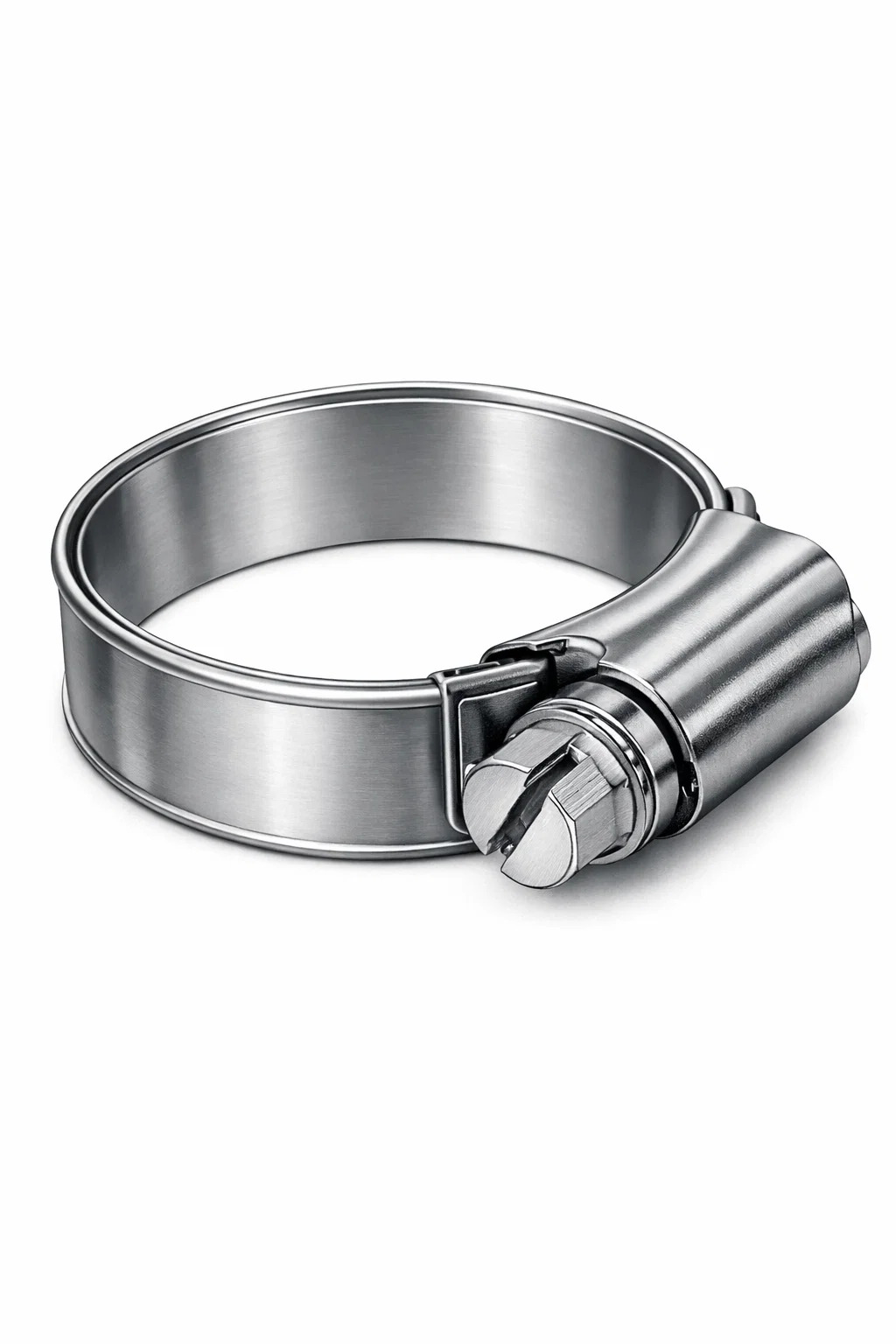
German type hose clamp: Its steel band surface is smooth, without any punched holes. Its gear track is a groove (sometimes called an embossed pattern) directly pressed into the steel band.
Why this design?
With a holed clamp, when tightening the hose, the rubber of the hose will squeeze out through the holes like dough, as if being grated, easily damaging the hose wall.
The German type's non-perforated design has a very smooth inner wall, so no matter how tightly you tighten it, it won't bite into the hose material, being very gentle on the hose.
2. "Rolled edges"
This is a very detailed but thoughtful design.
If you touch the edge of an ordinary clamp, it's usually a straight, sharp metal edge. When you tighten the hose clamp very tightly, this sharp edge will cut into the hose like a blade, and over time the hose is prone to cracking at this point.
The German type hose clamp slightly rolls the edges of the steel band outwards (flared edges), creating a rounded shape. This means that no matter how tightly you tighten it, the contact surface is smooth and will never cut the hose.
3. Stronger and more even clamping force
Because of the "no-hole" design mentioned earlier, the structure of the steel band is not compromised, so its tensile strength is higher than that of a perforated one.
When tightening, it can withstand greater torque. Moreover, its bandwidth is usually slightly narrower than ordinary clamps, and combined with the thickened steel plate, it can distribute the force very concentratedly and evenly around the hose, resulting in a particularly stable sealing effect.
4. Specifically designed for "delicate" hoses
Based on the above characteristics, German-style hose clamps are usually used in the following situations:
Silicone hoses: The blue or red hoses commonly used in modified cars. Silicone is very soft and easily damaged, so German-style clamps are necessary for protection.
High-end original equipment manufacturers (OEMs): If you open the hood of a BMW, Mercedes-Benz, Audi, or Volkswagen, you'll find that most of the original clamps are of this type.
Fuel lines: These pipes are very dangerous if they break, so these clamps that don't damage the pipes are needed to secure them.