 英语
英语 俄语
俄语
Content
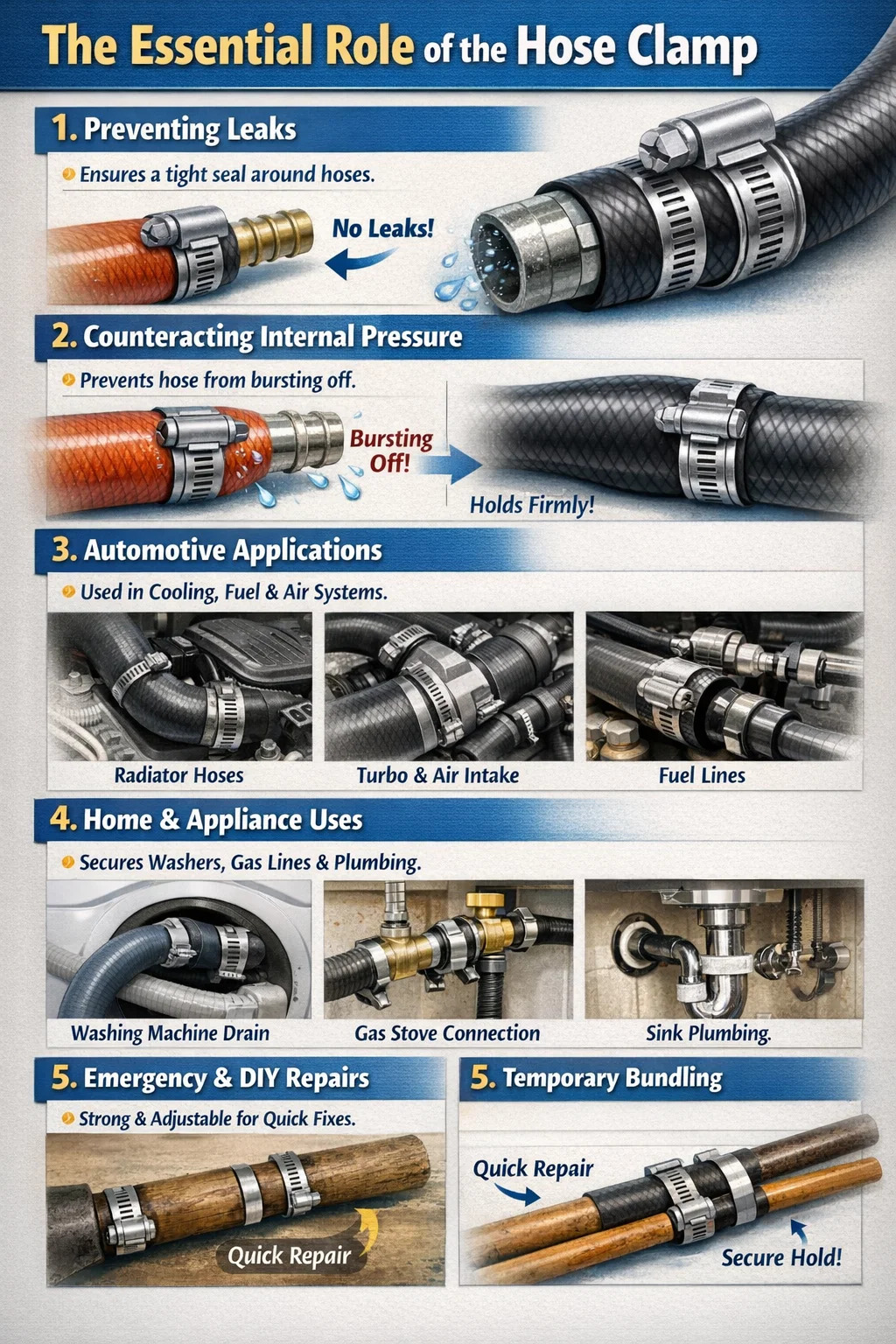
A hose clamp is a fastener responsible for connecting flexible hoses to rigid fittings. Hoses are flexible, while fittings are rigid; connecting these two completely different materials while ensuring no leaks of air or water is entirely dependent on this small circular clamp.
Although seemingly insignificant, its function is actually crucial, primarily in the following areas:
1. The most basic function: preventing leaks
This is the original purpose of the hose clamp.
When you attach a flexible hose to a rigid pipe or barbed fitting, it may seem tightly fitted, but once water, gas, or oil flows through the pipe, the fluid will try to escape through any gaps.
The hose clamp uses mechanical force to compress the hose, forcing the inner wall of the hose to tightly "grip" the grooves of the fitting. This ensures that no matter how much pressure the fluid exerts, not a single drop will leak from the connection.
2. Counteracting internal pressure (preventing the hose from bursting)
If you've ever pressurized a garden hose or looked under the hood of a car, you know that fluids have force.
When the pressure of the liquid or gas inside the pipe increases, it creates a force that pushes the hose outwards. Without something to hold it in place, the hose would simply "burst" off the fitting like a bullet.
This is where the hose clamp acts as an "anchor." It clamps the hose, holding it firmly against the barbs or protrusions of the fitting, ensuring that the hose remains in place regardless of the internal pressure.
3. Connecting the "blood vessels" of automotive systems
Open the hood of any car, and you'll find a large number of hose clamps.
Cooling system: The large, thick hoses connecting the radiator (water tank) are all secured by these clamps. The environment here is harsh, hot and vibrating, so the clamps must ensure that the antifreeze doesn't leak.
Intake system: Turbocharger lines or hoses from the air filter require these clamps for sealing, ensuring that the engine only inhales clean air, preventing leaks and dust ingress. Fuel and Oil Lines: Although high-pressure fuel lines are generally connected using crimping, hose clamps are still widely used in some return lines or low-pressure sections.
4. The "Invisible Guardian" of Home Life
You might not see it at home, but it's always working.
Washing Machines and Dishwashers: Look at the drain hose behind your washing machine; the metal ring that secures the drain hose to the drainpipe or the machine itself is a hose clamp.
Gas Stoves: The gas hose connecting to the stove or pressure regulator must be secured with a hose clamp. This is a matter of safety, preventing gas leaks.
Bathroom Plumbing: It's also commonly used to reinforce some non-metallic flexible connections behind the toilet tank or under the sink.
5. Emergency Repairs and "Improvised" Fastening
Besides connecting pipes, because it's adjustable and strong, many handy people use it as a "universal tie."
Repair Tools: For example, if the wooden handle of a shovel cracks, tightening two hose clamps around it will prevent further cracking and allow you to continue using it.
Temporary Bundling: When you need to tie two rods together or fix something to a post, its strength is far superior to tape and rope.