 英语
英语 俄语
俄语
Content
- 1 What Is a Storz Coupling?
- 2 How a Storz Coupling Works: The Mechanics Explained
- 3 Storz Coupling Sizes: A Complete Reference
- 4 Materials Used in Storz Couplings and Why They Matter
- 5 Where Storz Couplings Are Used
- 6 Storz Coupling vs. Other Coupling Types
- 7 Standards and Certifications Governing Storz Couplings
- 8 Maintenance, Inspection, and Common Failure Modes
- 9 Adapters and Transitions: Connecting Storz to Other Systems
- 10 Selecting the Right Storz Coupling for Your Application
What Is a Storz Coupling?
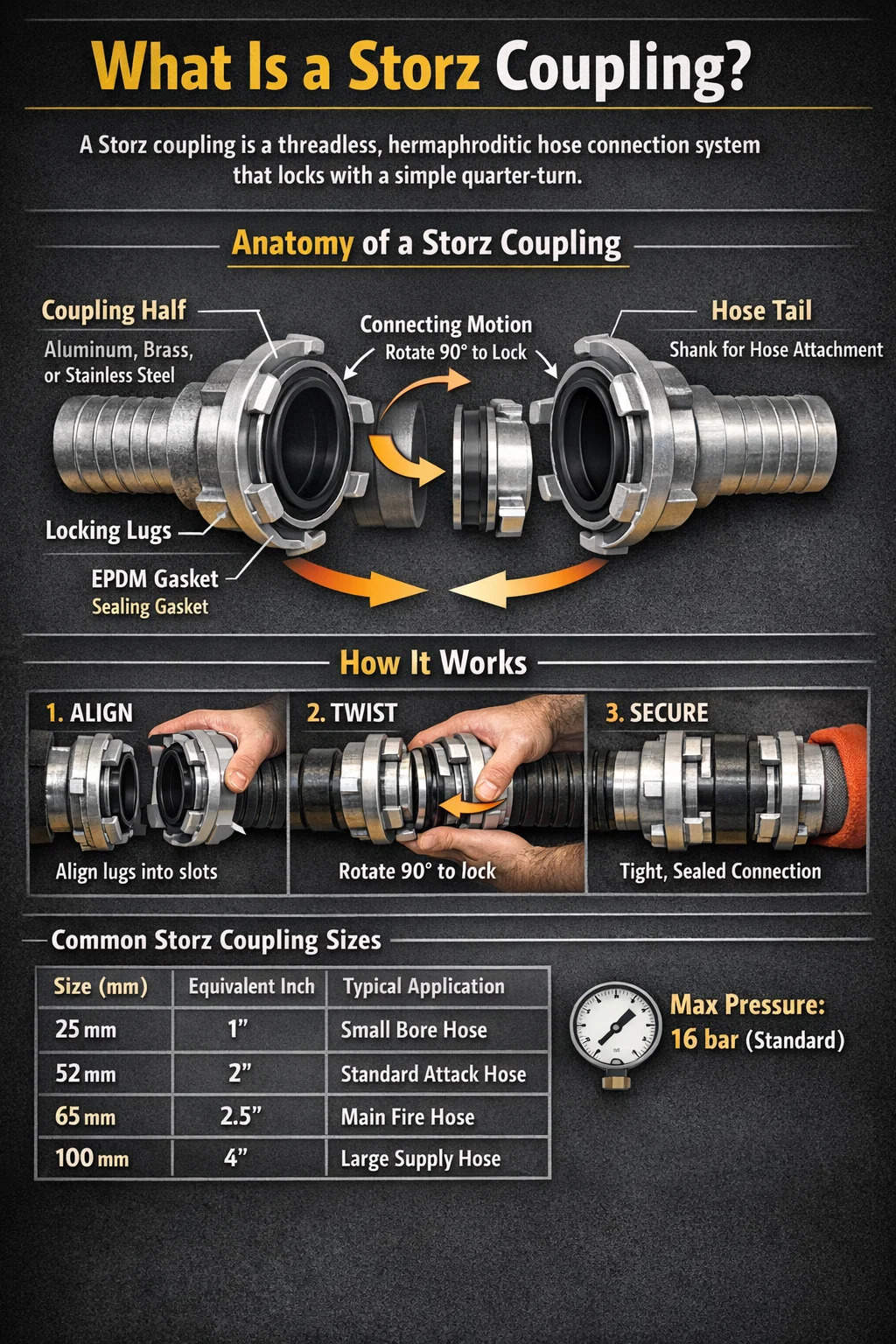
A Storz coupling is a symmetrical, self-locking, threadless hose coupling that allows two identical halves to connect with a simple quarter-turn rotation. Unlike traditional threaded couplings where a male end must mate with a female end, both sides of a Storz coupling are identical — meaning any two Storz fittings of the same size will join together instantly without orientation concerns. This design was invented by Carl August Guido Storz in Germany in 1882 and has since become one of the most widely adopted coupling standards in firefighting, industrial fluid transfer, and emergency response operations worldwide.
The core mechanism relies on two lugs on each half that slot into corresponding recesses on the other half. Once the lugs are engaged, a 90-degree rotation locks them into a secure, leak-resistant connection. A rubber or EPDM gasket seated inside one face ensures a watertight seal under pressure. Disconnection follows the same process in reverse — rotate and pull apart. No threads, no wrenches, no complicated alignment required.
This simplicity is not accidental. Storz couplings were specifically engineered for high-pressure, time-critical environments where every second counts. A firefighter in full protective gear can connect or disconnect a Storz coupling in under three seconds, compared to 15–30 seconds for a threaded coupling of comparable size. That speed differential has made Storz the dominant coupling standard for fire suppression systems across Europe, Australia, and increasingly, North America.
How a Storz Coupling Works: The Mechanics Explained
Understanding the mechanics of a Storz coupling helps clarify why it outperforms threaded alternatives in most demanding applications. Each coupling half consists of a circular flange body with two diametrically opposed lugs projecting outward. These lugs fit into a matching pair of slots cut into the face of the opposing half. The slots are shaped with a slight ramp so that as the connection rotates, the lugs ride up the ramp and compress the internal gasket, creating the seal.
Key Components of a Storz Coupling
- Coupling body (aluminum, brass, or stainless steel)
- Two locking lugs on each half
- Internal gasket (typically EPDM, NBR, or natural rubber)
- Shank or tail end for hose attachment (instantaneous, threaded, or flanged)
- Optional locking safety clip or wire to prevent accidental disconnection
The gasket design is a critical detail. It sits in a groove on one face of the coupling so that when two halves are brought together, only one gasket is needed per connection point. This reduces inventory complexity and ensures consistent sealing performance. EPDM gaskets handle temperatures from -40°C to +120°C and resist ozone, UV, and water-based fluids. NBR (nitrile) gaskets are used where petroleum-based fluids or fuel exposure is anticipated.
Because the coupling is symmetrical, there is no male or female designation — a property formally described as hermaphroditic or neuter coupling design. This eliminates the frustration and delay of finding a matching opposite end, which is a significant operational advantage when assembling temporary piping systems under time pressure or in low-visibility conditions.
Storz Coupling Sizes: A Complete Reference
Storz couplings are manufactured in a standardized range of sizes, typically defined by the nominal bore diameter in millimeters. The most common sizes used in fire service and industrial applications are shown in the table below. Note that the nominal size refers to the internal bore, not the outer diameter of the coupling body, which is always larger.
| Nominal Size (mm) | Equivalent Inch | Typical Application | Max Working Pressure |
|---|---|---|---|
| 25 mm | 1" | Small-bore fire hose, chemical transfer | 16 bar |
| 38 mm | 1.5" | First attack fire hose, hydrant connections | 16 bar |
| 52 mm | 2" | Standard attack hose, standpipe systems | 16 bar |
| 65 mm | 2.5" | Main attack hose, fire engine outlets | 16 bar |
| 75 mm | 3" | Supply hose, tanker operations | 16 bar |
| 100 mm | 4" | Large diameter supply hose, hydrant mains | 16 bar |
| 125 mm | 5" | Large diameter water supply, industrial | 10 bar |
| 150 mm | 6" | Heavy industrial transfer, bulk water | 10 bar |
The 65 mm Storz coupling is by far the most widely deployed size in European fire services. Germany, Switzerland, Austria, and many other countries standardized on 65 mm as the primary attack hose size decades ago. In Australia, both 64 mm and 70 mm variants exist due to historical standardization differences between states. The 52 mm size is common in building standpipe systems and urban search and rescue equipment.
For industrial fluid handling outside the fire sector, custom Storz sizes extending up to 300 mm or larger can be manufactured, though these are non-standard and typically fabricated to project-specific requirements. At these larger diameters, the coupling body shifts from aluminum alloy to fabricated steel due to the mechanical loads involved.
Materials Used in Storz Couplings and Why They Matter
The material selection for a Storz coupling directly impacts its weight, corrosion resistance, durability, and cost. Three primary materials dominate the market, each suited to different environments and budgets.
Aluminum Alloy
Aluminum is the dominant material for fire service Storz couplings. A typical 65 mm aluminum Storz coupling weighs around 380–420 grams, roughly half the weight of an equivalent brass fitting. This weight reduction matters enormously when firefighters carry 30–50 meters of charged hose. Aluminum alloys used are typically EN AW-6061 or equivalent, offering tensile strengths in the 260–310 MPa range. Anodized or hard-coated aluminum adds surface hardness and corrosion resistance. The main limitation of aluminum is susceptibility to galvanic corrosion when coupled with dissimilar metals, and reduced performance at elevated temperatures above 150°C.
Brass
Brass Storz couplings offer superior corrosion resistance and are the preferred choice for permanent installations, chemical plants, and marine environments. Brass has inherent biostatic properties that inhibit microbial growth in potable water systems. The tradeoff is weight — a 65 mm brass Storz coupling typically weighs 700–800 grams, nearly double its aluminum counterpart. Brass is also significantly more expensive, with raw material costs roughly 3–4 times that of aluminum by weight. For underground hydrant systems, fixed pump connections, and any installation where the coupling is not being carried by personnel, brass is often the more practical long-term choice due to its 30–50 year service life in corrosive environments.
Stainless Steel
Stainless steel (typically 316L grade) Storz couplings are specified for highly aggressive chemical environments, offshore applications, and food or pharmaceutical processing where contamination is a concern. Stainless offers excellent resistance to chlorides, acids, and a wide range of solvents. These couplings are the heaviest and most expensive option, with 65 mm units weighing over 1 kg and costing 4–6 times the equivalent aluminum fitting. Their use in fire service is minimal, but in chemical tanker unloading, beverage processing, and coastal infrastructure, they are the correct engineering choice.
Polymer and Composite
Glass-fiber reinforced nylon and other polymer composites are increasingly used for lightweight, low-cost Storz couplings in portable irrigation systems, temporary dewatering, and disaster relief applications. These fittings offer near-zero corrosion susceptibility and can be produced in bright colors for easy size identification. Their working pressure ratings are lower — typically 8–12 bar — and they are not suitable for hot water or steam service. For single-use or short-service-life applications, polymer Storz couplings represent the most cost-effective option.
Where Storz Couplings Are Used
While Storz couplings are most associated with firefighting, their symmetrical, tool-free design has found adoption across a surprisingly broad range of industries. The following areas represent the primary application domains.
Fire Service and Emergency Response
This remains the largest application by volume. Fire hose couplings must withstand operating pressures of 8–16 bar during active firefighting, cyclic pressure spikes during pump surges, mechanical abuse from dragging over rough surfaces, and UV degradation over years of outdoor storage. Storz couplings are the standard on attack hoses, supply hoses, and hydrant connections across most of Europe, Australia, New Zealand, and large parts of Asia and South America. German DIN 14307 and European EN 1659 standards govern the dimensional and performance requirements for fire service Storz couplings. In the United States, the National Fire Protection Association (NFPA) historically standardized on threaded couplings, but many US departments have adopted Storz for large-diameter supply hose due to faster deployment times.
Industrial Fluid Transfer
Chemical plants, refineries, and manufacturing facilities use Storz couplings for temporary hose connections during maintenance, tanker unloading, and fluid transfer operations. The tool-free connection minimizes worker exposure time in hazardous environments and reduces the risk of cross-threading or over-torquing that can damage threaded couplings. For bulk chemical transfer, Storz couplings in stainless steel with chemically resistant gaskets (PTFE or Viton) are specified to handle aggressive media including acids, alkalis, and solvents.
Agriculture and Irrigation
Large-scale irrigation systems — particularly center-pivot and lateral-move systems — use Storz couplings extensively on aluminum irrigation pipe. The ability to quickly reconfigure pipe layouts without tools is a major productivity advantage during seasonal setup and takedown. A single farm worker can connect a 100 mm Storz coupling in under five seconds, whereas the equivalent aluminum cam-lock fitting of the same bore requires alignment of multiple components. Agricultural Storz couplings are typically lower-pressure rated (6–10 bar) and made from lighter aluminum alloys or polymers to minimize cost and weight over long pipe runs.
Dewatering and Flood Response
Portable pumps used for construction dewatering, mine drainage, and flood emergency response are frequently fitted with Storz connections for rapid deployment. A dewatering crew can set up a 100-meter hose run with multiple pump stages in under 10 minutes using Storz couplings, compared to 30–40 minutes with threaded connections that require multiple workers to avoid cross-threading under field conditions. Civil defense organizations in Germany, Austria, and Switzerland maintain large inventories of standardized Storz-equipped dewatering pumps and hose sets precisely because of this rapid-deployment capability.
Building Services and Fixed Installations
Rising mains in high-rise buildings — vertical pipes running up a building's core to supply water to fire hoses on each floor — are typically terminated with Storz landing valves. Wet and dry riser systems in commercial buildings across Europe almost universally use Storz connections at outlet points so that fire crews can connect their own hose sets directly without adapters. This compatibility between building infrastructure and portable fire equipment is a direct benefit of the standardized Storz interface.
Storz Coupling vs. Other Coupling Types
Choosing the right coupling type for a given application requires understanding how Storz compares to the alternatives. The main competitors are threaded couplings, cam-lock (camlock) couplings, and instantaneous (or snap-lock) couplings.
| Criterion | Storz | Threaded | Camlock | Instantaneous |
|---|---|---|---|---|
| Connection time | <3 seconds | 15–30 seconds | 3–5 seconds | 2–4 seconds |
| Symmetrical (no M/F) | Yes | No | No | No |
| Max working pressure | 16 bar | 40+ bar | 14 bar | 16 bar |
| Cross-connection risk | None | High | Low | Low |
| Tool requirement | None | Spanner needed | None | None |
| Fire service standard | Europe, AU, NZ | USA (traditional) | Industrial | UK (some) |
Threaded couplings still dominate applications requiring pressures above 20 bar, such as hydraulic systems and high-pressure water jetting, where the thread engagement provides mechanical advantage that the Storz lug system cannot match. Camlock fittings (Type A through F per MIL-C-27487) are preferred in petrochemical and food-grade applications where the male-female configuration allows positive flow direction control and prevents accidental self-connection of the same pipe back to itself. Storz's key differentiator remains its symmetry — it is the only widely standardized coupling that genuinely does not care which end you pick up.
Standards and Certifications Governing Storz Couplings
Multiple national and international standards define the dimensional tolerances, pressure ratings, materials, and test procedures for Storz couplings. Compliance with these standards is essential for interoperability — a coupling from one manufacturer must connect seamlessly with a coupling from another.
- DIN 14307 (Germany) — The original and most comprehensive standard for fire service Storz couplings. Covers sizes from 25 mm to 150 mm, dimensional tolerances, proof pressure testing (typically 1.5× working pressure), and material specifications.
- EN 1659 (European Union) — European harmonized standard for fire fighting hose couplings, including Storz type. Required for CE marking of fire equipment sold in the EU market.
- AS 4487 (Australia) — Australian standard for fire service hose couplings, including Storz variants. Specifies both 64 mm and 70 mm versions reflecting historical state-based differences in Australia.
- ISO 19018 — International standard for fire fighting hose connections, providing a global reference that aligns closely with EN 1659.
- NFPA 1963 (USA) — American standard covering fire hose connections. Historically threaded-centric but now includes provisions for Storz-type connections used on large-diameter supply hose.
One important practical point: while all standards define a "Storz" interface, dimensional tolerances vary slightly between DIN 14307 and AS 4487. A 65 mm DIN Storz coupling and a 64 mm AS Storz coupling are not interchangeable, despite the similar nominal sizes. This has caused operational problems for international disaster relief operations and has driven renewed efforts toward ISO harmonization. Any organization deploying Storz-equipped equipment internationally should verify standard compatibility before assuming cross-brand interoperability.
Maintenance, Inspection, and Common Failure Modes
Storz couplings are mechanically simple, but they do require periodic inspection and maintenance to ensure reliable performance. The consequences of a coupling failure during active firefighting or chemical transfer are severe, making a structured inspection regime essential.
Routine Inspection Checklist
- Check lug engagement — lugs should rotate smoothly through the full 90-degree arc without binding or excessive play. Worn lugs that allow more than 5 degrees of rotational slop indicate coupling replacement is needed.
- Inspect gasket condition — EPDM gaskets should be supple and free of cracks, compression set, or swelling. A hardened or cracked gasket that compresses less than 1.5 mm under finger pressure should be replaced immediately.
- Check coupling face for nicks, burrs, or deformation — any damage to the sealing face or lug profile can compromise the connection. Minor surface corrosion on aluminum can be cleaned with a non-abrasive pad; structural corrosion requires replacement.
- Verify hose shank condition — the tail or shank connection to the hose should show no cracks, corrosion, or movement. On instantaneous shank connections, check that the serrated barb retains positive grip on the hose jacket.
- Test connection and disconnection — pair two couplings and cycle through three connect/disconnect cycles. The action should be positive, with clear engagement felt and heard during locking. Any sponginess or failure to lock positively under hand force indicates worn components.
Common Failure Modes
The most frequent failure mode in aluminum Storz couplings is lug wear from repeated connection cycles. Under sustained use in fire service, where a coupling may be connected and disconnected hundreds of times per year during training exercises, the lugs gradually wear and develop excessive clearance. Industry guidance typically specifies coupling retirement at 10 years of service life or when dimensional wear exceeds manufacturer tolerances, whichever comes first.
Gasket extrusion is another common problem. If a coupling is connected while the gasket is not properly seated in its groove, pressurization forces the gasket outward past the sealing face, causing an immediate leak. This typically occurs after gasket replacement where the installer does not confirm the gasket is fully seated. The solution is to always test connect two halves and verify the gasket is retained before putting the assembly into service.
Corrosion-related seizure in dissimilar metal installations is a third issue. When an aluminum Storz coupling is permanently mated with a brass fitting — such as at a hydrant outlet — galvanic corrosion can fuse the lugs over years of outdoor exposure, making disconnection impossible without tools or cutting. Stainless steel or nylon washer inserts between dissimilar metal couplings, combined with annual disconnection and lubrication, prevent this problem.
Adapters and Transitions: Connecting Storz to Other Systems
In practice, Storz-equipped systems frequently need to interface with non-Storz infrastructure. A comprehensive range of adapters and transition fittings addresses these situations.
- Storz to BSP/NPT thread adapters — Allow Storz hoses to connect to threaded valves, pumps, or hydrant outlets. Available in male and female thread variants. Critical to select the correct thread standard (British Standard Pipe vs. American National Pipe Taper) to avoid seal failures.
- Storz to Storz reducers — Transition between two different Storz sizes, e.g., 100 mm supply hose to 65 mm attack hose. These fittings carry a Storz connection on each end but with different diameter bores.
- Storz to NPSH (National Hose Thread) — Used in the United States where Storz large-diameter supply hose connects to older threaded pump inlets or hydrant outlets. This adapter type is specified in NFPA 1963.
- Storz blind cap — Seals an open Storz connection when not in use. Essential for hydrant outlets, standpipe landings, and stored hose ends to prevent debris ingress. Most blind caps include a chain tether to prevent loss.
- Storz to flanged connections — Bolted flange adapters allow Storz connections to fixed pipe flanges in pump stations and treatment facilities. Available to ANSI, DIN, and AS flange standards.
When specifying adapters, pay close attention to whether the adapter's pressure rating matches the system design pressure. A Storz coupling rated at 16 bar should never be adapted to a system operating above that pressure without upgrading the coupling. The adapter itself must also carry a rating equal to or higher than the weakest component in the system.
Selecting the Right Storz Coupling for Your Application
With the range of sizes, materials, pressure ratings, and end connections available, selecting the right Storz coupling requires a structured approach. Work through the following criteria systematically to arrive at the correct specification.
Step 1: Define the Flow Rate and Pipe Size
The coupling bore must support the required flow rate at acceptable velocities. For fire hose applications, a rule of thumb is that 65 mm hose handles flows up to 500 liters per minute at typical firefighting pressures. For supply operations requiring 1,000–1,500 liters per minute, 100 mm Storz hose is the appropriate choice. Undersizing the coupling creates excessive pressure drop and can prevent achieving the required discharge flow at the nozzle.
Step 2: Confirm Operating Pressure
Most standard Storz couplings are rated to 16 bar working pressure with a proof test at 24 bar. If your system operates above 12 bar, verify that both the coupling and gasket are rated for the actual working pressure, not just the nominal. Always add a safety factor — for fire service applications, NFPA and EN standards require that the test pressure be at least 1.5× the maximum working pressure.
Step 3: Choose the Right Material for the Environment
Use aluminum for portable fire service equipment. Use brass for permanent installations in aggressive outdoor or underground environments. Use stainless steel for chemical service or any application involving chlorides, acids, or food-contact requirements. Use polymer where cost and weight are the primary drivers and pressure is below 10 bar.
Step 4: Select the Correct Shank or End Connection
The end of the coupling that connects to the hose or pipe comes in several configurations. Instantaneous hose shanks with barbed tails are crimped onto the hose and are the standard for fire hose. Threaded shanks screw directly onto pipe or valve bodies. Flanged tails bolt to pipe flanges. The end connection must be specified to match the existing hose or pipe interface — a mismatch here is one of the most common specification errors in Storz coupling procurement.
Step 5: Verify Standard Compliance
Confirm which national or international standard governs the installation. For European fire service: EN 1659. For German fire service: DIN 14307. For Australian fire service: AS 4487. Mixing couplings from different standards — even within the same nominal size — can result in incomplete lug engagement, gasket seal failure, or accidental disconnection under pressure. This is a safety-critical requirement, not a procedural formality.