 英语
英语 俄语
俄语
Content
- 1 The Other Names for a Storz Coupling
- 2 Symmetrical Coupling: The Most Descriptively Accurate Name
- 3 Neuter Coupling and Hermaphroditic Coupling: Names from Connector Theory
- 4 Quarter-Turn Coupling: Named for the Connection Action
- 5 Instantaneous Coupling: A Name from the Speed of Connection
- 6 Lug Coupling: A Mechanical Description
- 7 Regional and Country-Specific Names Used Worldwide
- 8 Why the Storz Name Became Generic
- 9 Practical Implications: Which Name to Use and When
- 10 Confusing Terms: What Is Not the Same as a Storz Coupling
- 11 A Quick Reference: All Major Alternative Names at a Glance
The Other Names for a Storz Coupling
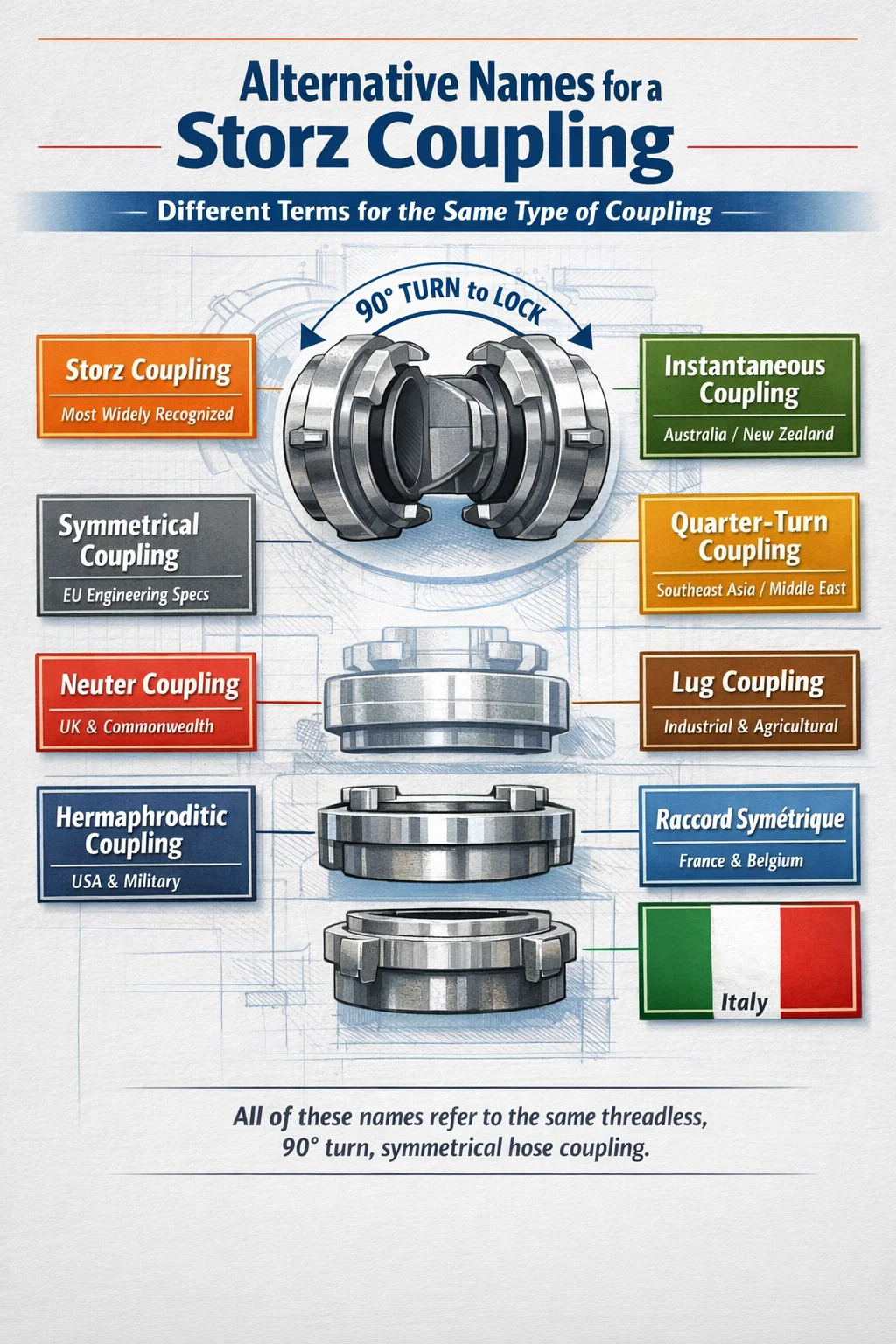
A Storz coupling goes by several alternative names depending on the industry, country, and context in which it is used. The most widely used alternative names are symmetrical coupling, neuter coupling, hermaphroditic coupling, and quarter-turn coupling. In some regions and trade catalogues it also appears as a Storz-type hose coupling, instantaneous coupling, or simply a lug coupling. Each name describes the same fundamental device — a threadless, self-locking hose or pipe connector that joins two identical halves with a 90-degree rotation — but each name emphasizes a different characteristic of its design.
Understanding which term is used in a given country or industry matters practically, not just academically. A procurement officer searching for "neuter coupling" in a European industrial catalogue and a fire equipment buyer searching for "Storz coupling" in an Australian supplier database are looking for exactly the same product. Getting the terminology wrong can result in missed search results, specification mismatches, or unnecessary adapter procurement. The sections below break down every significant alias, where it originates, and when you are likely to encounter it.
Symmetrical Coupling: The Most Descriptively Accurate Name
"Symmetrical coupling" is arguably the most technically precise alternative name for a Storz coupling. It refers directly to the defining structural property of the design: both halves of the connector are geometrically identical, meaning the connector has a plane of symmetry through its axis. There is no male end and no female end. Any two Storz halves of the same nominal size and standard will join together, regardless of which half came from which hose or pipe run.
This term appears frequently in engineering and specification documents, particularly in Germany and German-speaking countries where the coupling originated. German technical standards such as DIN 14307 use the term "Symmetrische Kupplung" (symmetrical coupling) as a formal descriptor alongside the brand-derived name "Storz-Kupplung." In French-language technical documents used across Belgium, Switzerland, and parts of Canada, the equivalent term "raccord symétrique" serves the same function.
When writing technical specifications for tenders or procurement contracts, "symmetrical coupling" is often preferred over the brand name "Storz" to avoid implying a preference for a specific manufacturer. A specification that reads "65 mm symmetrical coupling conforming to EN 1659" is brand-neutral and invites bids from all compliant manufacturers, whereas "65 mm Storz coupling" might be interpreted as specifying a particular brand. This distinction matters in public procurement in the European Union, where brand-name specifications in public tenders can be legally challenged.
Neuter Coupling and Hermaphroditic Coupling: Names from Connector Theory
In connector engineering, components are classified by their gender: male connectors insert into female connectors. A Storz coupling defies this classification entirely — it has neither a male nor a female role. This property is captured by two related terms: neuter coupling and hermaphroditic coupling.
Neuter Coupling
"Neuter coupling" is the term most commonly used in British and Commonwealth engineering literature. It appears in British Standards Institution documents and is the preferred term in formal UK fire service procurement specifications. The word "neuter" is borrowed from grammar, where it denotes a third gender that is neither masculine nor feminine — an apt analogy for a coupling that is neither male nor female. The term is also in active use in South African and Indian fire service technical documentation, both of which inherited their technical vocabulary from British colonial-era standards.
Practically speaking, if you are ordering Storz couplings from a UK-based supplier and use the term "neuter coupling" rather than "Storz coupling," you will get the same product. Most UK fire equipment catalogues list both terms as cross-references for exactly this reason.
Hermaphroditic Coupling
"Hermaphroditic coupling" takes a slightly different conceptual angle. Where "neuter" implies the absence of both genders, "hermaphroditic" implies the presence of both simultaneously — each half contains features that are simultaneously male-like and female-like. The Storz lug, which projects outward (a male characteristic) and also receives the opposing lug in a slot (a female characteristic), fits this description exactly. The term is more common in North American industrial literature, particularly in chemical process engineering and military logistics documentation. The US military's own coupling standards reference "hermaphroditic quick-disconnect couplings" when describing Storz-type fittings used in military refueling and firefighting equipment.
Both terms — neuter and hermaphroditic — describe exactly the same physical property. The choice between them is largely a matter of regional technical vocabulary rather than any meaningful difference in meaning or application.
Quarter-Turn Coupling: Named for the Connection Action
Another widely encountered alternative name is quarter-turn coupling, sometimes written as quarter turn coupling or ¼-turn coupling. This name describes how the coupling connects: insert one half into the other and rotate 90 degrees — one quarter of a full turn — to lock. This action is immediately recognizable to anyone who has used the fitting and makes the name highly intuitive for training and operational communications.
The quarter-turn name is particularly common in industrial fluid handling catalogues across North America, Southeast Asia, and parts of the Middle East where the Storz brand name is less embedded in technical culture. Suppliers in Singapore, Malaysia, and the Gulf states frequently catalogue these fittings as "quarter-turn hose couplings" or "quarter-turn fire couplings" because the operating principle resonates more clearly with buyers who may not be familiar with the Storz historical brand identity.
One important caution with this name: "quarter-turn coupling" is not exclusive to Storz-type fittings. Some cam-lock valves, bayonet connectors, and other coupling types also require a quarter-turn rotation to engage. When ordering or specifying using this term alone, always add dimensional and standard information — for example, "65 mm quarter-turn symmetrical coupling to DIN 14307" — to ensure you receive the correct product type.
Instantaneous Coupling: A Name from the Speed of Connection
In Australian fire service documentation and some New Zealand standards, Storz couplings are frequently referred to as instantaneous couplings. This name emphasizes the speed of the connection process — the coupling engages almost instantaneously compared to threaded alternatives that require multiple rotations and often a spanner. The Australian standard AS 4487, which governs fire hose couplings, uses "instantaneous coupling" as its primary descriptor for the Storz-type fitting.
This terminology creates a potential point of confusion: in the UK and some other Commonwealth countries, "instantaneous coupling" refers not to a Storz-type fitting but to a different quick-connect design sometimes called a "London coupling" or "round-thread instantaneous coupling" that uses a short threaded section with lugs for rapid engagement. The actual mechanism is different from a Storz coupling. When working across Australian and British fire service equipment standards, it is worth confirming which type of "instantaneous coupling" is intended before ordering or specifying components.
Australian fire brigades and state fire services use instantaneous as the everyday operational term. A firefighter in New South Wales will call it an "insto" in casual radio or briefing language — a further abbreviation that is meaningful within that operational context but entirely opaque to someone outside Australian fire service culture.
Lug Coupling: A Mechanical Description
"Lug coupling" is a less formal but descriptively accurate alternative name that appears in workshop manuals, maintenance documentation, and some industrial supply catalogues. It refers to the two projecting lugs on each coupling half that form the locking mechanism. While not a standardized term in the way that "symmetrical coupling" or "neuter coupling" is, "lug coupling" is immediately meaningful to any engineer or tradesperson familiar with the physical mechanism.
This name is most commonly encountered in agricultural irrigation supply, construction dewatering equipment, and general industrial hose fitting contexts where the fitting may not be specifically associated with fire service history. An irrigation equipment supplier in the western United States might list their 100 mm aluminum fittings as "lug-type hose couplings" in a catalogue that makes no reference to the Storz name at all. The product is identical in function and often in dimensions to a standard Storz coupling, but the naming reflects the supplier's industry and customer base rather than any technical difference.
Regional and Country-Specific Names Used Worldwide
Beyond the engineering-derived names above, Storz couplings carry a range of regionally specific names that reflect local fire service culture, historical standardization, and language. The table below summarizes the most common region-specific names and the contexts in which they are used.
| Name / Term | Region / Context | Notes |
|---|---|---|
| Storz coupling / Storz-Kupplung | Germany, Austria, Switzerland, global fire service | Brand-derived name now used generically across all manufacturers |
| Symmetrical coupling | EU procurement, engineering specs | Brand-neutral; preferred in public tender specifications |
| Neuter coupling | UK, South Africa, India, Commonwealth | Standard term in British fire service and BSI documents |
| Hermaphroditic coupling | USA, military, industrial North America | Used in US military logistics and chemical process engineering |
| Instantaneous coupling / "insto" | Australia, New Zealand | Formal term in AS 4487; "insto" is everyday operational slang |
| Quarter-turn coupling | Southeast Asia, Middle East, industrial supply | Describes the locking action; not exclusive to Storz type |
| Lug coupling | Agriculture, construction, general industrial | Informal mechanical description; not a standardized term |
| Raccord symétrique | France, Belgium, French-speaking Switzerland | French equivalent of "symmetrical coupling" |
| Accoppiamento Storz / raccordo simmetrico | Italy | Italian fire service uses both the brand name and the descriptive term |
| Storz hose fitting / Storz fire coupling | Global e-commerce and general retail | Common search terms used by buyers unfamiliar with formal standards |
The sheer number of names in circulation reflects both the coupling's 140-year history and its global adoption across very different industrial and regulatory environments. No single term has achieved truly universal adoption outside of specialist fire service communities, which is why cross-referencing multiple names when searching catalogues or writing specifications is good practice.
Why the Storz Name Became Generic
The fact that "Storz coupling" functions as a generic term — like "Hoover" for vacuum cleaners or "Velcro" for hook-and-loop fasteners — is the result of a specific historical and commercial trajectory. Carl August Guido Storz patented the symmetrical hose coupling in 1882 in Germany. The design was rapidly adopted by German fire brigades and subsequently standardized under DIN specifications in the early twentieth century. By the time other manufacturers began producing compatible fittings, the Storz name was already embedded in fire service training, maintenance manuals, and procurement documents across Central Europe.
Post-World War II reconstruction efforts and the subsequent expansion of German technical standards internationally — particularly through DIN and later through ISO and CEN harmonization — carried the Storz name into global technical vocabulary. Countries that adopted DIN fire standards also adopted the Storz name, even when purchasing from local manufacturers producing the coupling under their own brand names. Today, manufacturers in at least 30 countries produce Storz-compatible couplings without any commercial relationship to the original Storz company, yet all refer to their products using the Storz name because that is what their customers specify and what standards documents reference.
This genericization has had practical consequences. Unlike "Velcro," which remains a registered trademark vigorously defended by Velcro Companies, the Storz trademark in the context of fire hose couplings has effectively become generic in many jurisdictions. Patent protection expired long ago. The original German firm has changed ownership and focus multiple times. As a result, there is no meaningful legal restriction on any manufacturer using the Storz name to describe a DIN 14307-compliant symmetrical coupling, which is why you will find "Storz coupling" used freely across the global supply chain regardless of the actual manufacturer.
Practical Implications: Which Name to Use and When
Knowing the alternative names is useful, but knowing which name to use in which context is where this knowledge becomes operationally valuable. The following guidance covers the most common situations where terminology choice matters.
Writing Technical Specifications and Tenders
Use "symmetrical coupling" or "neuter coupling" followed by the governing standard (DIN 14307, EN 1659, AS 4487) and the nominal size. This approach is brand-neutral, legally defensible in public procurement, and unambiguous to any compliant supplier worldwide. Example: "65 mm symmetrical hose coupling conforming to DIN 14307, aluminum alloy body, EPDM gasket, rated to 16 bar working pressure."
Purchasing from Suppliers and Catalogues
Use "Storz coupling" as the primary search term for fire service equipment suppliers in Europe, Asia, and the Americas. Add "instantaneous coupling" as an alternative search if targeting Australian or New Zealand suppliers. If searching North American industrial catalogues, try both "Storz coupling" and "hermaphroditic coupling" to capture all relevant listings. Always confirm the nominal size and governing standard in any order to avoid receiving a non-interoperable product.
Training and Operational Documentation
Use whichever term is standard in your organization's existing documentation and matches your national fire service standard. Consistency within an organization's training materials is more important than global terminological precision. If your brigade calls them "Storz couplings," use that term throughout. If your state fire authority documents call them "instantaneous couplings," standardize on that. Mixing terms within a single training document creates unnecessary confusion for new recruits.
Cross-Border Operations and International Deployments
When deploying equipment internationally — for disaster relief, cross-border mutual aid, or international exercises — the safest approach is to specify both the name and the standard. A European fire team deploying equipment to Australia should check whether their DIN 14307 65 mm couplings are interchangeable with AS 4487 64 mm couplings before assuming compatibility. The dimensional differences between standards are small but sufficient to prevent a reliable seal under firefighting pressures. Carry standard-to-standard adapters whenever operating in environments where equipment standards may differ from your own.
Academic and Engineering Literature
Use "symmetrical coupling" or "hermaphroditic coupling" in technical papers, engineering theses, and standards development work. These terms are precise, brand-neutral, and describe the coupling's properties in a way that remains meaningful even to readers unfamiliar with the Storz historical context. Including a parenthetical note — "(also known as a Storz coupling)" — on first use ensures the widest possible audience can follow the reference.
Confusing Terms: What Is Not the Same as a Storz Coupling
Several coupling terms are sometimes confused with Storz couplings but refer to genuinely different designs. Being clear about these distinctions prevents specification errors and equipment incompatibilities.
- Camlock coupling (cam and groove coupling) — This is a male-female quick-connect system widely used in chemical and petroleum transfer. Despite also being a quick-connect design, camlock couplings are not symmetrical and are not interchangeable with Storz couplings. Camlocks are covered by MIL-C-27487 and ISO 9972. Confusing "quick-connect" with "Storz" is a common error in general industrial contexts.
- London coupling (UK instantaneous coupling) — As noted above, in the UK "instantaneous coupling" sometimes refers specifically to a short-thread, lug-assisted coupling used on certain British fire hose connections that is not a Storz design and is not dimensionally compatible with Storz fittings. Specifying by standard reference rather than name avoids this ambiguity entirely.
- Guillemin coupling — A French symmetrical coupling design with some similarities to Storz but different lug geometry, gasket arrangement, and dimensional standards. Guillemin couplings (governed by NF E29-572) are common in French industrial applications and are not interchangeable with DIN Storz couplings despite both being symmetrical in design.
- Bayonet coupling — Uses a pin-and-slot bayonet mechanism rather than a full circumferential lug. Not interchangeable with Storz. Common in electrical connectors, camera lenses, and some medical gas fittings, but occasionally encountered in low-pressure fluid applications.
- Dry break coupling — A specialized coupling designed to prevent fluid spill during disconnection, used in fuel transfer and chemical handling. Dry break couplings can be symmetrical or male-female depending on design, but they are a distinct product category from standard Storz fire hose couplings.
The key differentiator for a genuine Storz coupling — regardless of what name it carries — is the combination of full symmetry (both halves identical), the lug-and-slot locking mechanism, a 90-degree rotation to lock, and compliance with one of the recognized Storz-type standards (DIN 14307, EN 1659, AS 4487, or ISO 19018). Any coupling meeting these criteria is a Storz coupling, whatever its trade name or local designation.
A Quick Reference: All Major Alternative Names at a Glance
For those who need a fast summary of every significant name used for a Storz coupling, the list below consolidates all the terms covered above. These names all refer to the same fundamental product — a symmetrical, quarter-turn, lug-locking hose coupling — and can be used as search terms, specification references, or cross-references depending on context.
- Storz coupling (most widely recognized globally)
- Symmetrical coupling (preferred in EU procurement and engineering specs)
- Neuter coupling (standard in British and Commonwealth fire service documents)
- Hermaphroditic coupling (used in US military and industrial North America)
- Instantaneous coupling / insto (Australian and New Zealand fire service)
- Quarter-turn coupling (Southeast Asia, Middle East, industrial supply catalogues)
- Lug coupling (informal, agricultural and construction contexts)
- Storz-type hose coupling (generic descriptor used in multi-brand catalogues)
- Raccord symétrique (French-language technical documents)
- Storz-Kupplung (German technical and procurement documents)
- Raccordo simmetrico (Italian fire service and industrial documents)
Whichever name you encounter or need to use, the practical verification step is always the same: confirm the nominal bore size in millimeters and the governing dimensional standard. A 65 mm DIN 14307 symmetrical coupling and a 65 mm DIN 14307 Storz coupling are the same product. A 65 mm DIN 14307 coupling and a 64 mm AS 4487 instantaneous coupling are not, despite both being Storz-type fittings. Size and standard together tell you everything you need to know about interoperability — the name alone does not.