 英语
英语 俄语
俄语
Content
- 1 What Is Pipe Thread?
- 2 How Pipe Thread Works: The Basic Mechanics
- 3 Major Pipe Thread Standards and Their Differences
- 4 Pipe Thread Sizes: How Nominal Pipe Size Actually Works
- 5 Pipe Thread in the Context of Camlock Couplings
- 6 Materials Used in Threaded Pipe Fittings and Camlock Couplings
- 7 How to Correctly Assemble a Threaded Pipe Joint
- 8 Identifying Pipe Thread Type and Size in the Field
- 9 Common Pipe Thread Failures and How to Prevent Them
- 10 When to Use Threaded Connections vs. Other Joining Methods
- 11 Industry Applications Where Pipe Thread and Camlock Couplings Work Together
- 12 Key Takeaways for Working with Pipe Thread
What Is Pipe Thread?
Pipe thread is a helical ridge cut or formed on the outer surface (male thread) or inner surface (female thread) of a pipe or fitting, designed to create a mechanical joint when two threaded components are screwed together. The primary purpose is to form a secure, pressure-resistant connection that can transfer fluids, gases, or steam from one section of piping to another without leaking.
Pipe threads are not the same as standard fastener threads. They follow specific dimensional standards — such as NPT, BSP, or BSPT — that define the thread angle, pitch, taper, and diameter to ensure interoperability across components made by different manufacturers. A single mismatched thread standard can cause joint failure, leaks, or even dangerous pressure blowouts.
Understanding pipe thread is essential for anyone working with plumbing systems, hydraulic lines, pneumatic equipment, chemical transfer systems, or industrial fluid handling. It directly impacts whether you select the right camlock coupling, valve, nipple, or adapter for a given application.
How Pipe Thread Works: The Basic Mechanics
When two threaded components are joined, the ridges of one thread engage with the grooves of the other. As the connection is tightened, the mating surfaces compress against each other, creating friction and — in the case of tapered threads — a wedging action that generates a mechanical seal.
There are two fundamental thread geometries used in pipe connections:
- Tapered threads: The thread diameter gradually increases or decreases along the thread length. As the male thread is driven into the female thread, the taper creates a wedging seal. NPT (National Pipe Tapered) is the most widely used tapered thread standard in North America.
- Parallel (straight) threads: The thread diameter remains constant throughout. These threads do not self-seal by mechanical interference and require a gasket, O-ring, or bonded washer seated against a flat face or shoulder to achieve a pressure-tight joint. BSPP (British Standard Pipe Parallel) is a common example.
Even with tapered threads, most pipe joints in liquid or gas service require the addition of thread sealant — PTFE tape (commonly called Teflon tape) or pipe dope — applied to the male thread before assembly. This fills microscopic voids in the thread engagement area and prevents fluid migration through the spiral leak path that inherently exists along any threaded joint.
Major Pipe Thread Standards and Their Differences
Across the globe, multiple pipe thread standards exist. They are not universally interchangeable. Connecting components from different standards can result in cross-threading, incomplete sealing, or structural failure. Here is a breakdown of the most common standards:
NPT — National Pipe Taper
NPT is the dominant thread standard in the United States, Canada, and much of Latin America. It features a 60-degree thread angle and a taper rate of 1 in 16 (or 3/4 inch per foot) measured on the thread diameter. Common pipe sizes range from 1/8 inch to 6 inches nominal pipe size (NPS), though larger sizes exist for industrial applications.
NPT threads rely on the deformation of thread flanks during assembly to achieve a seal, supplemented by thread sealant. They are widely used in water supply, oil and gas distribution, pneumatic systems, and industrial piping. When a camlock coupling with NPT threads is specified, it will be labeled accordingly — for example, "2-inch NPT male camlock adapter."
NPTF — National Pipe Taper Fuel
NPTF (also known as Dryseal) shares the same 60-degree angle and taper as NPT but is manufactured to tighter tolerances. The thread crests and roots are designed to make metal-to-metal contact before the flanks fully engage, creating a more reliable seal without sealant. NPTF is common in hydraulic and fuel systems where sealant contamination is a concern.
BSP — British Standard Pipe
BSP threads use a 55-degree Whitworth thread form and come in two variants:
- BSPT (British Standard Pipe Taper): Tapered, self-sealing with sealant, used similarly to NPT. Common in the UK, Australia, Asia, and much of Europe.
- BSPP (British Standard Pipe Parallel): Straight threads requiring a face seal via an O-ring or bonded washer. Widely used in hydraulics and pneumatics throughout Europe and Asia.
NPT and BSP threads are not interchangeable. While a 3/4-inch NPT and a 3/4-inch BSPT have the same nominal size designation and similar thread count (14 TPI for NPT vs. 14 TPI for BSPT at that size), the different thread angle (60° vs. 55°) and root/crest profile make them mechanically incompatible for a reliable seal.
Other Standards Worth Knowing
- JIC (Joint Industry Council / SAE 37°): A 37-degree flare thread used heavily in hydraulic tubing. Seals on the flare, not the thread.
- Metric pipe threads (ISO 7): Used in many continental European and Japanese applications. Not compatible with BSP or NPT despite possible dimensional similarities.
- Garden hose threads (GHT): A non-tapered, non-standard thread used specifically for garden hoses in North America. Not suitable for pressure piping.
| Standard | Thread Angle | Taper or Parallel | Primary Region | Sealant Needed |
|---|---|---|---|---|
| NPT | 60° | Tapered | North America | Yes (PTFE / pipe dope) |
| NPTF | 60° | Tapered | North America | Not required (Dryseal) |
| BSPT | 55° | Tapered | UK / Asia / Europe | Yes |
| BSPP | 55° | Parallel | UK / Europe / Asia | O-ring / face seal |
| Metric (ISO 7) | 55° | Tapered | Europe / Japan | Yes |
Pipe Thread Sizes: How Nominal Pipe Size Actually Works
One of the most common points of confusion when working with pipe thread is the relationship between nominal pipe size (NPS) and actual thread dimensions. The nominal size does not refer to any physical measurement of the pipe or thread itself — it is a legacy designation inherited from early pipe manufacturing practices.
For example, a 1/2-inch NPT thread has an actual outside diameter of approximately 0.840 inches (21.34 mm), not 0.5 inches. A 1-inch NPT thread measures approximately 1.315 inches (33.40 mm) in outside diameter. This disconnect originates from the historical practice of measuring the inside diameter of the pipe bore, while the thread was cut on the outside.
Thread pitch — the number of threads per inch (TPI) — also varies by size. Common NPT thread pitches include:
- 1/8 inch NPT: 27 TPI
- 1/4 inch NPT: 18 TPI
- 3/8 inch NPT: 18 TPI
- 1/2 inch NPT: 14 TPI
- 3/4 inch NPT: 14 TPI
- 1 inch NPT: 11.5 TPI
- 2 inch NPT: 11.5 TPI
When ordering threaded fittings — including camlock couplings with threaded ends — always specify both the nominal size and the thread standard. Stating "2-inch camlock" is incomplete. "2-inch NPT male camlock coupling adapter" gives a supplier all the information needed to send the correct component.
Pipe Thread in the Context of Camlock Couplings
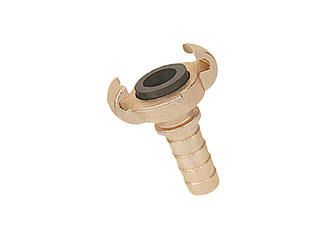
Camlock coupling (also called cam and groove coupling) is a type of hose fitting widely used in fluid transfer for agriculture, chemical processing, petroleum, food and beverage, and fire suppression. These couplings connect and disconnect quickly — without tools — by engaging cam arms on the female coupler (socket) over the grooves on the male adapter.
Pipe thread enters the picture when a camlock coupling must connect to a threaded pipe, tank outlet, pump port, or manifold. Most camlock coupling adapters are available with NPT, BSPT, or BSPP threaded ends, allowing the quick-connect coupler to interface with conventional threaded piping systems.
Standard Camlock Coupling Types and Thread Configurations
Camlock couplings are manufactured to MIL-C-27487 (now superseded by commercial standards) and commonly produced per the recommendations of the TTMA (Truck Trailer Manufacturers Association). They come in several configurations designated by letter:
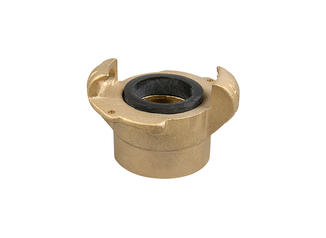
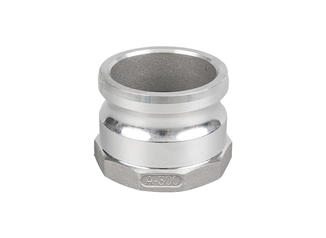
- Type A: Male adapter with female NPT (or BSPT) threaded end. Used to screw into a female-threaded port and present a male camlock fitting.
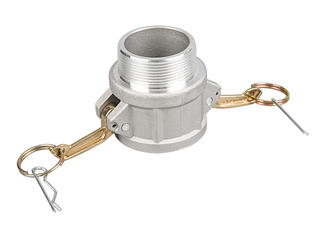
- Type B: Female coupler with male NPT (or BSPT) threaded end. Connects to a male-threaded pipe and presents a female camlock socket.
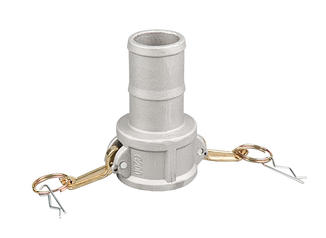
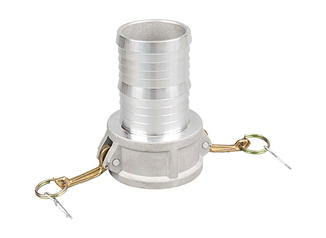
- Type C: Female coupler with hose shank (barb) end.
- Type D: Female coupler with female NPT threaded end.
- Type E: Male adapter with hose shank (barb) end.
- Type F: Male adapter with female NPT threaded end.
- Type DC: Dust cap (female, no thread).
- Type DP: Dust plug (male, no thread).
When a Type A or Type B camlock coupling is installed onto a threaded pipe connection, the same rules that apply to all pipe thread connections apply here: correct thread standard, proper engagement depth, and appropriate sealant. Under-tightening a threaded camlock adapter can result in leaks at high flow rates, which is particularly problematic in chemical or fuel transfer operations.
Camlock Coupling Sizes and Corresponding Thread Sizes
Camlock couplings are manufactured in standard sizes, typically ranging from 1/2 inch to 6 inches, with the thread end matching the nominal camlock size. The table below shows the standard camlock coupling sizes and their corresponding NPT thread specifications:
| Camlock Size (inch) | NPT Thread Size | Threads Per Inch (TPI) | Typical Max Working Pressure (PSI) |
|---|---|---|---|
| 1/2 | 1/2 NPT | 14 | 250 |
| 3/4 | 3/4 NPT | 14 | 250 |
| 1 | 1 NPT | 11.5 | 200 |
| 1-1/2 | 1-1/2 NPT | 11.5 | 150 |
| 2 | 2 NPT | 11.5 | 125 |
| 3 | 3 NPT | 8 | 75 |
| 4 | 4 NPT | 8 | 75 |
Note that working pressure ratings for camlock couplings decrease as size increases. This is a function of the increased cross-sectional load at larger bore diameters, not the thread itself. The thread connection, when properly assembled, typically exceeds the pressure capacity of the coupling body in larger sizes.
Materials Used in Threaded Pipe Fittings and Camlock Couplings
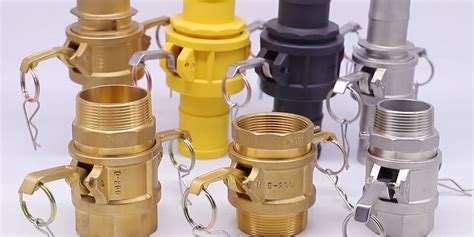
The material of a threaded fitting or camlock coupling determines its chemical compatibility, pressure rating, temperature range, and durability. Selecting the wrong material for a threaded pipe joint can lead to corrosion, thread galling, cracking, or contamination of the transferred fluid.
Aluminum
Aluminum camlock couplings and threaded adapters are lightweight, corrosion-resistant to many chemicals, and cost-effective. They are widely used in agriculture for irrigation and fertilizer transfer, as well as in petroleum product transfer. Aluminum is not suitable for strong acids, bases, or chlorinated solvents. Thread galling — where the aluminum surfaces weld together under friction — is a risk when assembling aluminum male to aluminum female threads; anti-seize compound should always be used.
Stainless Steel (304 and 316)
Stainless steel provides superior corrosion resistance, high strength, and suitability for high-temperature applications. 316 stainless steel, with its molybdenum content, offers better resistance to chlorides and is preferred for marine, chemical processing, and food-grade applications. Stainless steel camlock couplings are commonly found in pharmaceutical, dairy, and chemical industries where hygiene and chemical compatibility are critical.
Brass
Brass offers good machinability, moderate corrosion resistance, and compatibility with water, compressed air, and petroleum products. Brass threaded fittings and camlock couplings are common in plumbing, HVAC, and general industrial use. They are not suitable for ammonia-based fertilizers (dezincification risk) or seawater.
Polypropylene and Nylon
Plastic camlock couplings and threaded adapters are used for low-pressure, non-solvent chemical transfer where metal contamination is a concern. Polypropylene offers good resistance to acids and bases; nylon provides higher mechanical strength. Plastic threaded fittings should never be over-tightened — the thread can crack or strip, and the material creep under sustained load can loosen the joint over time.
How to Correctly Assemble a Threaded Pipe Joint
Improper thread assembly is one of the leading causes of leaks in industrial piping systems. Following the correct procedure for making up a threaded joint — whether it is a simple pipe nipple connection or a threaded camlock coupling adapter — prevents failures and extends service life.
- Inspect the threads. Check both male and female threads for damage, burrs, corrosion, or contamination. Damaged threads should not be reassembled — replace the component or re-cut the thread with a tap or die.
- Clean the threads. Remove metal shavings, old sealant, dirt, and oil with a wire brush or rag. Contamination under the sealant can prevent a proper seal.
- Apply sealant to the male thread only. For NPT and BSPT connections, wrap PTFE tape clockwise (as viewed from the thread end) starting from the second thread. Apply 2–4 wraps for standard pressure service; additional wraps may be needed for gas service. Alternatively, apply a thin coat of pipe dope. Do not apply sealant to the first thread — it can contaminate the system interior.
- Start threads by hand. Thread the male into the female by hand until finger-tight. This confirms the threads are engaging correctly and prevents cross-threading. If it feels unusually stiff or irregular, stop, back off, and re-check alignment and thread compatibility.
- Tighten to the correct number of turns past hand-tight. For most NPT connections, 2–3 turns past hand-tight with a pipe wrench is standard. Over-tightening can crack cast fittings, split plastic threads, or distort thin-wall connections. Under-tightening leaves the thread engagement insufficient for a seal.
- Pressure test before service. After assembly, pressurize the system to working pressure and check all joints for leaks using a leak detection solution or soap water. Address any leaks before returning the system to service.
When assembling a threaded camlock coupling adapter to a pipe, the same rules apply. Do not rely on the cam locking mechanism of the coupling to compensate for a leaking threaded connection — the camlock seal addresses the coupling interface, not the threaded pipe connection.
Identifying Pipe Thread Type and Size in the Field
When you encounter an existing threaded connection and need to identify its standard and size — for example, when purchasing a replacement camlock coupling adapter or pipe fitting — use the following approach:
Step 1: Measure the Outside Diameter
Use a caliper to measure the outside diameter of the male thread (or the inside diameter of the female thread). Cross-reference with a thread dimension chart. For example, if the male thread outside diameter is approximately 1.050 inches (26.67 mm), the nominal size is likely 3/4 inch NPT or 3/4 inch BSPT.
Step 2: Count the Threads Per Inch
Use a thread pitch gauge — a set of metal combs with specific TPI values — to count the threads. Place each comb against the thread profile until one fits cleanly. For the example above, 14 TPI would confirm 3/4-inch NPT or BSPT. The TPI alone does not distinguish between NPT and BSPT at this size since they share the same count.
Step 3: Identify Tapered or Parallel
Look at the thread profile from the side. If the diameter visibly narrows toward the end, the thread is tapered (NPT or BSPT). If it remains constant, it is parallel (BSPP or NPS). A tapered plug gauge or ring gauge provides definitive confirmation.
Step 4: Determine the Thread Standard by Origin or Application
If dimensional measurements are inconclusive between NPT and BSPT (both tapered, close in dimension at some sizes), look at the equipment manufacturer's documentation, country of manufacture, or try fitting a known-standard gauge. Mixing NPT and BSPT can produce a partial fit that appears tight but leaks under pressure — this is a common source of costly troubleshooting in international facilities with mixed equipment origins.
Common Pipe Thread Failures and How to Prevent Them
Understanding why threaded pipe joints fail is as important as knowing how to make them correctly. The majority of failures fall into identifiable categories:
Thread Leaks
The most common failure. Causes include insufficient sealant, mismatched thread standards, under-tightening, or worn threads. On NPT connections, each additional turn past hand-tight increases the thread interference and seal quality. If a joint leaks after initial assembly, back it off, reapply sealant, and re-tighten. Do not simply add more turns to a dry joint — this can crack fittings.
Galling and Seizing
Common with stainless steel and aluminum threads when assembled without lubrication or anti-seize. Galling occurs when metal-to-metal friction generates enough heat and pressure to micro-weld the thread surfaces together. The result is a joint that cannot be disassembled without destroying one or both components. Prevention: always use anti-seize compound or thread sealant that provides lubrication during assembly.
Cross-Threading
Occurs when male and female threads are not aligned before tightening. The threads cut across each other at an angle, damaging the thread form and compromising the connection permanently. Always start threads by hand and confirm smooth engagement through at least two full turns before applying a wrench.
Cracked Fittings from Over-Tightening
Cast iron, plastic, and even brass fittings can crack if over-tightened. Tapered pipe threads generate very high radial forces as they are driven together — NPT threads can generate thousands of pounds of radial force in large sizes. Follow manufacturer torque specifications where available, and use calibrated torque wrenches for critical applications.
Vibration Loosening
In systems subject to mechanical vibration — pump discharge lines, compressor connections, mobile equipment — vibration can gradually back out threaded connections. Parallel threads (BSPP) with face seals are actually more resistant to vibration loosening than tapered NPT threads in some configurations, because the joint clamping force comes from the fastened face seal rather than thread interference. For tapered thread applications in high-vibration environments, thread-locking compounds or secondary mechanical locks should be considered.
When to Use Threaded Connections vs. Other Joining Methods
Pipe threads are one of several methods for joining pipe sections and fittings. Understanding when threaded connections are the right choice — and when an alternative like flanges, welding, or quick-connect couplings (such as camlock coupling systems) is better — is fundamental to good system design.
- Threaded connections are preferred for smaller pipe sizes (typically under 2 inches), lower to moderate pressure systems, applications requiring frequent disassembly and reassembly, and where welding is impractical (existing installations, non-weldable materials, field work).
- Flanged connections are preferred for larger pipe sizes, high-pressure or high-temperature service, applications requiring zero-leak integrity (such as steam or hazardous chemical lines), and where inspection or replacement of line components is routine.
- Welded connections provide the strongest, most leak-proof joint for permanent piping installations in high-pressure or high-temperature service. Not suitable where disassembly is required.
- Camlock coupling systems excel in applications requiring rapid connection and disconnection — filling and emptying tanks, transferring product between mobile containers, connecting hoses to pumps or manifolds. They often incorporate threaded ends (NPT or BSP) to interface with fixed piping, combining the permanence of a threaded pipe connection at the system boundary with the speed of a tool-free camlock interface in the field.
In practice, many fluid transfer systems combine all of these methods. A fixed processing vessel might have flanged nozzles for main process piping, welded connections for structural integrity, NPT-threaded ports for instrumentation and small-bore service, and camlock coupling points on loading and unloading lines for flexible hose connections during batch operations.
Industry Applications Where Pipe Thread and Camlock Couplings Work Together
The combination of threaded pipe connections and camlock couplings appears across virtually every industry that handles fluids. Below are specific examples that illustrate how pipe thread knowledge directly impacts operational decisions:
Agriculture and Irrigation
Irrigation mainlines and chemical injection systems use NPT-threaded ports on pumps, filters, and manifolds. Aluminum camlock coupling adapters (typically Type A or Type B) are threaded onto these ports to allow quick connection and disconnection of supply hoses, spray lines, or chemical injection equipment. A farmer connecting a 3-inch aluminum camlock adapter to a centrifugal pump outlet must ensure the adapter's NPT thread engages fully — a poor thread connection under the vibration of pump operation can loosen and flood a field with fertilizer or cause pump cavitation from air ingestion.
Petroleum and Fuel Transfer
Tank trucks, fuel depots, and refineries use camlock coupling systems for loading and unloading fuel. Stainless steel or aluminum camlock couplings with NPT threaded ends connect to fixed piping at loading racks. Thread sealant selection here is critical — standard PTFE tape is generally suitable, but some fuel operations specify PTFE tape rated for hydrocarbons, and pipe dope compounds must be verified for fuel compatibility to prevent swelling or degradation.
Chemical Processing
Chemical plants require careful matching of thread material to the process fluid. A stainless steel camlock coupling with BSPP parallel threads and an O-ring face seal might be specified for chlorinated solvent service, because the face seal provides a more reliable low-leak connection than a tapered NPT joint in aggressive chemical environments where even minor seepage is unacceptable from a safety and regulatory standpoint.
Food, Beverage, and Pharmaceutical
Sanitary applications require 316L stainless steel fittings with electropolished surfaces and gaskets of FDA-compliant materials (EPDM, silicone, PTFE). Threaded connections in food-grade systems are often BSPP with flat-face seals, since PTFE tape can shed particles into the product stream. Camlock couplings in these environments are typically sanitary-grade versions with polished interiors, used to connect flexible hoses during tank filling, CIP (clean-in-place) cleaning cycles, and product transfer.
Key Takeaways for Working with Pipe Thread
Pipe thread is not a single universal system. It encompasses multiple standards — NPT, NPTF, BSPT, BSPP, and others — each with specific dimensional tolerances, thread angles, and sealing mechanisms. Nominal pipe size does not directly describe any physical dimension of the thread. Proper assembly requires clean threads, appropriate sealant, correct engagement depth, and post-assembly leak testing.
When pipe thread intersects with camlock coupling systems, the same disciplined approach applies: identify the thread standard on the fixed piping, specify the camlock coupling adapter to match, use correct sealant for the fluid service, and assemble with appropriate torque. The threaded connection on a camlock adapter is as critical to system integrity as the cam and groove locking mechanism itself — both must be correct for the coupling to perform reliably under operating conditions.
Investing time to understand pipe thread fundamentals pays dividends in reduced maintenance, fewer unplanned leaks, longer service life of fittings and couplings, and safer operations across any fluid handling application.