 英语
英语 俄语
俄语
Content
- 1 What Is a Tri-Clamp Fitting and When Do You Actually Need One?
- 2 Anatomy of a Tri-Clamp Joint: Ferrule, Gasket, Clamp
- 3 Tri-Clamp Sizing: Measure the Tube OD, Not the Inside Diameter
- 4 Materials: Stainless Grades and Gasket Compounds That Match Your Process
- 5 Pressure, Temperature, and Torque: The Numbers That Matter
- 6 Installation Steps That Keep a Tri-Clamp Joint Leak-Free
- 7 Tri-Clamp vs. Threaded, Flanged, and Camlock Connections
- 8 Buying Tri-Clamp Fittings: What to Check Before You Place the Order
- 9 Tri-Clamp Fitting FAQ
What Is a Tri-Clamp Fitting and When Do You Actually Need One?
A tri-clamp fitting is a reusable, three-part sanitary connection: two flared ferrules face each other with a soft gasket between them, and an outer band clamp squeezes the whole assembly into a leak-free joint. You should specify it whenever a stainless process line has to be opened every day for cleaning, must stay free of internal dead spots, and runs at pressures below about 150 psi (10 bar). That describes most dairy, beverage, food, pharmaceutical, and biotech piping, which is precisely why tri-clamp has been the default connection in those industries for decades.
The reason engineers keep choosing it is a combination that threaded and flanged connections cannot match. A single wing nut opens the joint in under a minute. The gasket is the only wear part, so the ferrules and clamp can be resealed hundreds of times. And because the inside of the joint is smooth and continuous, there are no thread crests or crevices where CIP and SIP cleaning systems cannot reach. The trade-offs are just as clear: tri-clamp joints are noticeably bulkier than quick couplings, they require the tube ends to be welded or machined to a flared profile, and they are not the right tool for very high pressures or for flexible hose lines that get dragged around a yard. Choose them where cleanability and fast breakdown matter most, not where pressure and footprint are the only criteria.
Anatomy of a Tri-Clamp Joint: Ferrule, Gasket, Clamp
A complete joint is built from three functions, even though it ships as four pieces (two ferrules, one gasket, one clamp). Knowing each part by name makes the sizing and buying steps later in this guide much easier.
- Weld-on ferrule - a short stainless tube section with a flared, flat face at one end. One ferrule is welded onto each of the two lines being joined, and both faces are machined flat and parallel so that the gasket sits evenly between them.
- Gasket - a flexible ring that sits captive between the two ferrules. It creates the seal, prevents metal-to-metal contact, and absorbs the small amount of misalignment left by welding.
- Clamp - a hinged band with an internal groove and a wing nut or bolt. The groove wraps over the two flared faces and, as the nut tightens, forces the ferrules together and compresses the gasket in both the radial and axial directions.
One word of caution: in tri-clamp catalogs, "ferrule" always means the weld-on end fitting that the clamp grips. In the hose-fitting world, the same word describes a crimped metal sleeve that locks a fitting onto the hose wall. These two parts are not interchangeable, and confusing them is a common source of ordering errors. If your plant also terminates hoses with crimped sleeves, stainless steel ferrules for hose ends are available in matched grades and should be selected by the same material logic as your tri-clamp set.
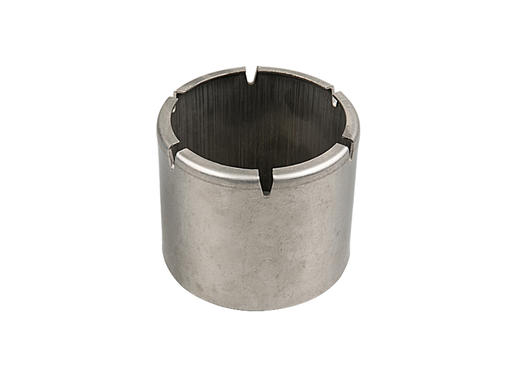 Wholesale Stainless steel Ferrule Suppliers, Factory - Ningbo Chili Hardware Co.Ningbo Chili Hardware Co., Ltd is China wholesale Stainless steel Ferrule Suppliers and factory,View Product →
Tri-Clamp Sizing: Measure the Tube OD, Not the Inside Diameter
The single most common tri-clamp ordering mistake is measuring the inside diameter of an existing hose or pipe and assuming it equals the fitting size. Tri-clamp sizes are defined by the outside diameter of the sanitary tube. That outside diameter determines the ferrule you weld on, the gasket you buy, and the clamp you install, so every sizing conversation should start with a caliper reading across the tube OD.
Measure the OD in inches or millimetres, then match it to the nominal sizes in the table below. As a rule of thumb, a 1-in fitting fits a 1.00-in (25.4 mm) tube OD, a 2-in fitting fits a 2.00-in (50.8 mm) tube OD, and a 4-in fitting fits a 4.00-in (101.6 mm) tube OD.
| Nominal Size (in) | Tube OD (in) | Tube OD (mm) | Clamp and Gasket Face OD (mm) |
|---|---|---|---|
| 1/2 | 0.50 | 12.7 | 25.0 |
| 3/4 | 0.75 | 19.05 | 25.0 |
| 1 | 1.00 | 25.4 | 50.5 |
| 1-1/2 | 1.50 | 38.1 | 50.5 |
| 2 | 2.00 | 50.8 | 64.0 |
| 2-1/2 | 2.50 | 63.5 | 77.5 |
| 3 | 3.00 | 76.2 | 91.0 |
| 4 | 4.00 | 101.6 | 119.0 |
Two quirks trip up first-time buyers. First, 1/2-in and 3/4-in ferrules share the same 25 mm face OD, so one clamp size covers both. Second, 1-in and 1-1/2-in ferrules share the same 50.5 mm face OD for the same reason. That is why a used clamp can look too large for the pipe when you first lay it on. The clamp size is tied to the ferrule face, not to the nominal tube size. When your plant mixes tube suppliers, do not rely on printed labels alone; measure the face OD with calipers whenever a tube size is in doubt.
Materials: Stainless Grades and Gasket Compounds That Match Your Process
The metal side of a tri-clamp fitting is almost always 304L or 316L stainless steel, chosen because these grades stay corrosion-resistant after welding and survive caustic and acid cleaning solutions. The "L" in 304L and 316L means low carbon, which helps prevent the grain-boundary carbide precipitation that can weaken welds in thicker sections.
Stainless Steel Grades and Surface Finish
| Grade | Best Choice For | Why It Is Specified |
|---|---|---|
| 304L | Water, light food lines, general process piping | Lower cost, good formability, adequate corrosion resistance for mild media |
| 316L | Dairy, pharma, biotech, CIP chemicals | Molybdenum addition resists chlorides and pitting from cleaning agents |
Surface finish is the selection detail that most buyers overlook. A standard tri-clamp ferrule is polished to 32 Ra or better on the wetted surface (0.8 micrometres); pharmaceutical installations routinely specify 20 Ra or 16 Ra, sometimes followed by electro-polishing. The rougher the surface, the easier it is for product to adhere and for bacteria to form a film, so match the polish to the cleanliness requirement of your process rather than ordering the cheapest ferrule on the shelf.
Gasket Compounds and Their Operating Windows
In a tri-clamp joint the gasket, not the stainless, defines the allowable temperature and chemical window. The table below covers the five compounds used in the majority of food and pharma lines. Temperature ranges are typical values from material data sheets; verify them against the specific gasket supplier before a critical installation.
| Compound | Typical Temp Range | Strong Points | Watch Out For |
|---|---|---|---|
| EPDM | -40 C to 150 C | Hot water, low-pressure steam, caustic CIP, general food service | Oils and hydrocarbons degrade it |
| Silicone | -60 C to 200 C | Very wide temperature window, soft, easy to seal | Poor resistance to solvents; not for steam service |
| FKM | -20 C to 210 C | Oils, fats, acids, many aggressive chemicals | Higher cost; narrower cold range |
| PTFE | -40 C to 260 C | Extreme chemical resistance, very low friction | Needs higher clamp torque; tends to cold-flow under pressure |
| NBR | -30 C to 120 C | Oils and compressed air lines | Not recommended for steam, dairy, or hot water |
Gasket hardness matters as much as compound. Most standard tri-clamp gaskets are 70 Shore A, which balances deformation and sealing force. If your ferrules have slightly rough faces, a softer silicone or EPDM compound seals more easily. If the process sees pressure surges, prefer a firmer compound so the gasket does not extrude between the ferrules. On PTFE, an envelope or over-jacket design is usually necessary to prevent cold flow under sustained pressure.
Pressure, Temperature, and Torque: The Numbers That Matter
Tri-clamp fittings are not high-pressure fittings, and trying to push them into high-pressure service is the fastest way to create a leak. A correctly installed 1-in to 3-in tri-clamp joint with a standard clamp and an EPDM gasket is typically rated to 100-150 psi (7-10 bar) at ambient temperature. Larger diameters are derated; a 6-in joint sees its effective rating drop to about half because the clamp load is spread over a much larger circumference.
- Pressure ceiling: about 150 psi (10 bar) for common sizes. The gasket is always the weak link, so read its data sheet before pushing the line harder.
- Temperature ceiling: stainless ferrules tolerate far more than any gasket, so the practical ceiling is the gasket's maximum continuous temperature (roughly 150 C for EPDM and up to 260 C for PTFE).
- Clamp torque: most stainless tri-clamp clamps up to 4-in size are tightened to roughly 50-80 in-lb (5.6-9 N-m). Overtightening warps the faces; undertightening leaves the joint loose.
- Retorque cycle: re-check the wing nut after the first one or two hot-cold cycles, because thermal expansion relaxes the initial compression and the gasket takes a permanent set.
If your application regularly exceeds 150 psi or sees sustained steam above 200 C, tri-clamp is the wrong connection. For those services, a flanged or fully welded joint gives you the pressure and temperature margin that a clamped sanitary fitting cannot provide.
Installation Steps That Keep a Tri-Clamp Joint Leak-Free
Most field problems with tri-clamp fittings are not caused by bad parts; they are caused by poor welding and hasty assembly. Follow the sequence below, and a tri-clamp joint will reliably outlast the campaign.
- Weld the ferrules with full penetration and grind the internal weld bead flush to the tube bore. A proud weld bead creates a dead zone and a turbulence point that no gasket can fix.
- Check that the two ferrule faces are square to the tube axis and parallel to each other. More than half a millimetre of angular misalignment has to be absorbed by the gasket alone.
- Wipe both ferrule faces and the gasket surface with a lint-free cloth so no debris scores the sealing area.
- Center the gasket exactly between the faces. Most gaskets have a locating ridge, but you still have to verify it before closing the clamp.
- Wrap the clamp around both flared faces and engage the hinge or bolt before tightening anything. The clamp groove must sit fully over both ferrules.
- Tighten the wing nut or bolt progressively from one side, not in repeated full turns, until the ferrules press evenly onto the gasket.
- Re-torque after the first thermal cycles. A joint that seals cold can weep when hot; a single re-tightening after shut-down usually stops that for good.
A good field check after assembly is to run a finger around the outer seam. If the gasket is not visible evenly around the whole circumference, the clamp is not seated correctly and the joint will leak at the thinnest spot. When working on existing plants, always keep spare gaskets of the correct compound and size in the maintenance store; gasket replacement is the cheapest insurance you can buy for a stainless line.
Tri-Clamp vs. Threaded, Flanged, and Camlock Connections
Tri-clamp is not automatically the best connection for every stainless line. The table below compares it with the three alternatives that compete for the same jobs, so you can make the choice on measurable criteria instead of habit.
| Connection Type | Time to Open | Cleanability | Pressure Ceiling | Typical Home |
|---|---|---|---|---|
| Tri-clamp | Seconds, no tools | Excellent, smooth bore | About 150 psi (10 bar) | Food, dairy, pharma, biotech |
| Threaded NPT | Minutes, tools required | Poor, threads trap product | High | General industrial piping |
| Flanged | Slow, bolted | Very good | Very high | Process piping, high pressure |
| Camlock | Seconds, no tools | Poor, internal grooves | Up to 250 psi (17 bar) | Hoses, tanker transfer, industrial |
Use threaded fittings when the connection almost never gets opened and pressure is high. Use flanges when structural rigidity and very high pressure matter. Use tri-clamp when cleanability and daily breakdown dominate. And use camlock when you are mating hoses at the end of a tanker or in a yard where the joint must tolerate rough handling and blind hook-up. The two families often coexist in the same plant, and understanding the boundary between sanitary and industrial keeps both kinds of line honest.
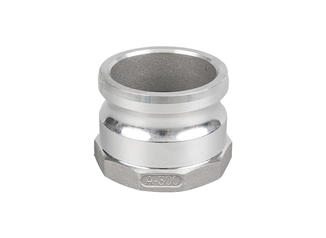
For the industrial side of that boundary, a stainless steel Type A camlock adapter is the direct equivalent of a weld-on tri-clamp ferrule: it becomes the permanent line end, and a Type D coupler or another Type A adapter gives you a tool-free joint in seconds. The basic principles of stainless camlock fittings and pipeline products apply across every material family, so a quick review of how these parts are classified will save you from mixing thread forms and sealing methods.
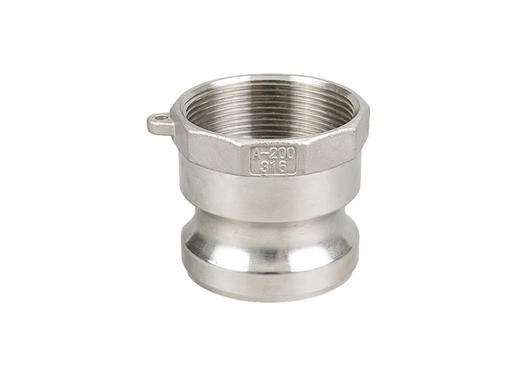 Wholesale Stainless steel type A camlock coupling Suppliers, Factory - Ningbo ChNingbo Chili Hardware Co., Ltd is China wholesale Stainless steel type A camlock coupling Suppliers and factory,Standard: Our camlock cou...View Product →
Buying Tri-Clamp Fittings: What to Check Before You Place the Order
A tri-clamp fitting looks like a simple product, but quality varies widely between low-cost import lots and fittings made by manufacturers who control the full production chain. Use this checklist when you evaluate quotations and delivered parts.
- Confirm the nominal size and the face OD together. The nominal tube size tells you the tube OD; the face OD tells you which clamp and gasket to buy. Ordering by one number alone is how wrong gaskets end up in the right boxes.
- Check the stainless grade marking on the ferrule shank. 304L and 316L are the only grades most process plants should accept for new sanitary lines.
- Verify the wetted surface finish. A 32 Ra or finer finish is the minimum for food service; for pharma, push for 20 Ra or better and consider electro-polishing.
- Specify the gasket by compound and hardness for each service, and order spares at the same time. A gasket bought later from a different source may not have the same dimensions or hardness.
- Choose the clamp style to match the maintenance habit: wing nut for rapid opening, bolt style if you worry about tampering, and always pick a clamp with a captured hinge so it cannot be dropped into equipment.
- Ask for the actual face dimension unless you are fully certain of the standard. Getting the ferrule and clamp from the same production line removes most variables.
Finally, evaluate the manufacturer as well as the part. A supplier that can explain tolerances, surface finish options, and application limits before you pay is far more valuable than one that only answers with a price list. The same selection framework that applies to choosing a hose coupling applies here: if the manufacturer cannot answer practical process questions, the parts will not answer them either.
Our own approach has always been to answer every technical enquiry against real production capability rather than against a glossy catalogue. That commitment is documented in our corporate values, and it is the reason so many overseas trade partners start with a sample order and stay for years.
Tri-Clamp Fitting FAQ
Q1: What size tri-clamp do I need?
Measure the outside diameter of the tube with calipers, not the inside. A 1-in tri-clamp fits 25.4 mm tube OD, 1.5-in fits 38.1 mm, 2-in fits 50.8 mm, and 3-in fits 76.2 mm. Match that OD to the ferrule, then confirm the clamp and gasket by the ferrule face OD.
Q2: What pressure can a tri-clamp fitting handle?
In the common 1-in to 3-in sizes, a properly assembled joint with an EPDM gasket is typically rated 100-150 psi (7-10 bar) at ambient temperature. The gasket compound is the limiting component, so verify its pressure rating before raising line pressure.
Q3: Which gasket should I use for steam service?
EPDM is the standard choice for steam up to about 150 C, provided the line pressure and cycling fit its data sheet. Silicone is not recommended for steam, and PTFE handles temperature well but requires more clamp torque and careful installation.
Q4: Can a tri-clamp fitting be used on flexible hoses?
Not directly. The ferrule needs a rigid welded stainless tube end to do its job. On flexible hose lines, a quick coupling such as camlock is the more practical tool-free connection, especially for transfer service.
Q5: Do 1/2-in and 3/4-in tri-clamps use the same gasket?
Yes. Both tube sizes share a 25 mm ferrule face OD, so the same 25 mm clamp and gasket fits both. The same happens at 1-in and 1-1/2-in, which share a 50.5 mm face OD.
Q6: Why does my tri-clamp leak after heating and cooling?
Thermal cycling relaxes the initial gasket compression and the gasket takes a set. Re-tighten the clamp after the first hot-cold cycle. If it still leaks, check the gasket compound against the process temperature and inspect the ferrule faces for welding distortion.